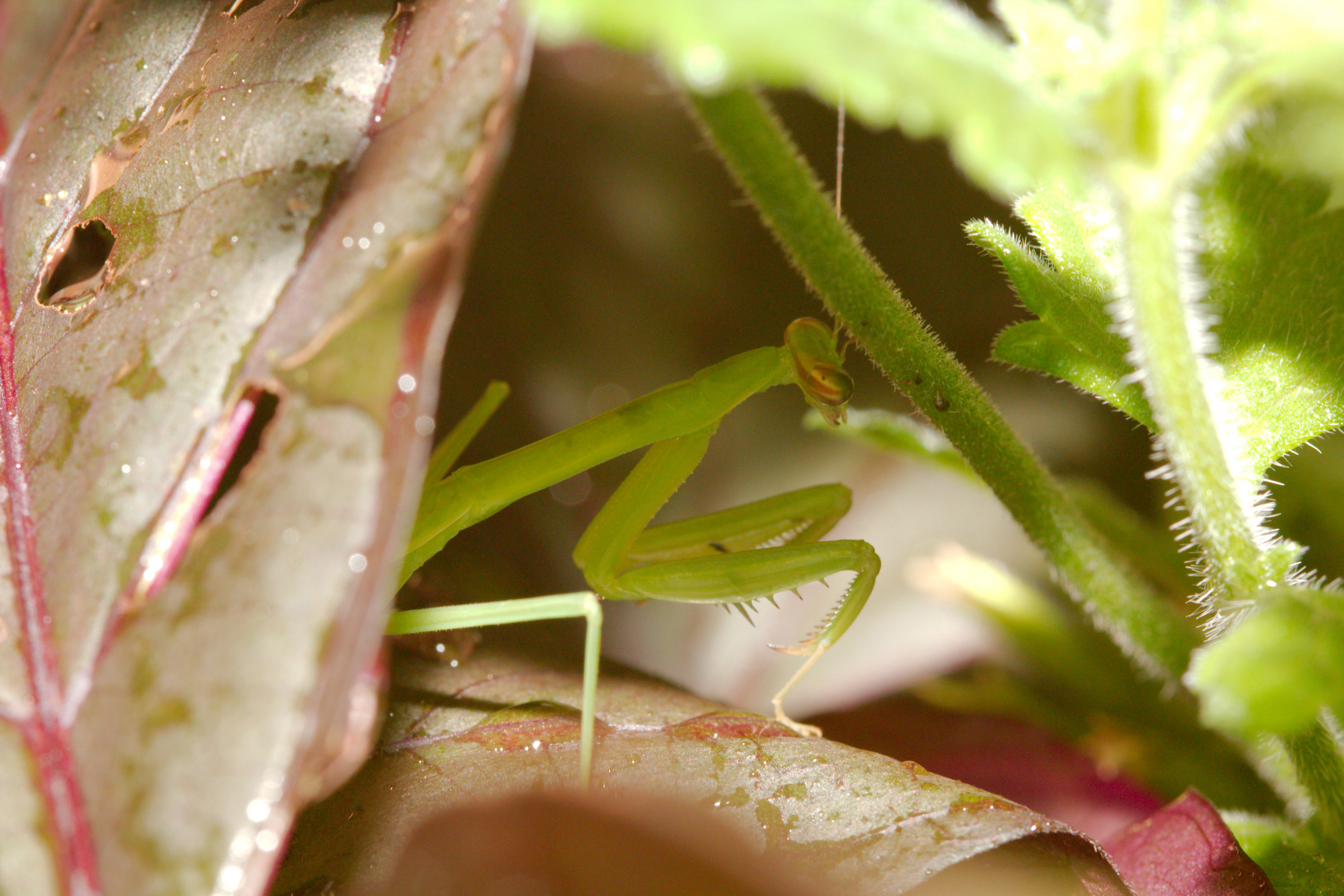
This isn’t a great picture but I was competing with a 10-year old who was trying to get a better view of it while I was trying to get a photograph. Actually, she was trying to “help” me get a clear view and she was moving the leaves around. Of course, the mantis didn’t stay in one place very long and I was lucky to get two pictures, both reasonably sharp. This is a small mantis, about two inches long. Metamorphosis in mantises is called hemimetabolism. The larval stage looks basically like the adult, only smaller (and without wings). As they grow, they shed their exoskeleton a number of times.
Mantis religiosa (European or Praying Mantis)
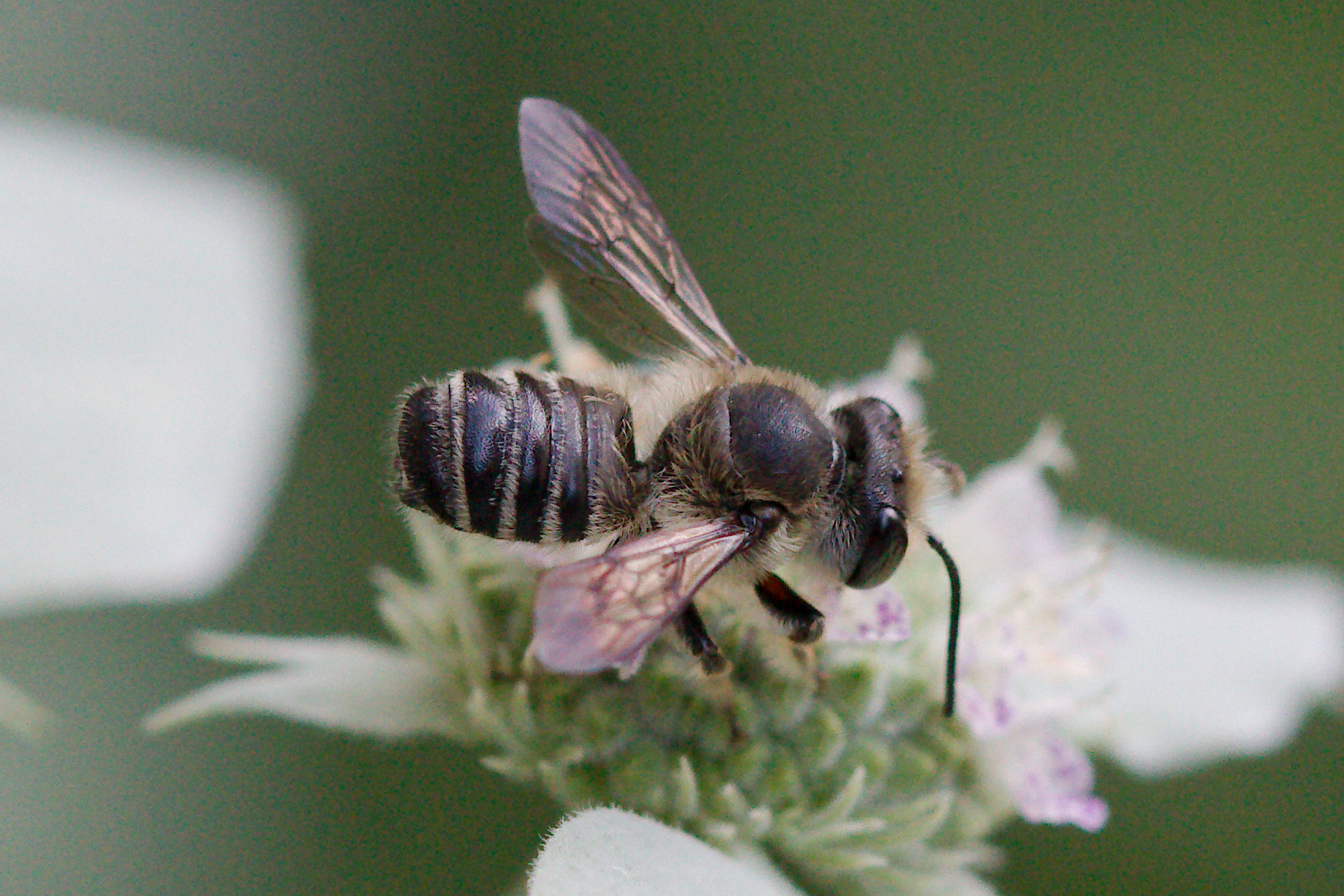
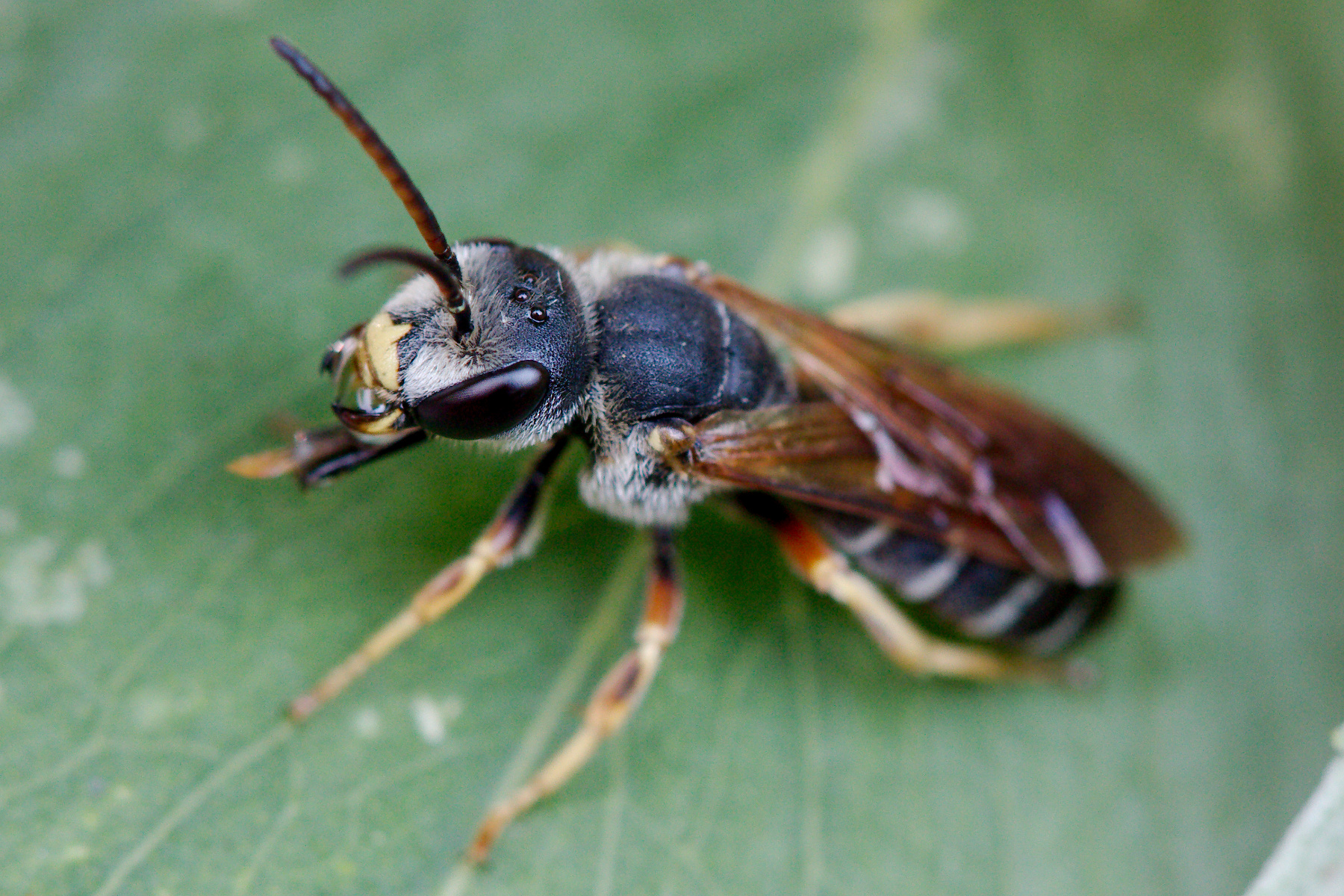
Halictus parallelus (A Sweat Bee)
I’m pretty pleased with this picture of a leaf-cutting bee. It could be better, to be sure, but I’m pretty psyched with it. The best part, in my view, is what it shows about bees’ eyes. Most people are familiar with the fact that most insects have compound eyes. These compound eyes are called oculi (singular oculus) and are made up of up to 9,000 ommatidia, the individual components of the eyes. What you may not know is that many insects have three additional simple eyes, called ocelli (singular ocellus) on the top of their head, arranged in a triangle. That’s right, they have five eyes, not two.
If you enlarge this image you should be able to see the three “additional” eyes on this leaf-cutting bee’s head. You’ll also get a nice view of the mandibles that she uses to cut pieces of leaf (thus the common name) to use as separators between cells of her nest.
Update: The good folks at BugGuide.net have identified this as Halictus parallelus (A Sweat Bee) (and a male, at that) rather than a Megachile (Leaf-cutting Bee). I have change the title and the caption on the photograph to reflect this.
Sunset Colors
I don’t have a lot to say about this picture, my third posted for July 19. We were stopping to see a friend and this was what the sky looked like as we got there. This was taken with a 100mm lens. The sky was mostly dark at this point and there was just this one small area of color, but what color it was! Wonderful.
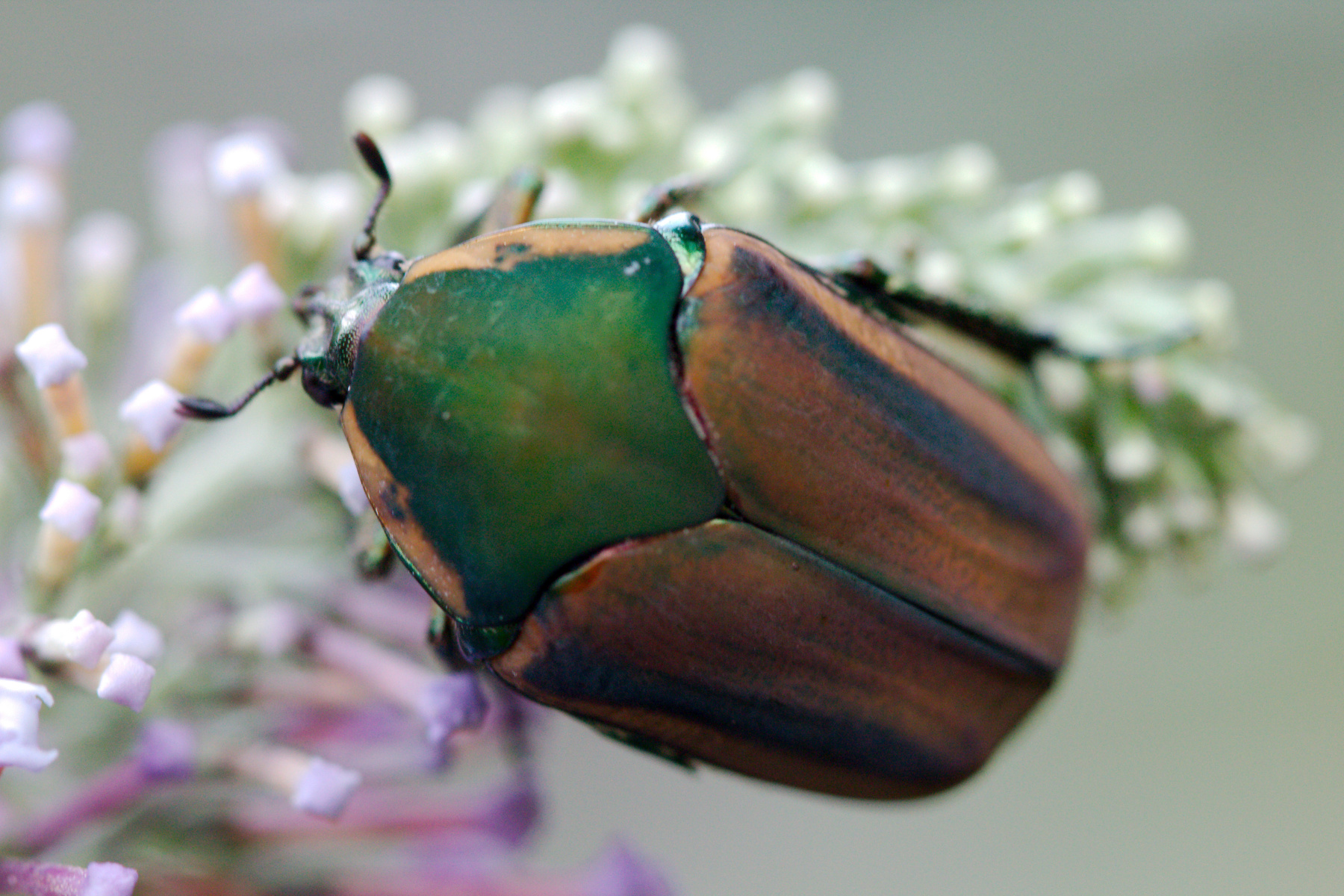
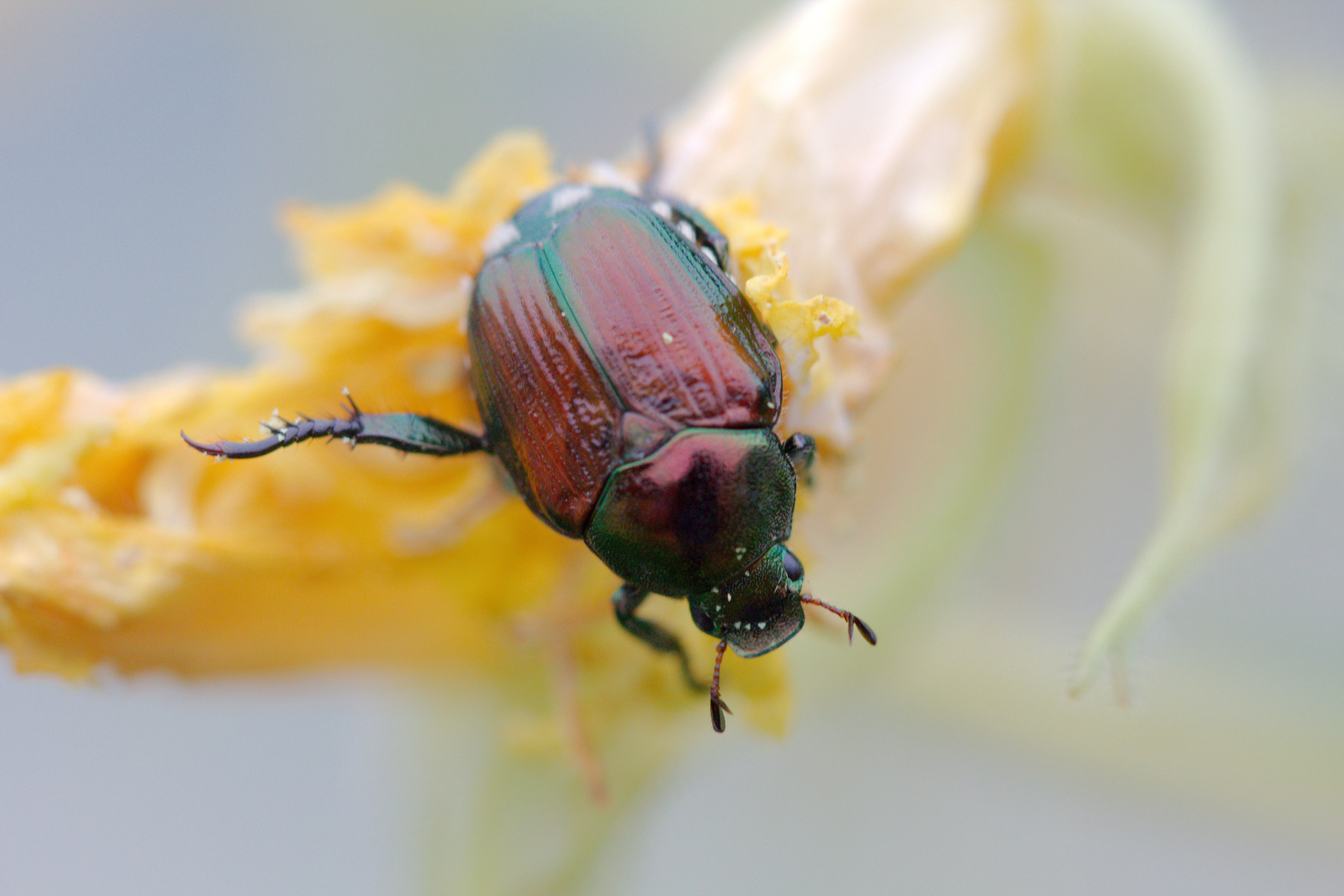
Cotinis nitida (Green June Beetle)
I saw a new insect today. Well, not technically a new insect, but one I haven’t photographed before. This is a fairly large beetle, about an inch long. It was up on the buddleia bush and I was able to get a reasonably sharp picture, although not as sharp as I’d like. It’s a little like a giant Japanese beetle, but it’s a green June beetle, Cotinis nitida, a North American native. They are generally considered to be pests, because their larvae eat the roots of many plants including grasses and ornamentals.
Black-eyed Susans
Here’s another black-eyed Susan picture. They sure do well in our yard, and we might need to cut them back a bit after they finish blooming, so that they don’t take over completely. The black-eyed Susan is the state flower of Maryland, by the way and in case you didn’t know. A good choice, I think. There are a couple dozen Rudbeckia species and they are named after Olof Rudbeck the Younger (1660-1740) and his father, Olof Rudbeck the Elder (1630-1702), both professors of botany at Uppsala University. The name was given by Carolus Linnaeus, who was their student.
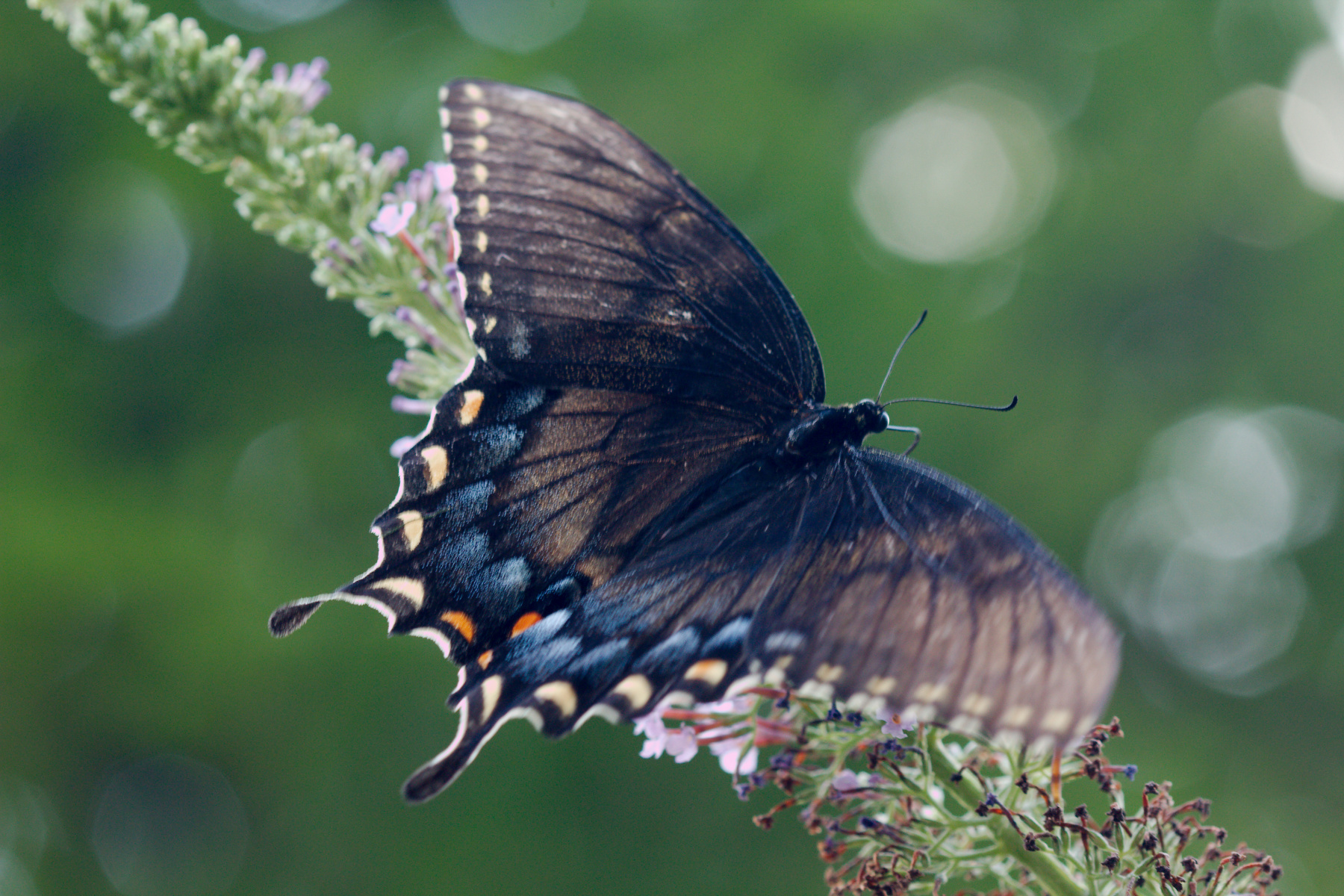
Dark Phase Tiger Swallowtail
At the risk of overdoing one subject, here’s another picture of a tiger swallowtail (Papilio glaucus). As you can see, this looks a bit different to the others I’ve posted lately. There is a dark phase which occurs in females through much of its range.
This little lady was playing hard to get, moving to the top of the buddleia (butterfly bush) and staying on the far side as I circled trying to get a good look at her. This is the best I could do, and it isn’t bad, anyway.
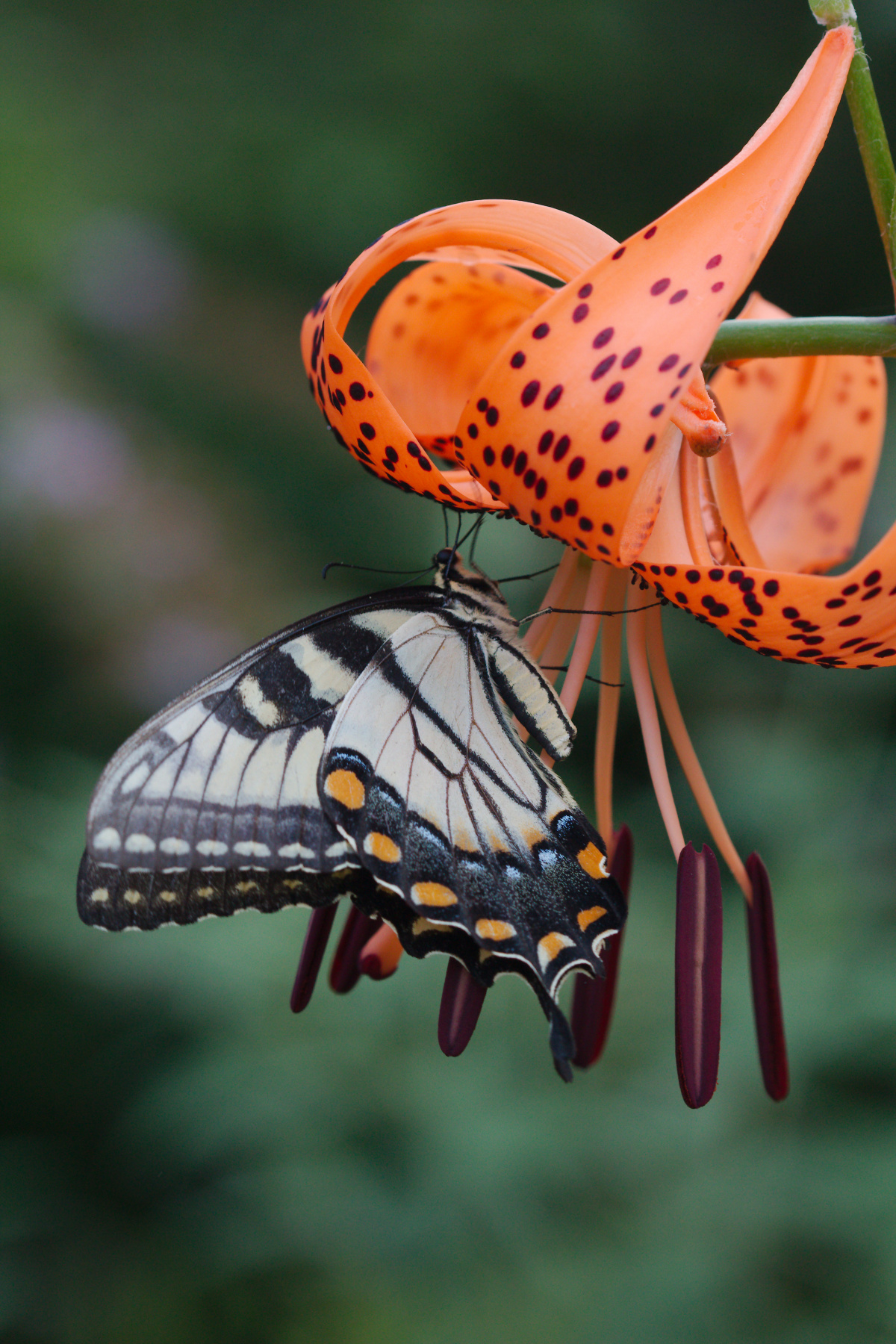
Tiger Swallowtail on Tiger Lily
As I left for work this morning I saw this tiger swallowtail butterfly (Papilio glaucus) on a tiger lily (Lilium lancifolium). I didn’t think I could let that opportunity pass without at least trying to get a picture. I took quite a few, starting relatively far away and working in a bit closer as she didn’t fly off. I am pretty happy with a good number of the images.
She kept circling the flower and would occasionally open her wings, but most of the good pictures show her in profile, like this. I did get a couple that are mostly of the butterfly and don’t show the entire flower, but I thought I’d use this one here. A few were closer still and in them you can see the individual scales on the butterfly’s wing.
It’s turned quite hot the last day or three and I was glad to get my photo-taking out of the way in the morning. That way I didn’t have to do it later in the day or even when I got home. My car said it was 101°F at 5:30 PM.
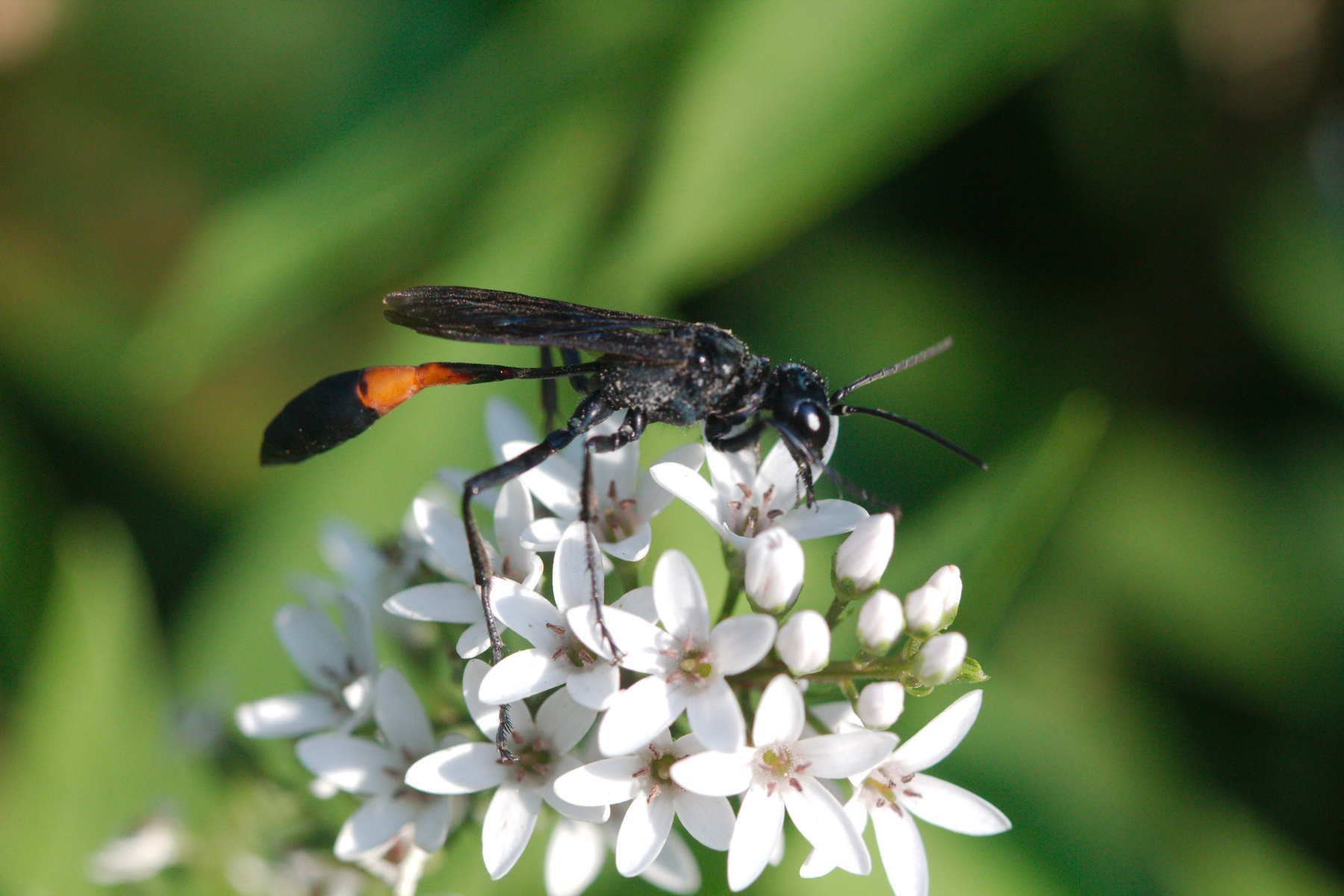
Ammophila nigricans (Thread-waisted Wasp)
I saw this chap on the gooseneck loosestrife (Lysimachia clethroides) but at first is wouldn’t come close. I stood for a while without taking any pictures and eventually it came near. I managed to take quite a few pictures but most of them either aren’t in focus or don’t show enough of the wasp to identify it. This is an Ammophila nigricans, one of the thread-waisted wasps. It’s a fairly large wasp and, as you can see, is characterized by a long, very narrow “waist” and the brown coloration on its abdomen.
Megachile, Leaf-cutting and Resin Bees
This is one of the leaf-cutting or resin bees in the genus Megachile. There are over 1,500 species world-wide and about 130 in our area. While I could eliminate a few species from consideration, I really have no idea which of them this is. It’s a little but not tiny bee, measuring about 12 to 15mm in length (I didn’t actually measure it with a ruler or anything).
This is one of a growing number of bees and wasps that is now enjoying the mountain mint (Pycnanthemum muticum).
Black-eyed Susan (Rudbeckia hirta)
It was a long but somehow beautiful day to end a long week. We celebrated a life and we welcomed our Daughter home from her first foreign trip without us (a little tired but not too much the worse for wear). I took a few pictures in the yard, including a few of the black-eyed Susans (Rudbeckia hirta) which are coming into their own, blooming profusely.
My camera doesn’t handle white balance very well in a picture like this, with so much bright yellow. I really need to find my neutral grey card so I can take a reading and set the white balance properly. This looks about right, though.
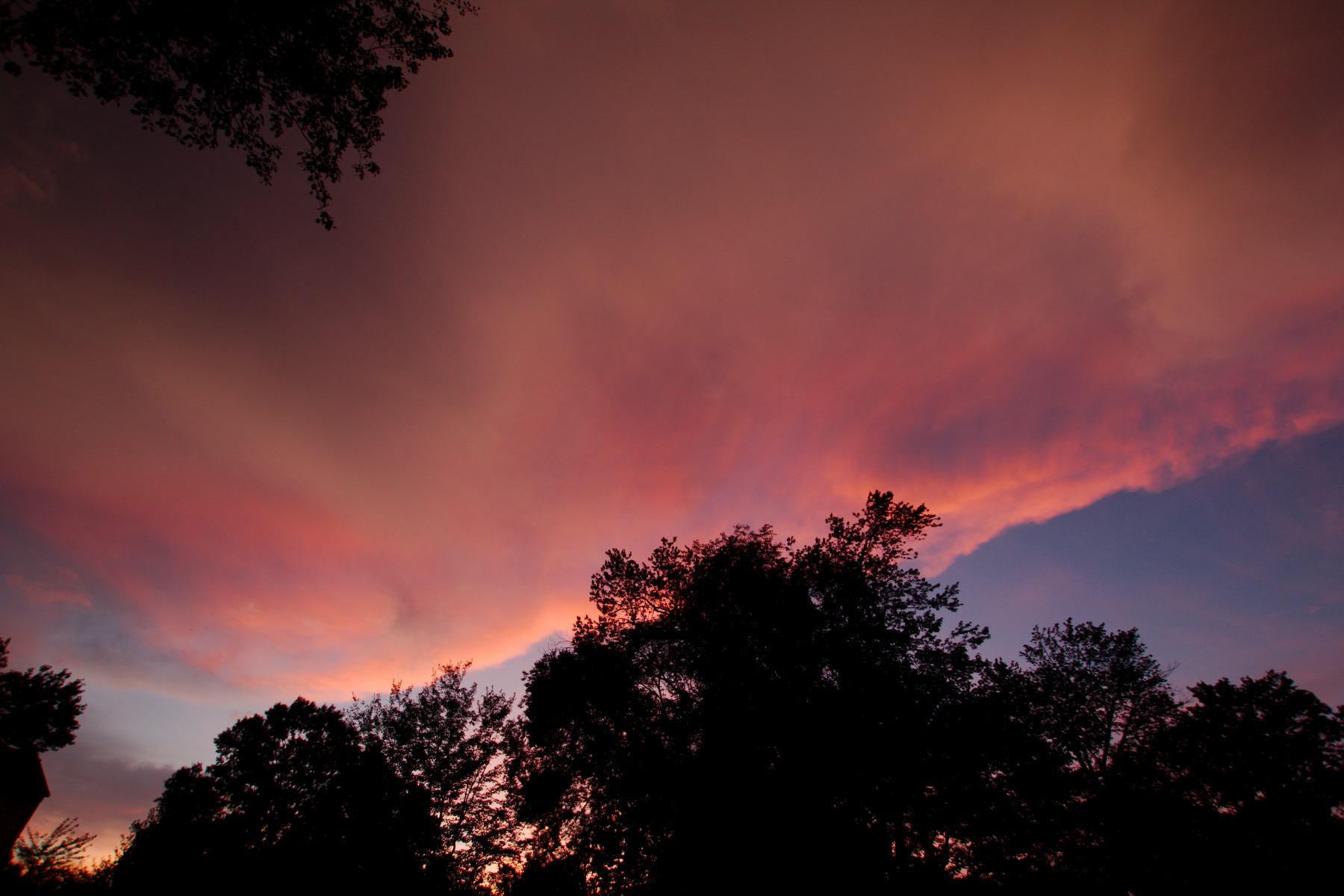
Sunset Colors
It’s been overcast all day after a mostly rainy day yesterday. This evening, however, the light turned the most remarkable color. It’s hard to describe what it was like, but later in the day, as the sun started to set, the light out our back windows was the most orangy green I’ve ever seen. It was green because it’s been a very wet summer so far and everything is so lush. But the light had an orangy, pink tinge to it that was absolutely wonderful over that lush green. I ran to get my camera but much of the light had gone by the time I got outside. This picture is looking nearly straight up with a very wide angle lens, and shows the source of the colored light, reflecting off the clouds. It doesn’t come close to doing it justice, so we’ll just have to remember how beautiful it was, although this photo is a small reminder.
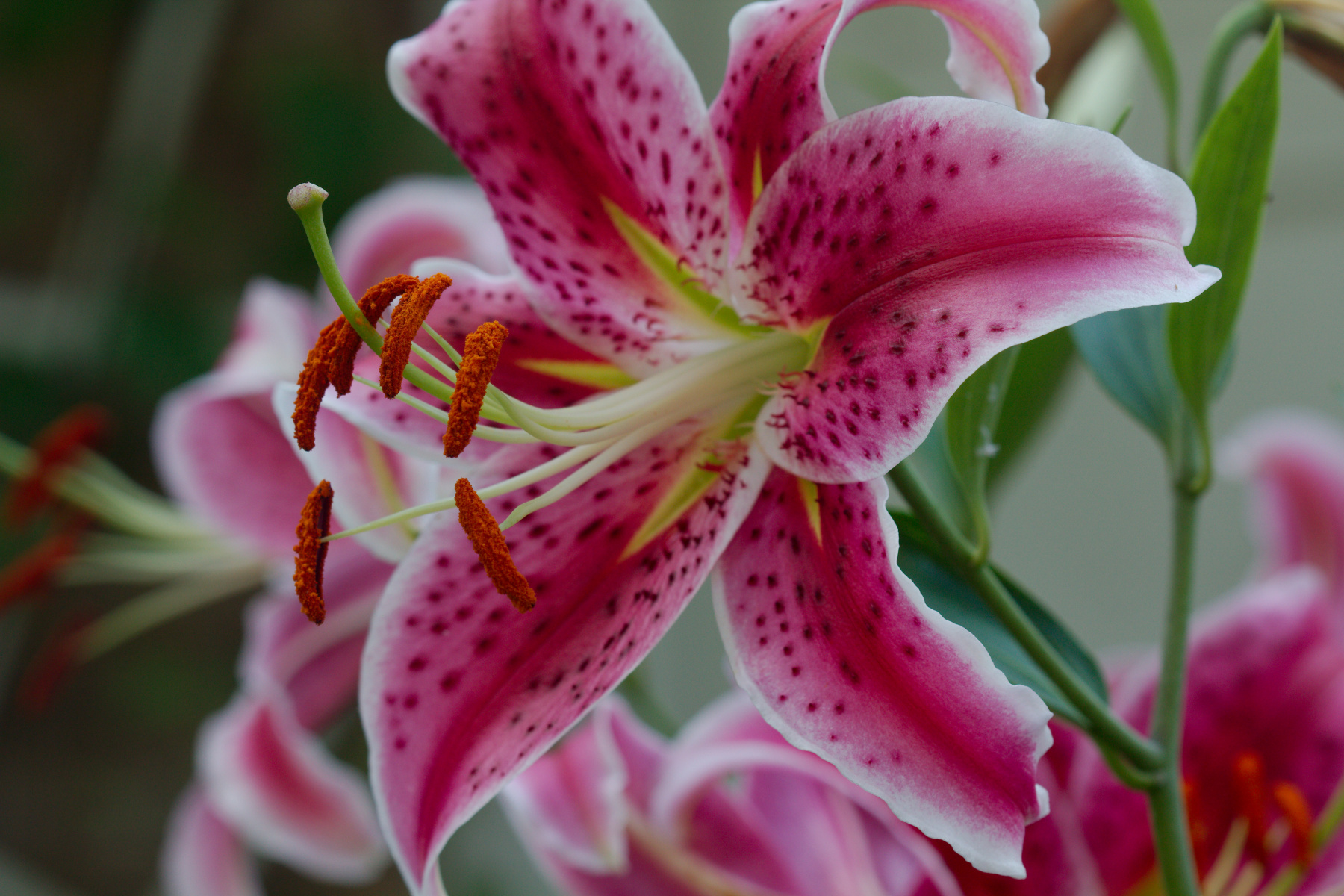
Lilium ‘Stargazer’ (The Stargazer Lily)
We have day lilies (Hemerocallis), tiger lilies (Lilium lancifolium), and a few Asiatic lilies in our yard and they are all beautiful in their way. They are mostly orange, although we have a few yellow day lilies. Although they were formerly considered to be in the same family as lilies, day lilies are not even in the same order any more. Anyway, I group them together in my mind, because they have somewhat similar flowers and of course the names are a link.
This flower, though, stands alone (in our yard, anyway). It is so different in terms of color that it seems less like the other true lilies than do the day lilies. It’s currently growing in a pot but we’ll be planting it when we get a chance. At least that’s the theory. We really need a small patch of these, not just one, but one thing at a time.
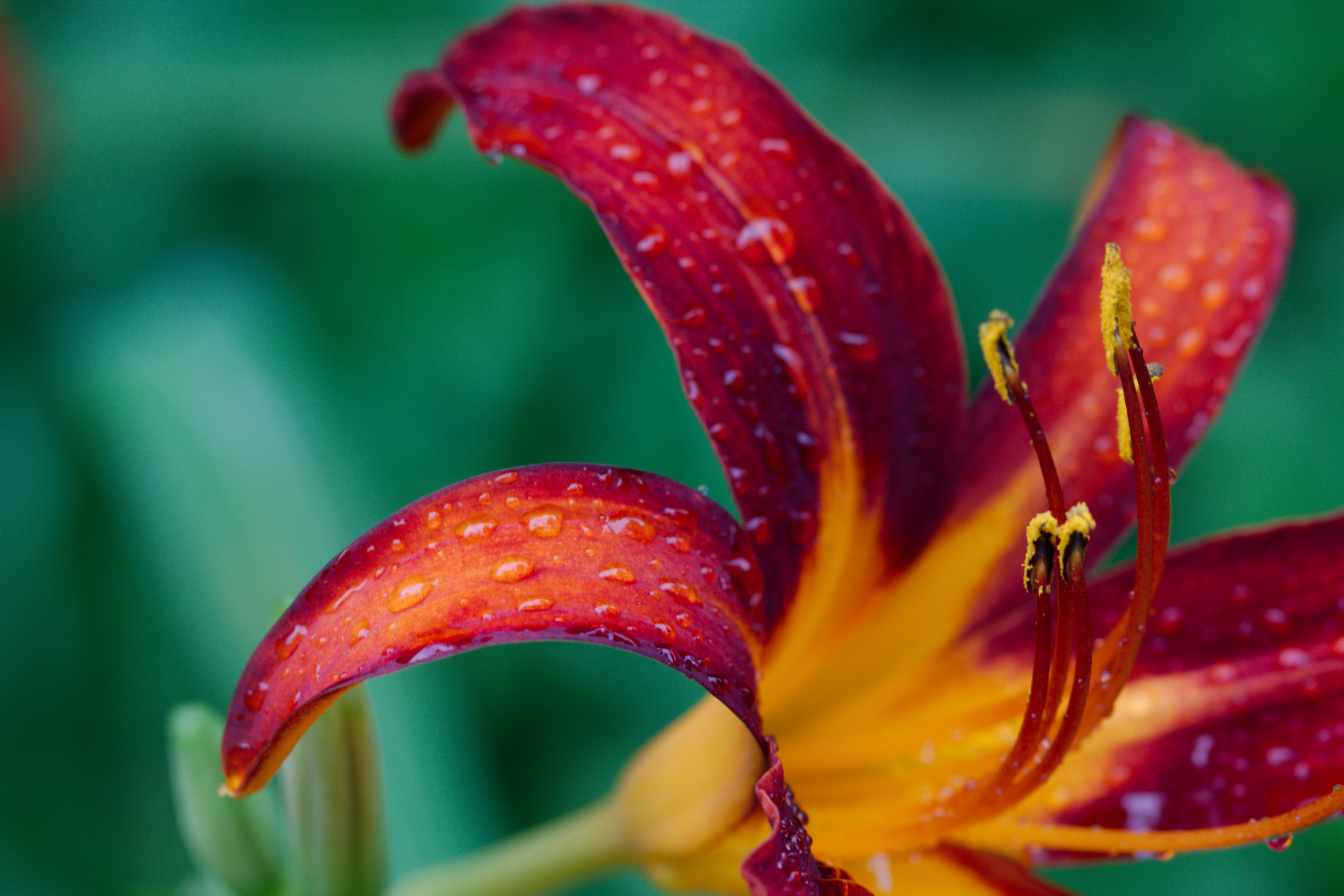
Dark Orange Day Lily
It was a beautiful rainy day today, considerably cooler although still fairly muggy. I was sort of busy at work so I didn’t get out. When I got home I took a picture I’ve been meaning to take for a while. I like day lilies in all their forms but I think this is one of my very favorites. I really love the deep orange, which is much more striking then the plain bright orange of the “standard” variety. The droplets of water on the petals are a small bonus.
Popillia japonica (Japanese Beetle)
This is not a friend of mine. Japanese beetles (Popillia japonica) are highly destructive plant pests. According to the U.S. Department of Agriculture, “the Japanese beetle was first found in the United States in 1916 in southern New Jersey. Since then, it has spread throughout most of the country east of the Mississippi River, as well as areas in Arkansas, Iowa, and Missouri.”
I have to admit that I find their metallic green exoskeleton to be quite pretty but I equally admit that I rarely take the time to admire them. I’m usually more intent of killing as many of them as possible. Fiends.
Wild Raspberries
The other day I mentioned that I picked and ate some wild raspberries and that I planned to go out to pick more when I had the chance. We’ll, I finally got out again today and picked a nice big tub of them. It was pretty hot out but fortunately I was working mostly in the shade rather in bright sun. Still, I worked for these. I think it was worth the effort, though. Don’t they look good? They aren’t huge but they are very tasty.
Thelesperma Flowers
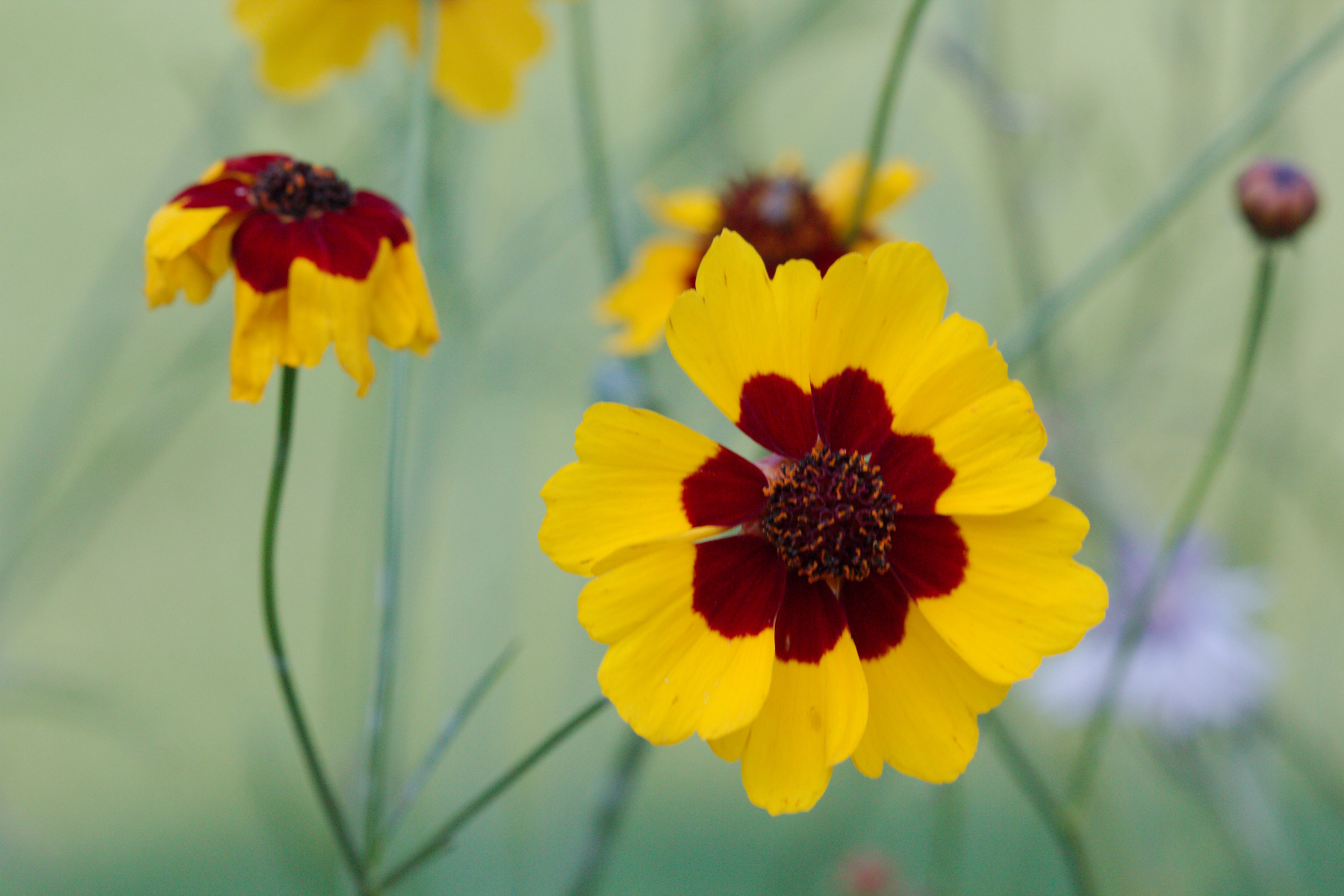
I didn’t take a lot of pictures today but did get out into the back garden of some friends. This is a Thelesperma, probably T. filifolium (stiff greenthread) growing there. It is a close relative to Coreopsis. In fact, until recently it was considered to be part of that genus. To be honest (hey, why not), I’m not completely sure this isn’t a Coreopsis, but I think I have it labeled right. Anyway, it is a nice bi-colored hybrid and I like the airiness of the photograph.
Airborne
Our friend, Dave, took two other friends, Jon and James, up in his plane this afternoon. He had to return the plane to Frederick and get his car, so they flew with him, along with his oldest son, Conor. I drove them to the airport where the plane was and took some pictures of them as they took off. I underestimated how much runway this larger plane needs to take off as compared to the smaller planes that take off so very quickly and easily. They got off the ground just before they got to where I was by the runway. The picture taken right before this is a little better in terms of showing the plane. I was trying to keep up with them as they hurtled towards me and I’m afraid that the framing is a bit off. Still, I like this one because you can see James in the cockpit. Another future pilot, perhaps?
In Memoriam — Kevin Snider
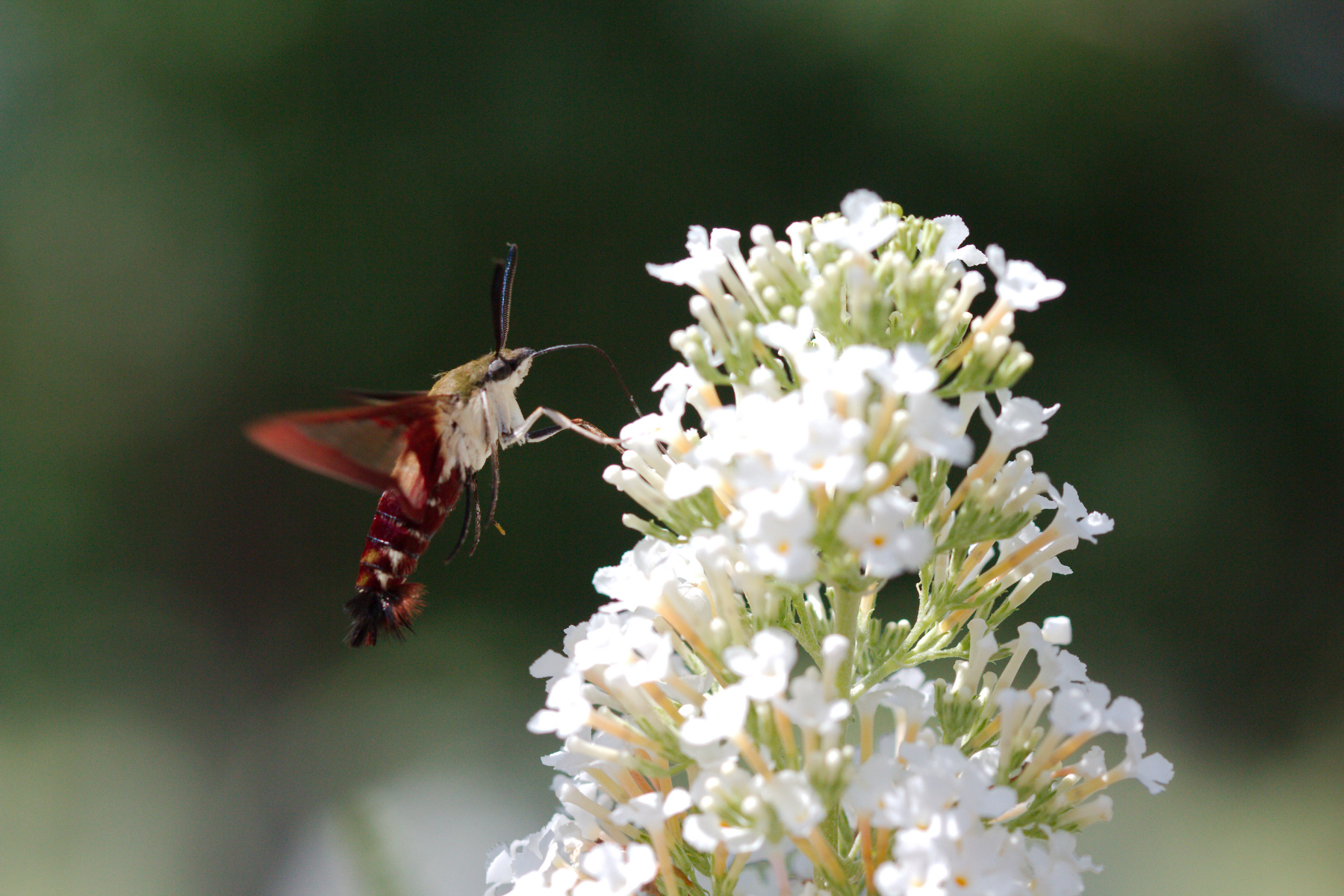
Sphinx Moth
Cathy and I went to Stadler Nursery after church today. While she shopped for a few things, I browsed with my camera, taking pictures of a few flowers that I liked. At the end of one of the tables was this white buddleia and flying around the flowers sipping their nectar, was a sphinx moth. Of the 124 described species found in America north of Mexico, I believe this is Hemaris diffinis, the snowberry clearwing.
I took quite a few blurry pictures but did get a few that are pretty decent, of which this one is the best. While I was watching, the moth never landed once. Taking a photo of a flying insect is a real challenge and you have to be prepared to end up with a lot more wasted shots than anything else.
Guatemala Team
Dorothy left early this morning for Guatemala early this morning. We dropped her off at Church of Christ at Manor Woods at 2:00 AM and they were off by 2:30, heading to the airport. By the time we were home from church later in the day there was a post on Facebook saying they had arrived safely in Antigua. It’s going to be hard not being able to call and ask her how she is, but we’re looking forward to all the stories she’ll have when she gets home. This is the team, just before the piled into the bus and headed out.