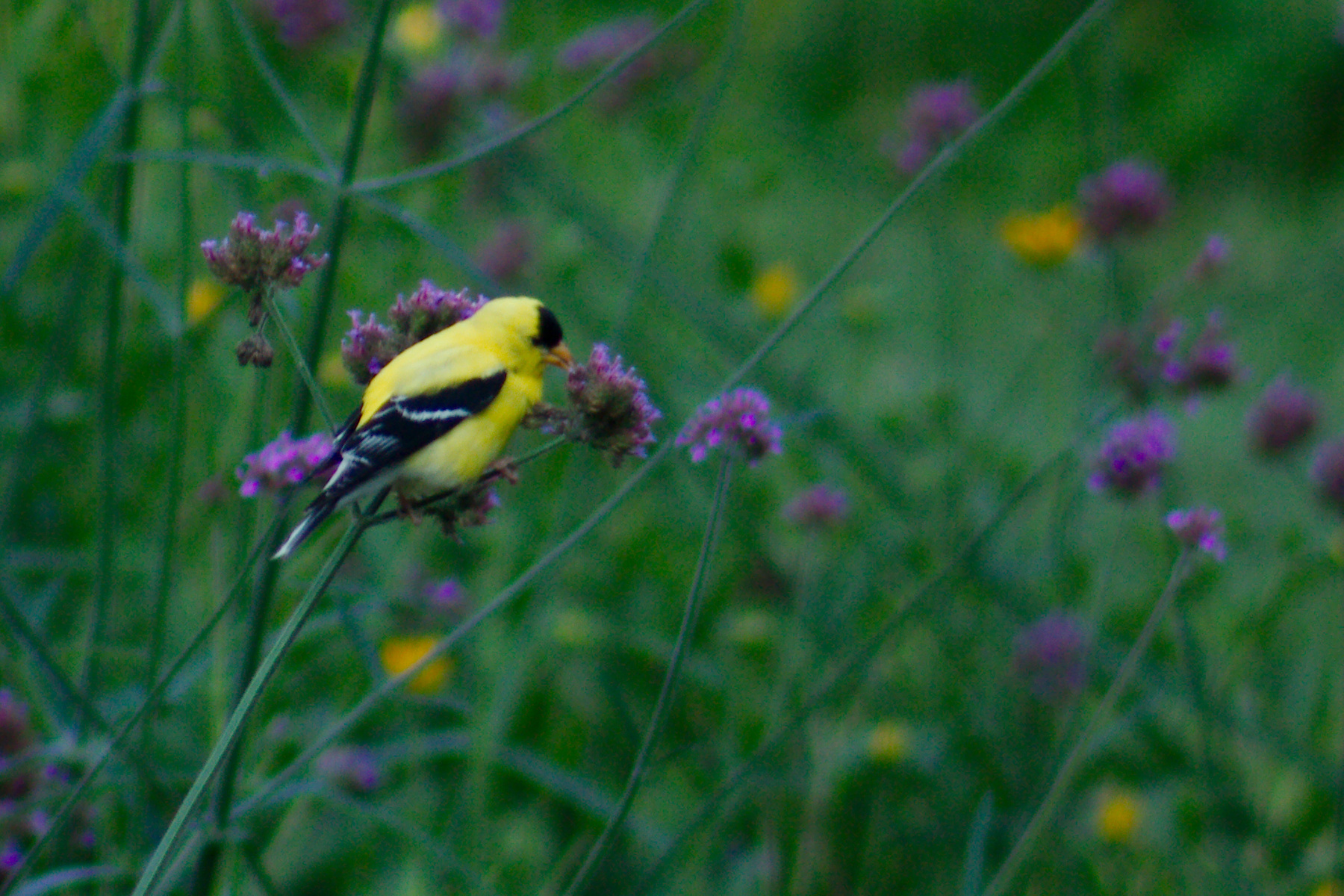
We have a fair amount of Verbena bonariensis growing around the yard. It’s somewhat of a weed but for the most part, we let it go, just keeping it barely within bounds. There are a few reasons for us letting it go. First, of course, is that it’s pretty on its own. I mean, the purple adds a bit of contrast to all the green in the early summer and it’s generally still in bloom when the black-eyed Susans really start to go crazy. But I think the main reason is that the American Goldfinches (Spinus tristis) really seem to like it. Usually I’ve been unable to get close enough to get even a poor photo of them before they fly away but this afternoon I got a reasonable picture showing three finches. They are such lovely birds and we enjoy watching them bounce around on the tall stems of the Verbina.
Flowers and Plants
American Goldfinches (Spinus tristis)
Lobularia maritima (Sweet Alyssum)
As I’ve mentioned, Cathy bought a bunch of annuals to go in containers and in a few locations around the house. One that she often gets is sweet alyssum (Lobularia maritima), a pretty little thing with masses of small (7 or 8mm) flowers. This variety has a purple tint and it really lovely. I think they are particularly nice up close. On the other hand, I think a lot of things are interesting up close, which is why a significant proportion of my photography is of small things, viewed up close. Anyway, I hope you enjoy these little flowers.
Tulip Poplar Leaf
I went out into the woods next to my building today. There wasn’t a lot that I decided to photograph. Mostly I took pictures of the sun shining through leaves. I love leaves (and I’m frond of ferns) and especially like looking at them with light shining through them. This is a leaf of a tulip poplar, or tulip tree (Liriodendron tulipifera) and it has large leaves of a unique and easily distinguished shape. While you can easily identify dogwood by its bark, the tulip tree is identified by its leaves.
Tanacetum parthenium (Feverfew)
This comes up all around our yard. It isn’t so invasive that it cannot be kept under control by judicious pulling and it certainly adds a bit of interest during a time when there isn’t a huge amount in bloom. The early spring flowers are done and the summer flowers haven’t really gotten going yet. There are Asiatic lilies blooming and the day lilies will be starting pretty soon. The Verbena bonariensis has started but the black-eyed Susans are still a good way off. Feverfew doesn’t have the most striking flowers around but they are certainly pretty enough. And there are plenty of them.
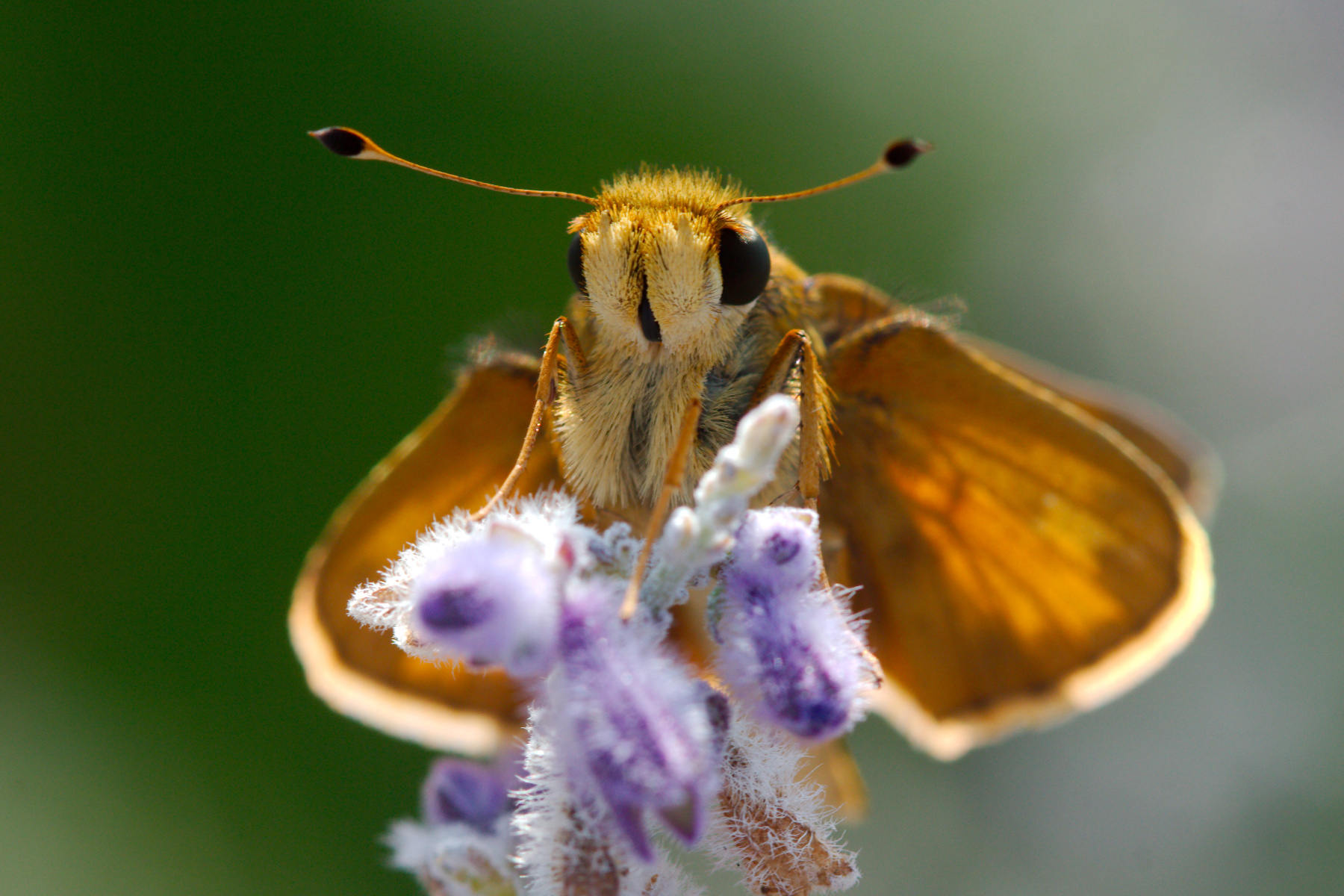
Skipper on Coreopsis
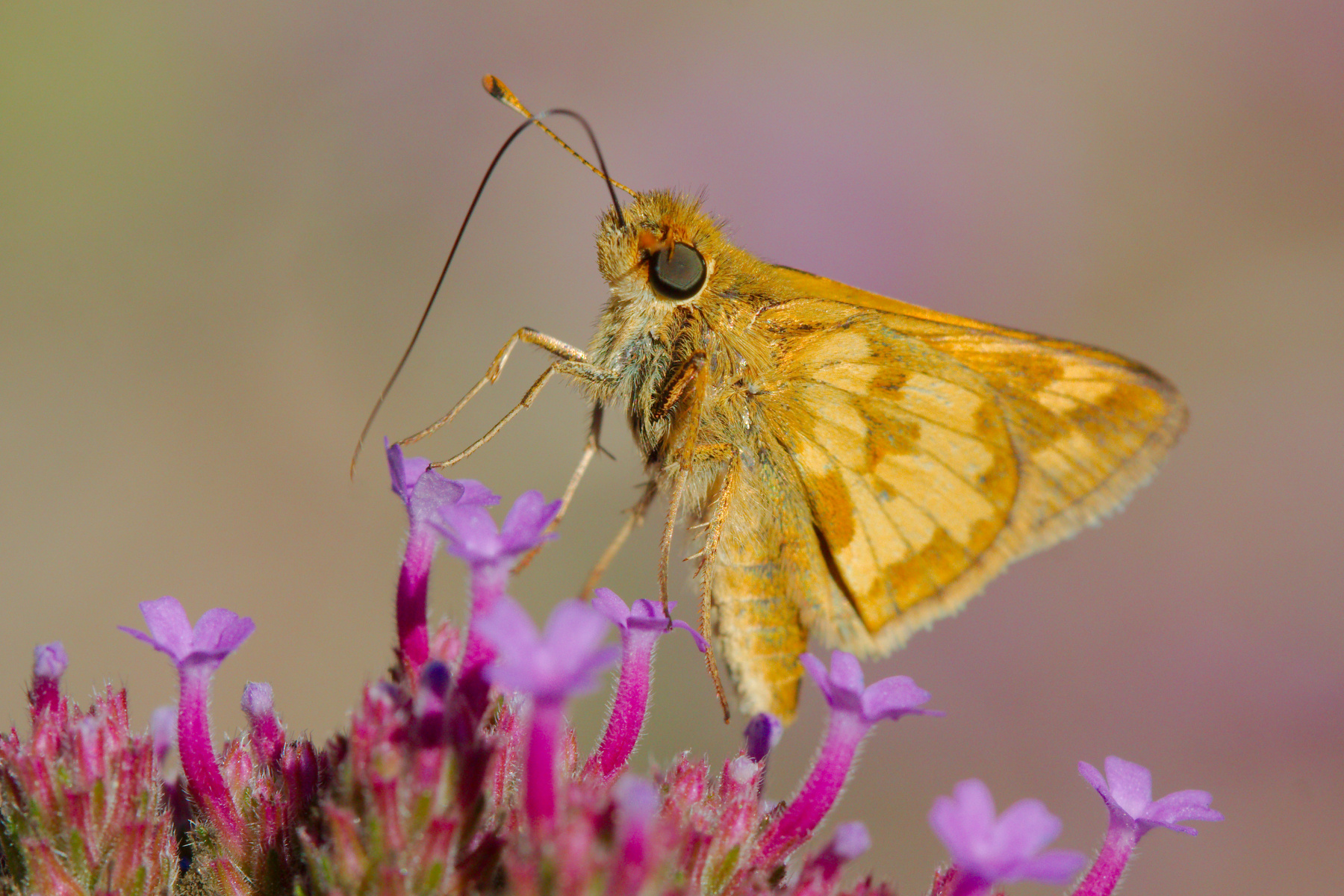
I sat on the patio for a while this afternoon, just enjoying being in the sun. It was actually a little hot for my taste, but still nice for all of that. Also, the light is better for macro photography in the sun, when you want as much depth of field and as fast a shutter speed as possible. I was watching the insects around the potted flowers on the patio and got a few pictures of this skipper (family Hesperiidae) on a coreopsis (a.k.a. tickseed) flower. The insects aren’t around it the huge numbers we’ll have in a few weeks, particularly when the mountain mint (Pycnanthemum muticum) starts to bloom, but they are certainly here and I really enjoy them.
Dracunculus vulgaris (Dragon Arum)
Ralph told me that the other day he noticed a vulture perched on the kids old jungle gym in his back yard. Later he noticed more had gathered. At first he wondered if some animal had died and attracted them. But no, that’s not what it was. It was this plant, a dragon arum, (Dracunculus vulgaris, formerly called Arum dracunculus), a native of the central and eastern Mediterranean. This plant attracts pollinators by mimicking the smell of rotting meat. It does a good job and fooled the turkey vultures (Cathartes aura) which find dead animals primarily with their highly developed sense of smell. Black vultures (Coragyps atratus) find food primarily by sight and by following turkey vultures.
On the Missouri Botanical Garden’s page about Dracunculus vulgaris it says,
Avoid planting this perennial near windows, doors, sidewalks or other frequently populated areas where the brief but overpowering odor from the spadices will be found objectionable.
Rose ‘Cutie Pie’
I’ve mentioned this rose a couple times so I decided that I’d finally get around to posting a picture. This is a miniature rose called ‘Cutie Pie’ and it is, really. I’ve found two roses named ‘Cutie Pie’ listed in commerce. This is WEKruruwel, Bred by Tom Carruth and introduced by Weeks in 2016. So, it’s a new rose. I’ve planted it in the large bed in the middle of our back yard where there used to be two trees. That bed needs a bit more variety and this was my start at that. I plan to add a few more roses, two at least and maybe as many as four. I’m looking at a few of David Austin’s English roses. We’ll see.

Asiatic Lily
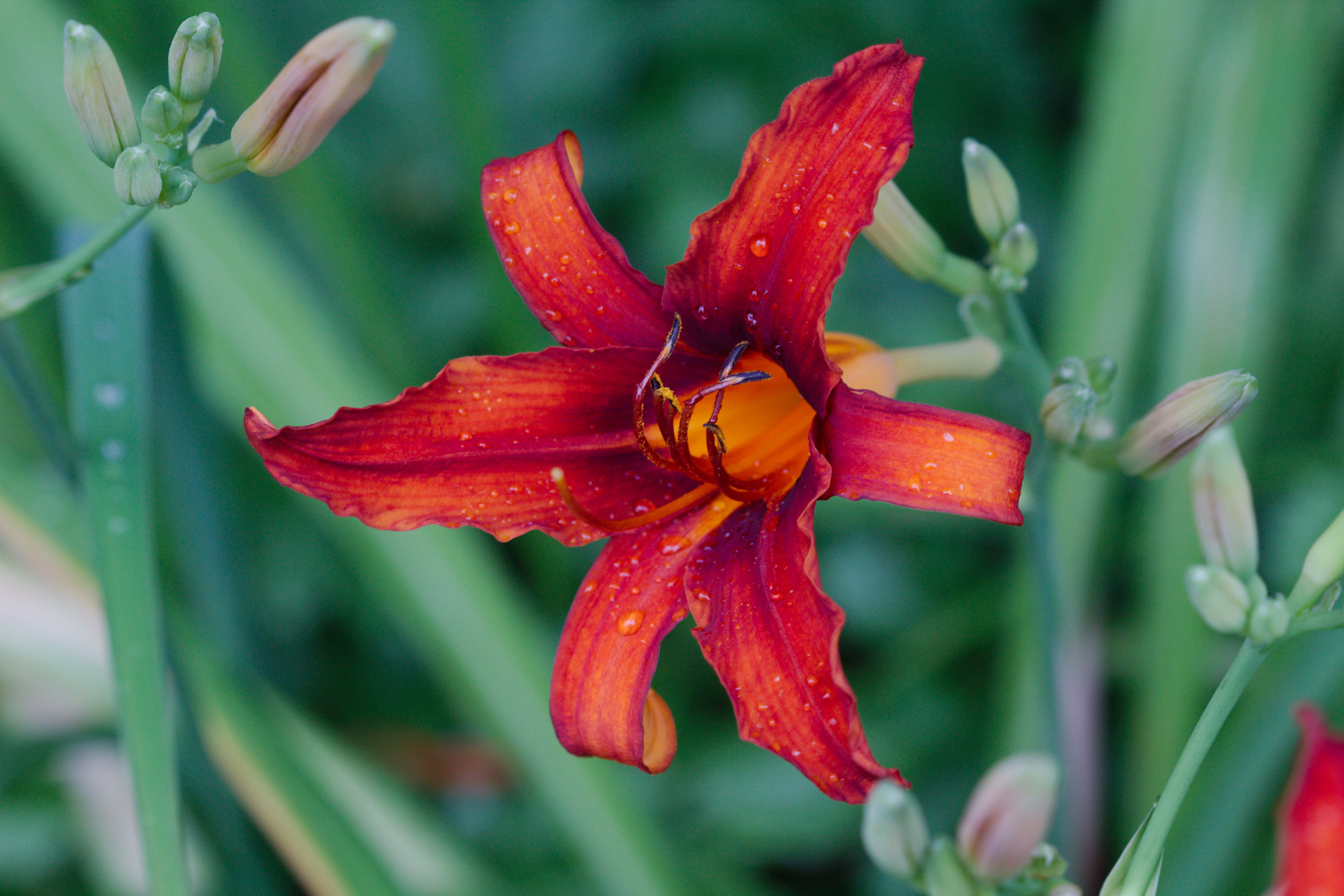
This is the first of our Asiatic lilies to come into bloom. We have been adding these every now and then and I really love them. They have such loud, hot colors and are such beautiful, symmetrical flowers. I don’t know that I could ever have too many of them. I think my favorites are the solid colors, particularly the orange and deep reds but I saw a mix of orange and yellow the other day that was out of this world. This one is relatively short, with the flower less than a foot and a half from the ground. I like that because it means it’s easier to look down into the flower. The tiger lilies are much taller but since the flowers hang down, that works out really well.
Celosia
Cathy’s been stocking up on her annuals and has begun to put them into containers to go around the house. There are some amazing colors and textures and I thought for today I’d feature this Celosia. Its bright orange flowers are about as close to a flame as you can get and the genus name actually comes from the Greek word keleos (κήλεος) meaning burning.
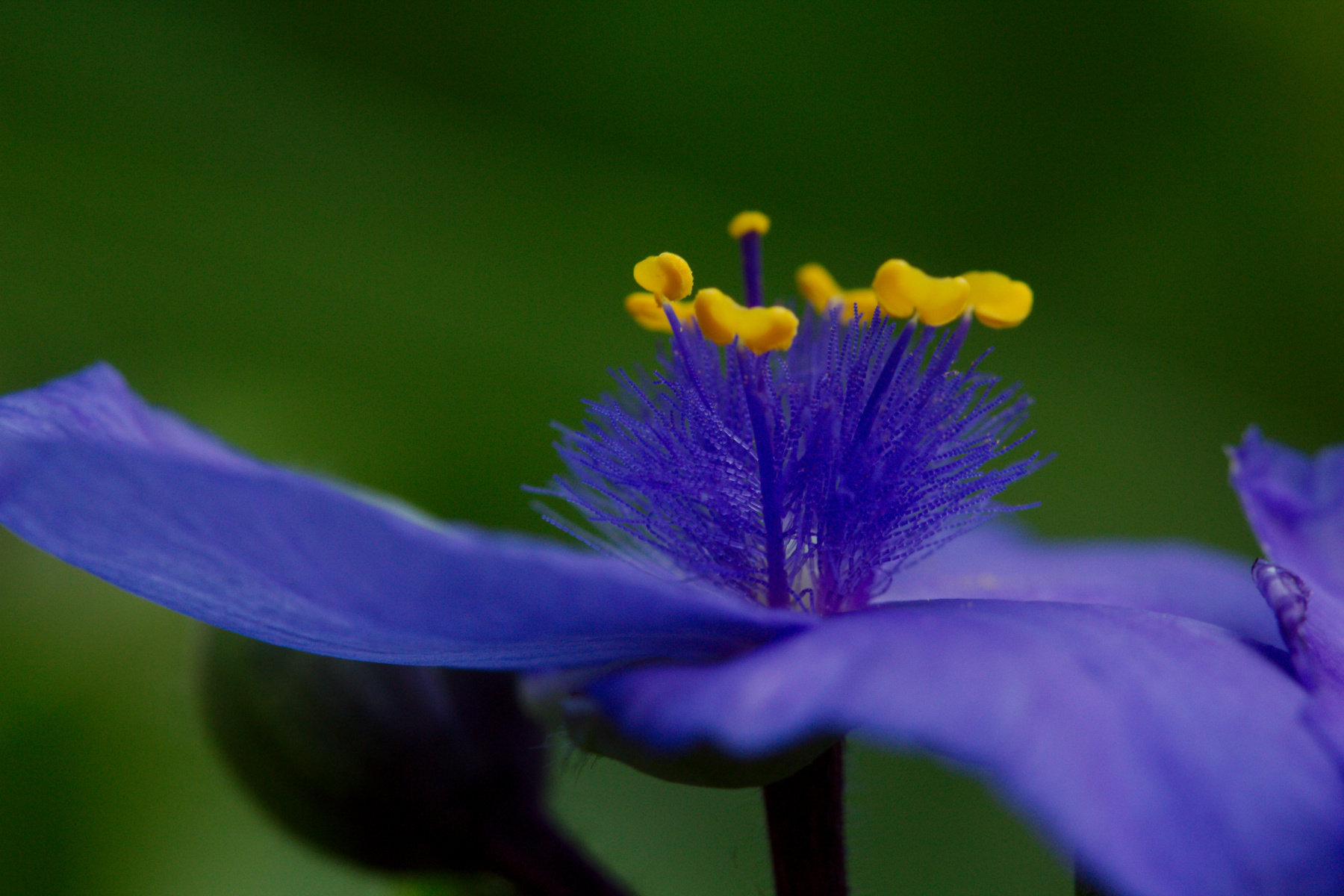
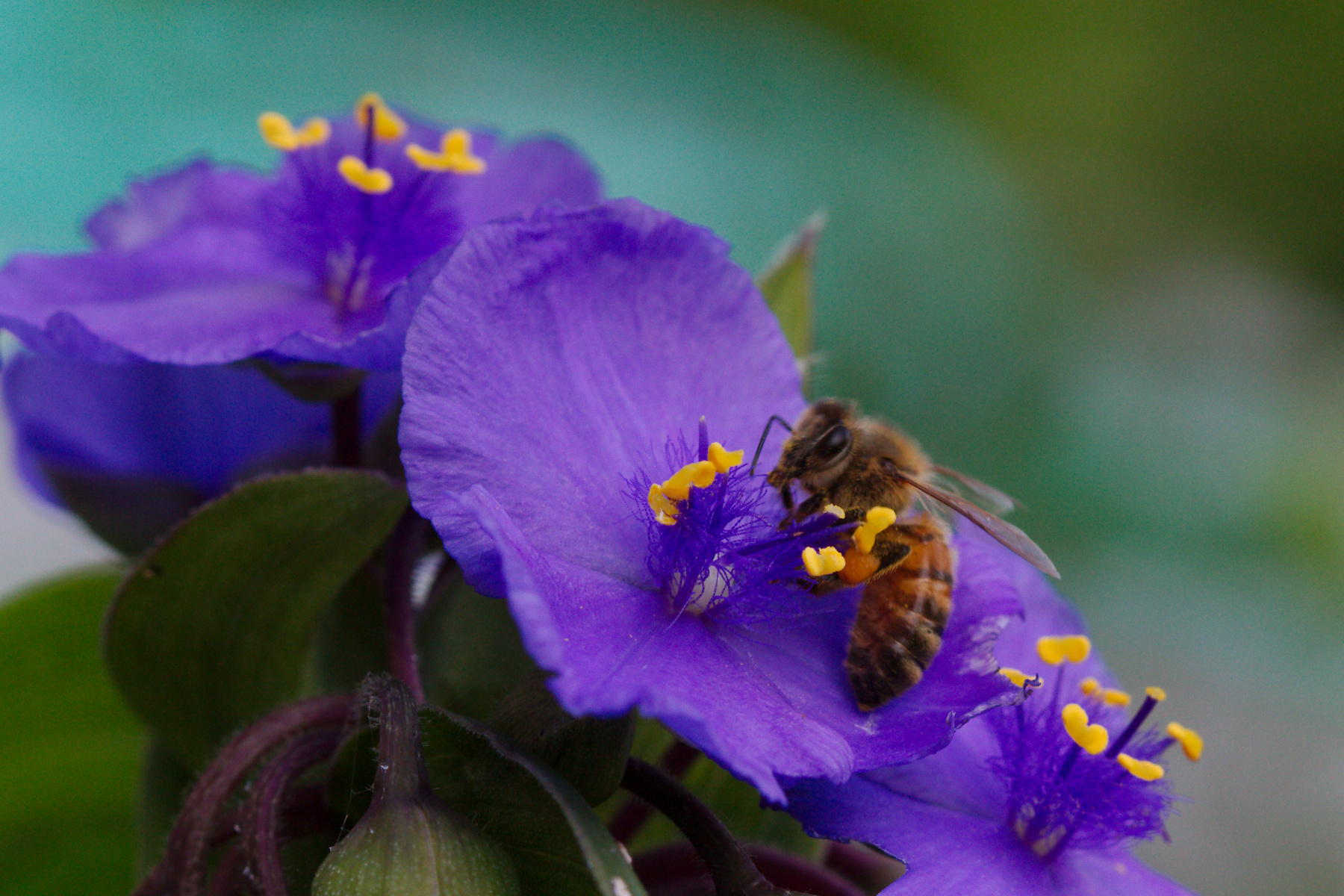
Cathy has a couple with this flower color and one that is a deep, hot red. They really are something and bloom well in full sun and even light shade. I didn’t know this until recently but apparently it is edible and is cultivated as a leafy green vegetable. According to Wikipedia (caveat emptor, or in this case the eater), “It is traditional fare in the countries of Central and West Africa, and is one of the leading leafy green vegetables in Nigeria, where it is known as ‘soko yokoto’, meaning ‘make husbands fat and happy.’”
Rose ‘Mill’s Beauty’
On page 134 of volume 48 (dated August 24, 1895) of The Garden: An Illustrated Weekly Journal of Horticulture In All Its Branches, under the heading Rosa setigera, it says:
The numerous varieties in this group are at once specially distinguished by their leaves being rough to the touch, shining on the upper surface, downy and glaucous underneath, deeply toothed at the margin, and furnished with curved prickles on the mid-rib and principal veins. The flowers are borne, mostly in threes, in numerous corymb-like clusters.
It lists a few varieties and then under ‘Mill’s Beauty’ it has the following:
A very vigorous-growing and most noteworthy variety, producing a brilliant effect when its flowers, which are of a redder colour, but not so double as those of the preceding variety [R. s. var Beaute des Prairies], are in the full flush of their freshness. An extra fine kind.
This is a rare rose and in past years Nick, whose this one is, called it his ‘Great Unknown Setigera’ It has now been identified as the same rose growing in Roseraie du Val-de-Marne à l’Haÿ-les-roses in France. ‘Mill’s Beauty’ is also known as or ‘Miller’s Climber’ and is a R. setigera hybrid of somewhat unknown origin. According to volume 12 of Modern Roses it was bred before 1835 and may be a hybrid between R. setigera and R. arvensis. It also says that it is more likely of U.S. origin rather than the generally assumed England.
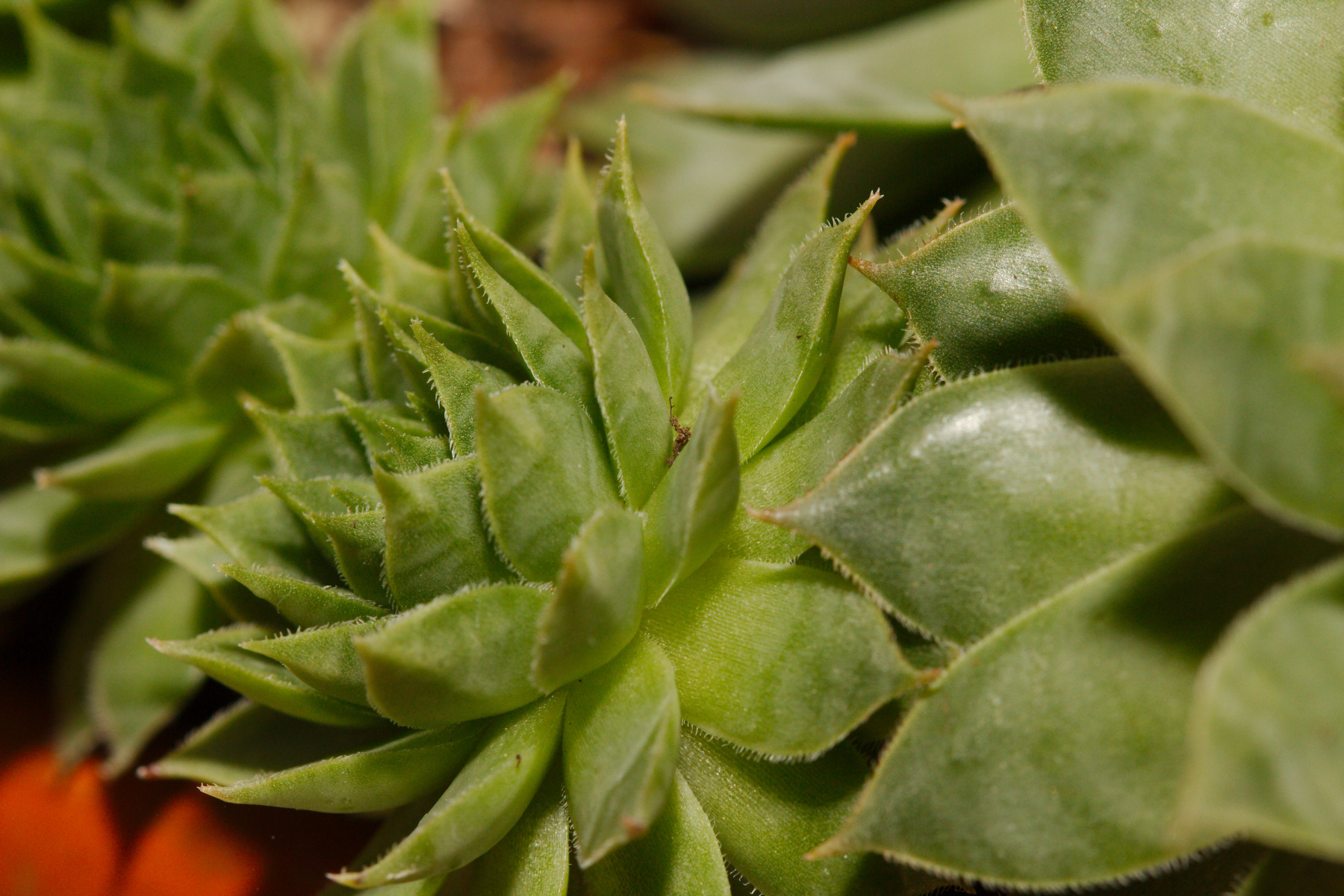
Sedum
We don’t remember where we first got this sedum or what it’s called but it’s very successful in containers and in the garden around our house. It doesn’t grow so fast or furiously that it’s a real problem but it certainly takes no effort to keep it alive. If you want something that will grown pretty much anywhere in your yard, this might be a good choice. It has very beautiful, little yellow, star-shaped flowers on light green foliage. We have it in full sun and in reasonably heavy shade. It places that are almost always wet and others that pretty much bake. If you want a little, let us know.
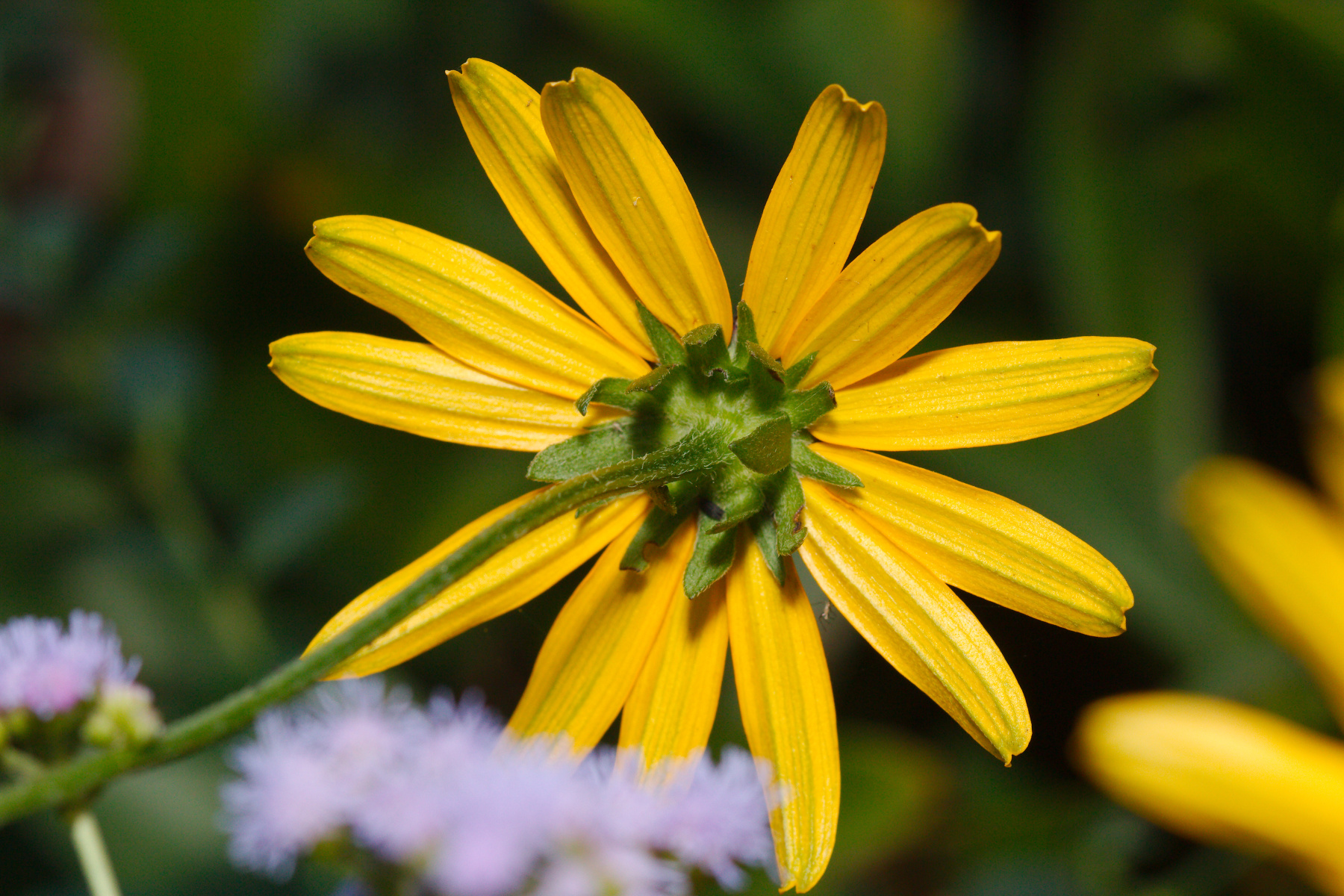
Coreopsis
This is a very nice Coreopsis (tickseed) growing in a container on our back patio. I like these larger-petaled Coreopsis flowers more than the fine-petaled varieties. I suppose they both have their uses but these are so much bolder and brighter. They certainly make a good show and outside the kitchen door is a nice place for a big splash of yellow. These are reliable blooms and come ahead of the sea of black-eyed Susans that fill our backyard later in the summer. For now, these are the sole source of this color in our garden (there are a few yellow irises but they are a much paler yellow).
Tradescantia virginiana (Spiderwort)
Spiderwort (Tradescantia virginiana) is one of my favorite perennials. It’s easy to grow, it does well in sun or shade, it can take fairly dry conditions, and it blooms for a nice, long while. We have one with leaves that are very pale green, almost yellow. We have one with flowers that are much more pink and some that are nearly pure, deep blue. Each bloom lasts for a day only but there are a lot of them, following one after the other.
From the Missouri Botanical Garden page:
Genus name honors John Tradescant (1570-1638) and his son John Tradescant (1608-1662), botanists and successive gardeners to Charles I of England.
Specific epithet means of Virginia.
When the stems of spiderworts are cut, a viscous stem secretion is released which becomes threadlike and silky upon hardening (like a spider’s web), hence the common name.
Rosa multiflora
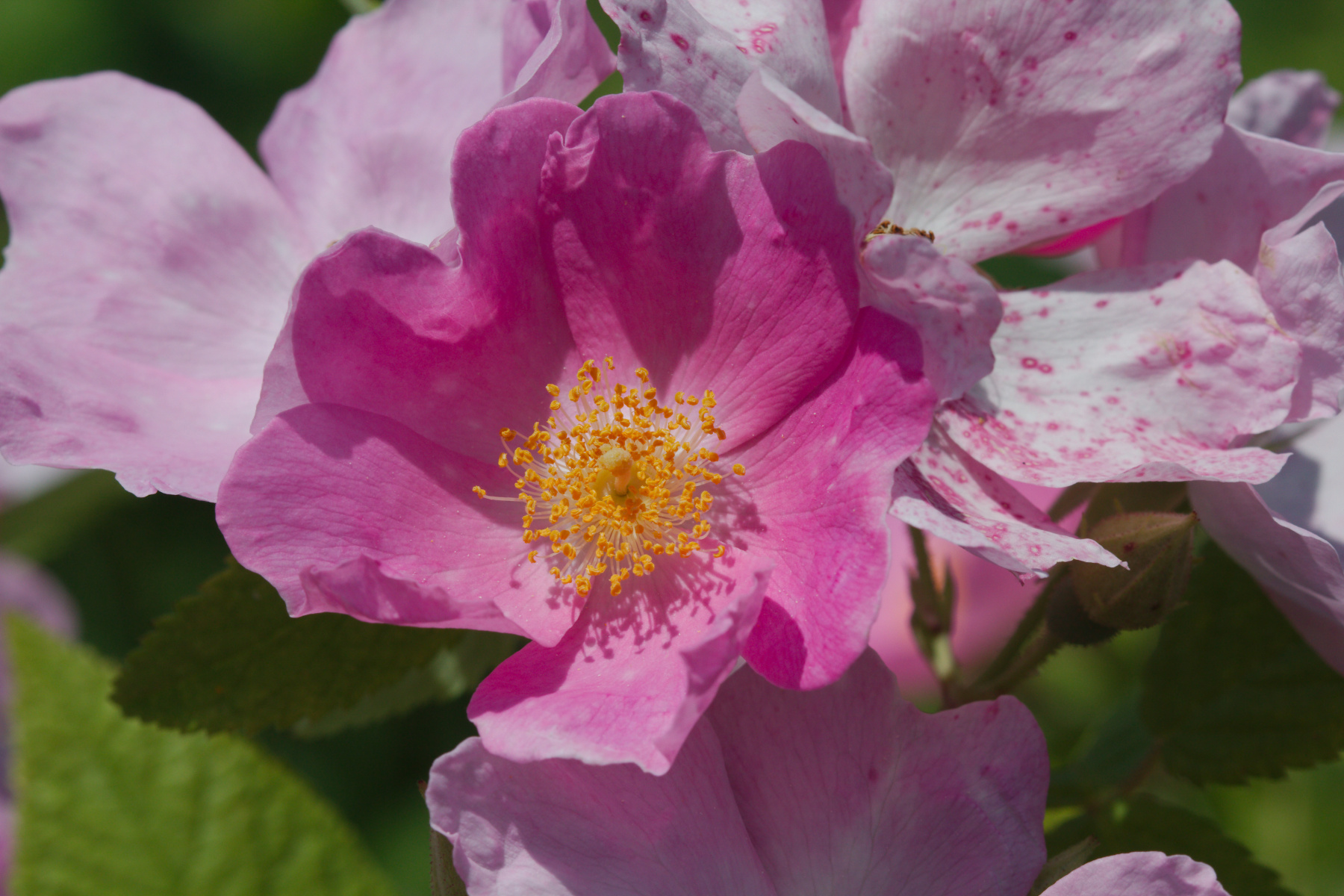
My pink multiflora rose is in full bloom. I suspect it isn’t 100% R. multiflora, because those have white flowers and this is clearly not white. What the rest of its genetic makeup is, I really couldn’t say. R. virginiana would be a reasonable guess. The color is right. The leaves are definitely R. multiflora and it’s got the requisite resistance to black spot. It’s possibly a bit less vigorous, but that’s probably something in its favor. R. multiflora will generally take over and this is large, but fairly well behaved. Pity it only blooms once, but then, the same can be said for the azaleas.
Siberian Iris ‘Eric The Red’
This little Siberian iris was originally planted in our garden in Gaithersburg. When we were getting ready to move I dug up a portion of it and brought it with us. It’s been doing pretty well in our yard here for ten years. Like most Siberian irises and despite being named ‘Eric The Red’, this flower is purple rather than anything you could describe as red. Some Siberian irises are much bluer, of course, so it has more red in it than those. But it’s purple, not red. Still, it’s a happy little flower and quite content without needing much of any care to do well. In a bit more sun we’d probably get more flowers but it’s happy where it is.
Asiatic Lily ‘Tiny Sensation’
Cathy and I went to Stadler Nursery this afternoon and while Cathy picked out a few perennials, I took a bunch of pictures. Actually, I bought something, as well, a Camellia japonica ‘Kumasaka’. I’m not sure where I’ll plant it but I’m thinking that it might go in front of the house to replace the dogwood that’s much too close to the house and really needs to come out. This photo is of an Asiatic lily called ‘Tiny Sensation’ and it’s a stunner. We have a few Asiatics in the yard and in containers. They mostly have solid colored blooms but all are quite hot.
Bearded Iris
This is the first of our bearded irises to bloom this year. We have a few of this color scattered around the yard, as well as a few that are bright yellow. I love the way the water droplets look on leaves and flower petals. I guess that’s why they are so often subjects of my photographic efforts. I’m not sure they ever really capture them properly but this one is pretty nice. The color of this flower is nice, too, of course, being such a deep purple. I don’t have a lot else to say. I guess I hope speaks for itself.
Viburnum
One of the shrubs that was in our yard when we bought this house is a large viburnum. It’s in the somewhat shady, northern end of the back yard next to a Spiraea. Some years the bloom isn’t anything to mention but this year is one of the best it’s had since we have lived here (over ten years). The individual flowers are not much to speak of the the entire bush, about ten feel tall and equally broad, is absolutely covered with them. It’s not quite pure white but close enough. The birds love this bush and right now, the insects are pretty happy with it, as well. Once the blooming is done, I’m going to do a bit of cutting, because it tends to get too big and it’s been a few years, but for now, we are really enjoying it.
Rosa rugosa ‘Roseraie De l’Hay’
This is a large and very easily grown rugosa rose that I’ve had in the yard since we first moved here. It’s about 9 feet tall and that’s the only real problem with it. It’s too tall to really be able to appreciate most of the blooms, which are all up at the top. If given more room the branches would arch over and more flowers would be accessible but it’s not sited well enough for that. I may need to move it but it is very happy where it is. Also, the blooms are quite visible from the kitchen, which is certainly a plus. The fragrance, as with most rugosa roses, it wonderful and strong.
Columbine (Aquilegia)
We have quite a bit of columbine (Aquilegia) growing in our yard. Many of the plants are seedlings and most look something like this. There are lots of quite fancy and brightly colored columbines among the 60 or 70 species (and many more varieties) but we’re happy enough with the slightly more staid, darker colors. Backlit by the sun the red comes alive and is quite bright. Growing mostly in the shade, however, it rarely gets this treatment. Still, it’s a good plant to have and isn’t generally bothered by rabbits or deer.