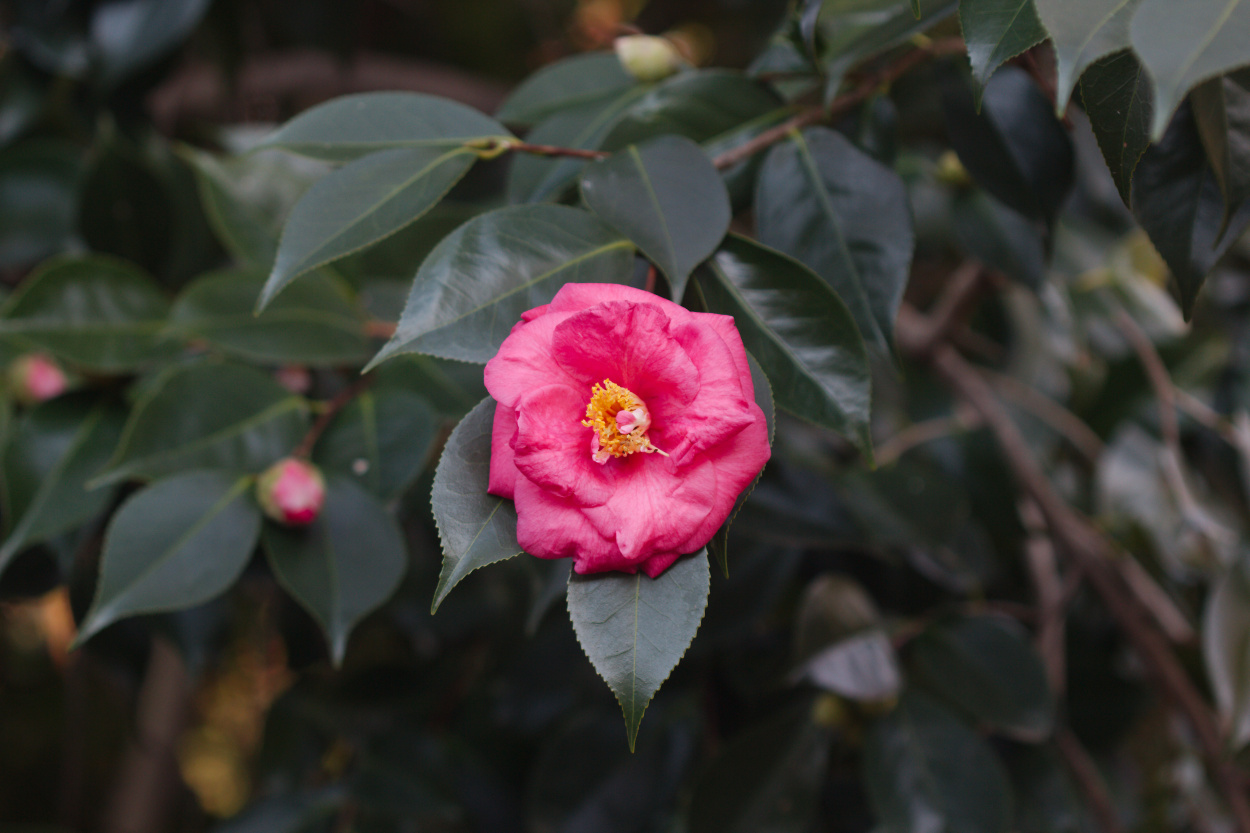
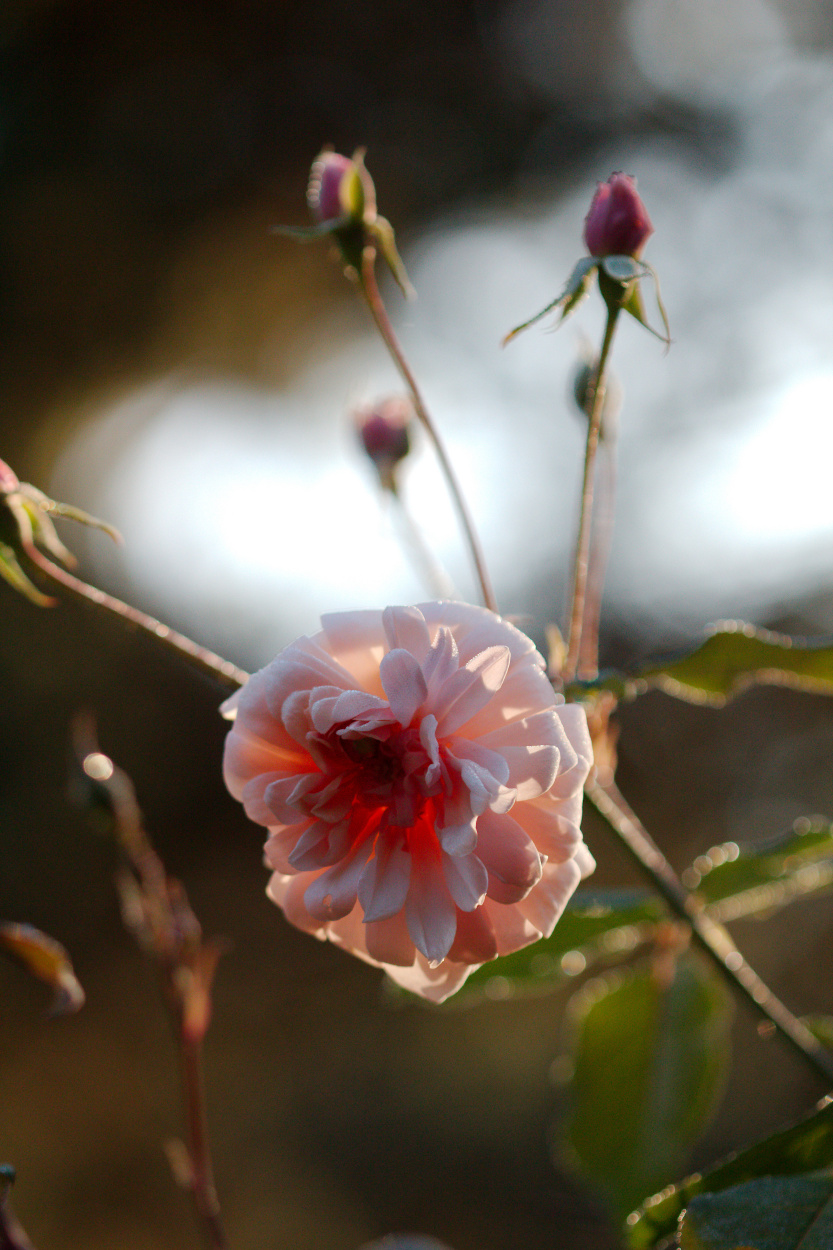
This little rose called ‘Perle d’Or’ is growing outside our front door. A few years ago it was a seven foot tall shrub but the winters of 2014 and 2015 each had very cold spells and killed back all of the taller canes. It’s much smaller than it was, less than five feet at the tallest point. This last winter was much milder in terms of temperature, though, and didn’t do so much damage and it will probably come back strong. It’s covered with these petite pink blossoms that are wonderfully fragrant. On a humid evening (like we’ve had the last week) they are really nice.
Flowers and Plants
Coreopsis
We have some Coreopsis in the bed at the back of our yard. That bed actually needs a bit of work, but this is a fairly reliable little perennial that I’d hate to lose to any renovation. It’s a very cheery orange color and although later in the summer that would be drowned out by all the black-eyed Susans, at this time of year, before even the day lilies have started to bloom, it’s quite welcome. We’ve had other Coreopsis plants but they haven’t done as well as this one with large petaled flowers and less feathery foliage. It’s quite happy to be mostly neglected, which is sort of what it takes in that garden.
Iris ‘Eric the Red’
This is a little Siberian iris called ‘Eric the Red’ and it’s in full bloom in our front yard. I really like this little thing, which in our yard only stands about 14 to 18 inches tall, though I’ve seen data that suggests it gets taller. It’s supposed to do well in a bog garden but ours is in a fairly dry spot, which may account for the shorter growth. It’s certainly happy there and blooms reliably. It’s usually hot by this time of year so the flowers don’t last all that long but they are great while they do.
Peony Sunrise
As I said in yesterday’s post, it’s been a good spring for peonies, at least in terms of my notice of them. Today features yet another peony photograph. We were up in Pennsylvania again today, doing a bit more work towards the big wedding coming up before long. I sprayed poison ivy again and am slowly but surely getting it taken care of. It won’t be gone by the wedding, but it needs to be done in any case.
This peony is one of a few growing in front of the cabin. We cleared weeds out of the garden two weeks ago and it’s starting to look like its old self (some of the weeds were trees with trunks an inch in diameter!). There was just the one bloom on the peony but perhaps if we keep at the weeds it will do better. I thought the flower looked a bit like a rising sun and took a few photos of it.
Peony Garden
I don’t know that this year has been anything out of the ordinary in terms of peony blooms but I think having the new peony blooming in my back yard has gotten me to look at them a bit more than normal. We have some on the end of our house but don’t go around there often enough to notice them, in particular. There is also a peony garden at Seneca Creek State Park with dozens of different peonies. Cathy and I went there once years ago and were a little disappointed in what it’s become. There is a beautiful little garden and truth be told, that alone is worth visiting. But it could be so much more. There is a field, probably six acres or so that is full of peonies. That could be so spectacular. But they only seem to cut the grass once a year (during the winter, when they can mow everything and then let the grass, poison ivy, and everything else you can imagine grow up with and around the peonies. It’s a shame because although the peonies are starting to bloom, many of them are hidden by the grass. You also want to stay out of the deep grass unless you are dressed for poison ivy, which is thick in the place. It’s still pretty but not nearly as impressive as it could be or even as we remember it (although our memories may be at fault there). The peony shown here is in the tended garden.
Rosa Multiflora
A few days ago this plant was a mass of buds in the rain. Now the rain has stopped and the buds are opening. Individually the flowers are not really all that amazing, five small, simple, pink petals around a bunch of yellow stamens. In mass they are quite impressive. The entire plant is turning from green to pink and will get pinker before it is done. I picked out one picture to post here and then second guessed myself. I found that I couldn’t decide which one I liked better so I’m posting them both.
Of course, like most rose species, this one only blooms once and then it’s done for the year. It also has very little fragrance. My dream is to cross this with roses that repeat and which have fragrance to get some of the multiflora vigor and disease resistance into a new group of hybrids. Whether that’s ever going to happen is anyone’s guess. Another project, even before crossing it with anything else, is an attempt to double the chromosomes. R. multiflora is, like many rose species, diploid (it has 14 chromosomes). Many hybrid garden roses, including most hybrid teas and floribundas and a lot of the roses I’d cross like to make crosses with, are tetraploid (28 chromosomes). For breeding purposes, a cross between a diploid and a tetraploid is problematic because it produces triploid offspring, which are, with notable exceptions, sterile.
Epimedium Leaf
We discovered Epimedium at the National Arboretum quite a few years ago and decided we needed to have some. At our old house we had at least three different varieties, blooming in red, white, and yellow. We brought some of them with us and have them in our garden here but they are all Epimedium x rubrum, a red flowered variety believed to be a cross between E. alpinum and E. grandiflorum. The leaves are interesting even after the flowers have finished. They have a little red in them and they also have pretty edges with little (and soft) spines along the edges. They are quite hardy and can take anything our winters are likely to give them, as well as getting through the summer drought without any trouble. They are semi-evergreen here, basically losing their leaves by the time the new growth starts in the spring. Common names for Epimedium x rubrum include red barrenwort and bishop’s mitre.
Peony ‘Coral Sunset’
In the fall of 2014 I planted three peonies in our back garden. Last year I saw leaves on two of them but they were barely above the top of the pachysandra amongst which they were planted. This spring I was happy to have all three of them send up leaves above the top of the pachysandra. They lived. Better still, one of them had a bud. It’s only one bud out of three plants but peonies are a long-term proposition and it should get better each year, now. They are a variety called ‘Coral Sunset’ and I think the flower is quite lovely. I’m looking forward to more flowers next year.
Multiflora Buds In The Rain
The rain continued today but I went out briefly to take a few pictures. The large, pink Rosa multiflora (or mostly multiflora, anyway) shrub against our back fence is covered with buds and is just starting to come into bloom. In a few days, and certainly in less than a week, it will be covered with pink flowers. At this point there are only occasional flowers and lots and lots of buds. But in the rain, even that can be pretty, I think. It builds anticipation, if nothing else.
Spiderwort Leaves In The Rain
It has been a fairly wet May this year. Not necessarily way out of character, as we often have wet weather in May, but April was so dry that in comparison, it seems wetter than normal. I don’t mind rain, in general, unless I have some outdoor activity planned that requires a bit less wetness than we generally get when it’s raining. I love a blue sky and all, but the sound of a gentle rain, the intensified colors of an overcast day, and the water droplets clinging to everything are all pretty wonderful, as well. Today was that sort of day and I took a few pictures of that water droplet thing, right outside my back door on the Tradescantia (spiderwort). This is the same plant whose purple flower I photographed (also in the rain) on Tuesday, May 03.
Rosa rugosa ‘Roseraie De l’Hay’
I wish I could post the fragrance of this rose, a largish rugosa called ‘Roseraie De l’Hay’. It was bred in France in 1901 by Jules Gravereaux and introduced by Charles Pierre Marie Cochet-Cochet in the same year. The flowers are large, about five inches in diameter and when you walk up to the plant when it’s in full bloom you get slammed by the amazingly strong and lovely clove fragrance. The flowers are beautiful, as well, of course. The plant is large and only suitable for a large space in full sun. It doesn’t have the huge thorns of many hybrid roses but the stems are completely covered with hundreds or thousands of fine prickles (some of which are fairly long). I love this rose. If you’re in the neighborhood, stop by and then stop and smell the roses.
Azalea Wands
The azaleas are done blooming and we’ve moved on to the next stage of spring bloom. The azaleas are not completely done, though. Although the white flowers have dried and fallen off of the bushes in front of our house, the long, white stigmata are still there, giving the entire bush a slightly airy feel. They aren’t as eye catching as the flowers, of course, but I find them interesting in their own way. Soon they, too, will be gone and the azaleas will be done for the year (and it will be time to do some much needed pruning).
Rhododendron
We’ve never had a lot of success with rhododendrons in our garden. At our old house we had a couple that did reasonably well but they took a long time to get beyond the stage where they grow about as much as they die back every year. In our current yard we don’t have any and I’m not sure where I’d put one, although I have a couple ideas. Our next door neighbors have one, however, on the north end of their house, which is the side that faces us. We get the benefit of it from our back yard and right now it’s in full bloom and quite striking.
Hibiscus Staminal Column
Cathy and I went to both Stadler’s and Johnson’s today because Cathy wanted to pick up a few things. While she shopped I took a few pictures.
This is the staminal column on a hibiscus flower. On the sides are the anthers with yellow pollen and at the top are the five, bright orange stigmata, which receive the pollen and are connected through the style to the ovary. The staminal column is fairly distinctive on hibiscus flowers, with everything on one stalk extending well out in front of the petals.
This photo would have been better if taken with a tripod but when you’re wandering around a garden center, that’s less accepted as it might be in a botanical garden or arboretum. If I had that, I would have been able to slow the shutter down a bit and gotten a bit more depth of field. Then I might be able to make out the insect that’s sitting just below the stigma farthest from the camera.
Ornithogalum umbellatum (Star of Bethlehem)
We were up in Pennsylvania again getting more work done in preparation for the wedding that’s getting nearer and nearer. Mom mentioned that I should go into the ‘back yard’ because there were some little white flowers that I’d like to photograph. So, of course I did. I’m pretty sure that this is star of Bethlehem (Ornithogalum umbellatum), which is native to Europe and western Asia but which is fairly common now our area and is known in all but a handful of states (and in at least 7 Canadian provinces). It is a pretty (but poisonous) little thing and quite happy in the grass behind our cabin.
Chive Flowers
The chives are in bloom. Chives themselves are nice to use as a garnish and seasoning in food but I particularly like using chive blossoms. They have basically the same flavor as the leaves but add a bit of color in addition to the taste. They are only available from my garden during a short period in the spring, though, so I have to use them when I can. For a few years I’ve had a container full of chives but last year I moved some of them to a small herb garden in our yard and that’s where these are growing.
Hello, Dahlia!
We took our annual Mother’s Day trip to the garden center this afternoon, a day before Mother’s Day, and Cathy bought a pretty good load of plants for the garden and her containers. These will be in addition to the hanging baskets she got yesterday, so it’s going to be a banner year for us. While she shopped, I wandered around taking pictures of flowers and especially enjoyed the dahlia plants, many of which were in full bloom. This one was especially nice and I like the symmetry of the petals, as well as the lovely color.
Cathy’s New Hanging Baskets
Generally Cathy likes to buy plants and put together hanging baskets for herself. That gives her the chance to be creative, to use the plants and colors that she particularly likes, and also saves money by starting with smaller plants that will quickly fill the baskets in any case. This year, however, there was an item in the school’s annual silent auction for four hanging baskets from a mostly wholesale nursery. Cathy bid on them and ended up with the high bid. Today she went and picked out the four she wanted. Three of them are going on hooks in the back yard and the fourth (the pink one in the middle of this photo) will go to her mom’s house.
Amur Honeysuckle (Lonicera maackii)
Not everyone’s favorite plant, the Amur honeysuckle is a seriously invasive plant. It’s a pretty enough plant in its own right, but you should never have any qualms about pulling it up or cutting it down if it should appear in your yard. These one is growing in the woods next to my office building, where it is quite happy. In addition to the sweet smelling flowers, it will have pretty red berries (which are mildly poisonous) before too long. Still, cut it down.
Columbine (Aquilegia)
We brought some columbine plants with us when we moved here from Gaithersburg, growing them in pots for the year we were in the rental house. They have done pretty well and they are scattered around our yard now. We had some that were bright red with bits of yellow on them that we dug up in what we called “plant rescue.” Most of what’s left, though, is a dusky purple color. This one, a self-seeded plant next to our front walkway, is lighter than most and I took some pictures of it this evening as we were preparing to go out. This is only a bud, of course, but I think even the buds are pretty cool, with their curled spurs.