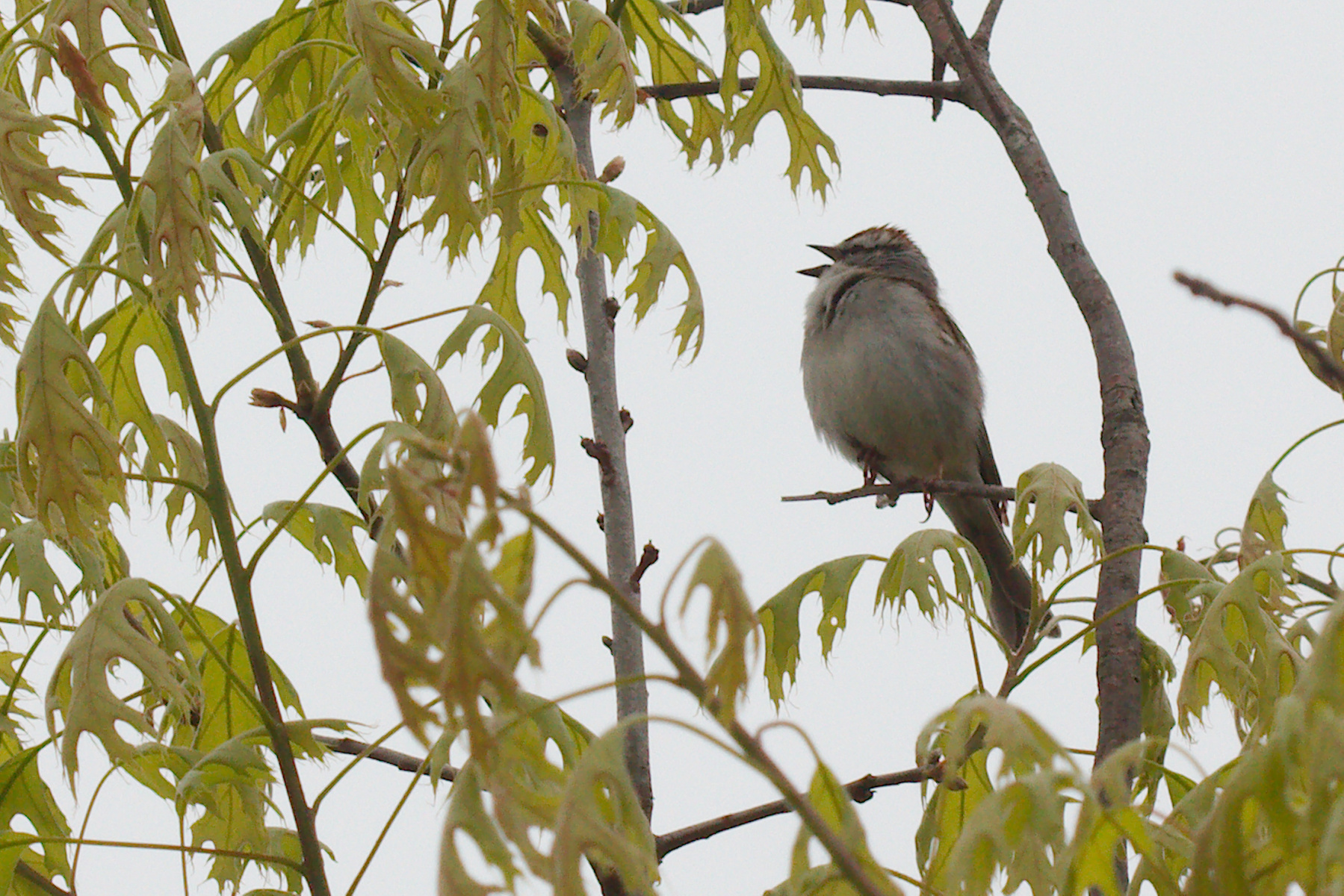
I dropped Dorothy off at school today for one of her finals (AP Literature, I think) and went in to visit briefly with a few of my friends in the lower school and office. On the way back to the car I heard a high-pitched chirping coming from the top of a small oak tree next to my van. This is the source, sitting high in the tree. I wasn’t sure what it was, partly because of the angle from which I was seeing it but mostly because I don’t know my birds nearly as well as I might. So, I did what any self-respecting person would do, I asked my brothers. Albert and George both thought it looked like a chipping sparrow (the dark line through the eye) and Albert asked if the song sounded like those presented at the All About Birds page for the chipping sparrow. Indeed it did. Quite recognizably.
Creatures
Narceus americanus (American giant millipede)
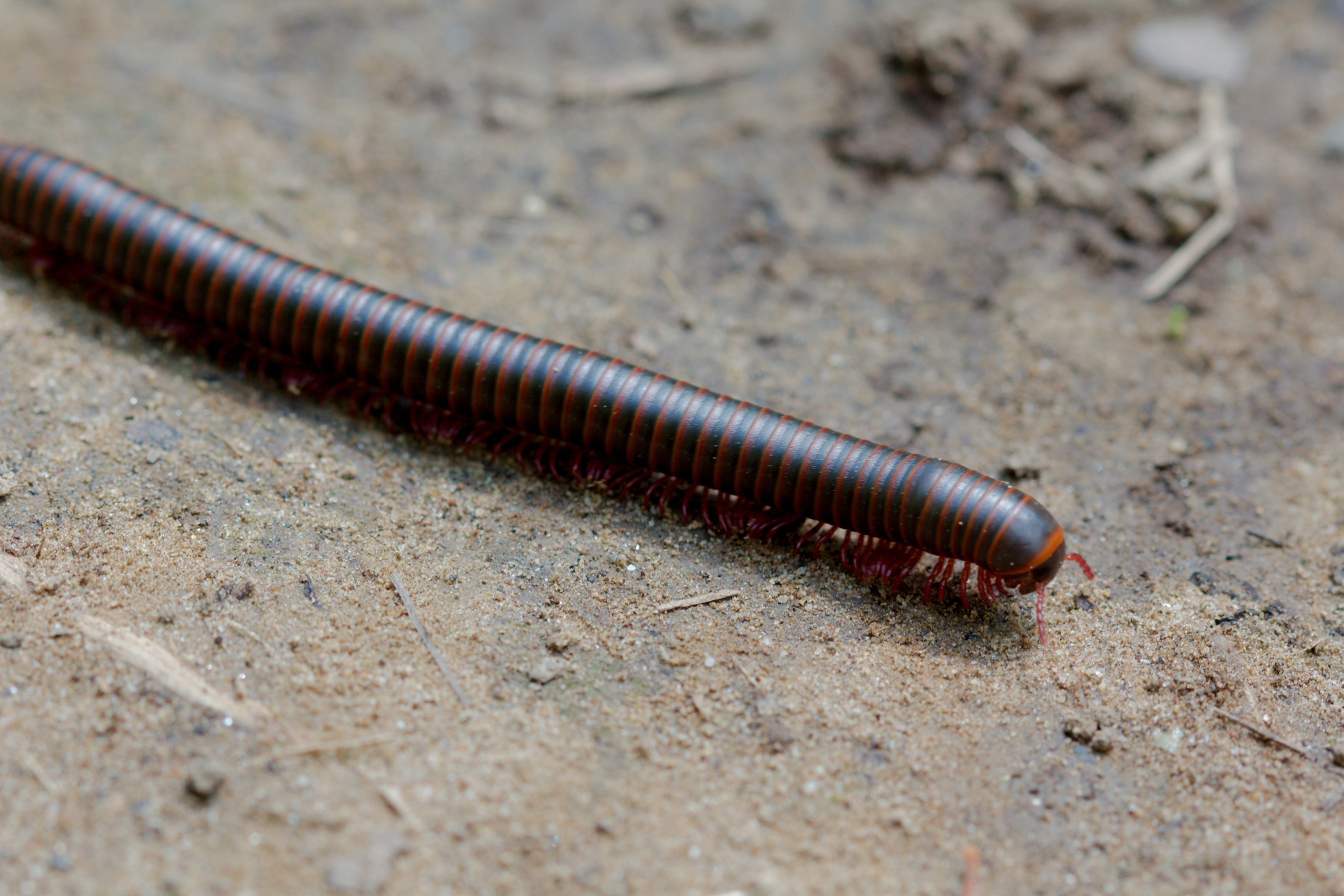
I thought I’d post a second photograph from our walk on the Billy Goat Trail. This is an American giant millipede (Narceus americanus, also called an iron worm) and it really is quite large, about four inches long. We saw a few of them and they are fairly common.
These millipedes do not have venomous stingers or fangs and are not dangerous to humans. They can secrete bad-smelling and bad-tasting chemicals from pores in the sides of their bodies. These chemicals help keep many predators away.
Easter Flashback
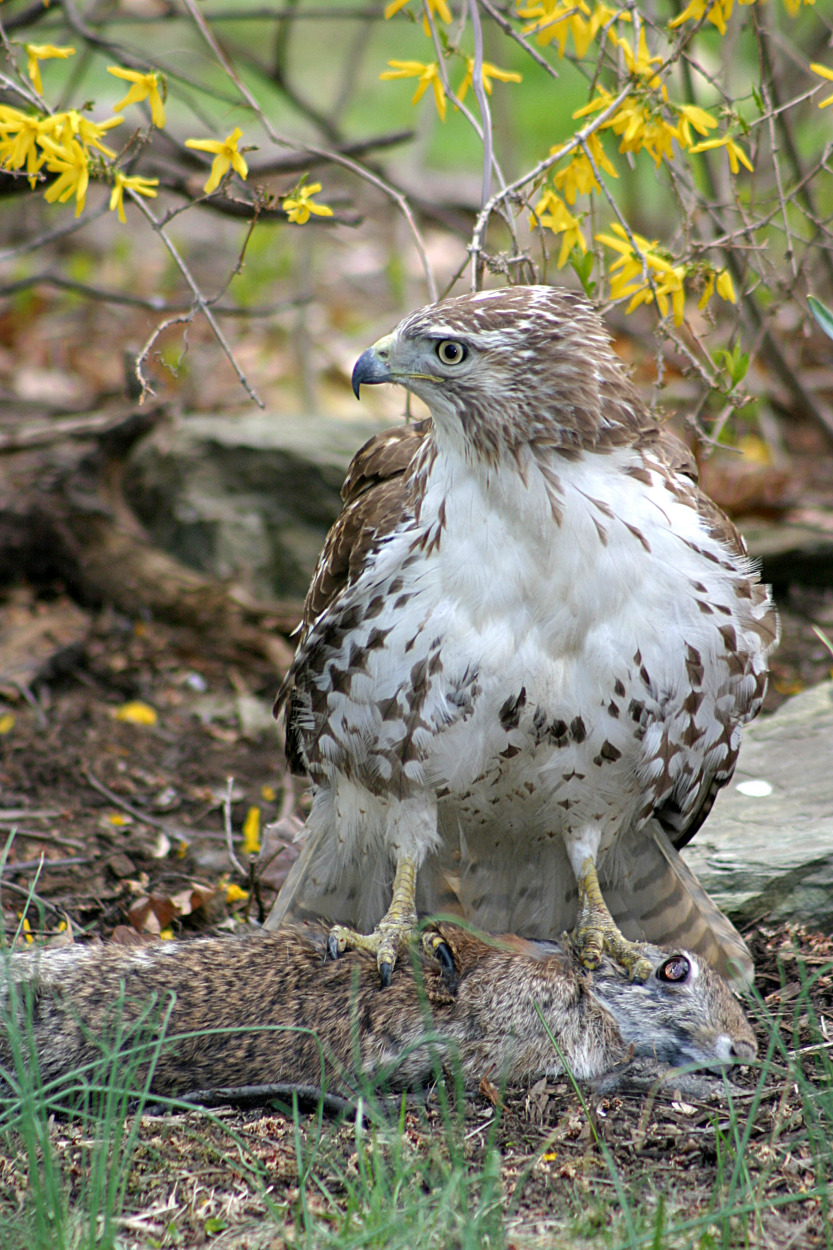
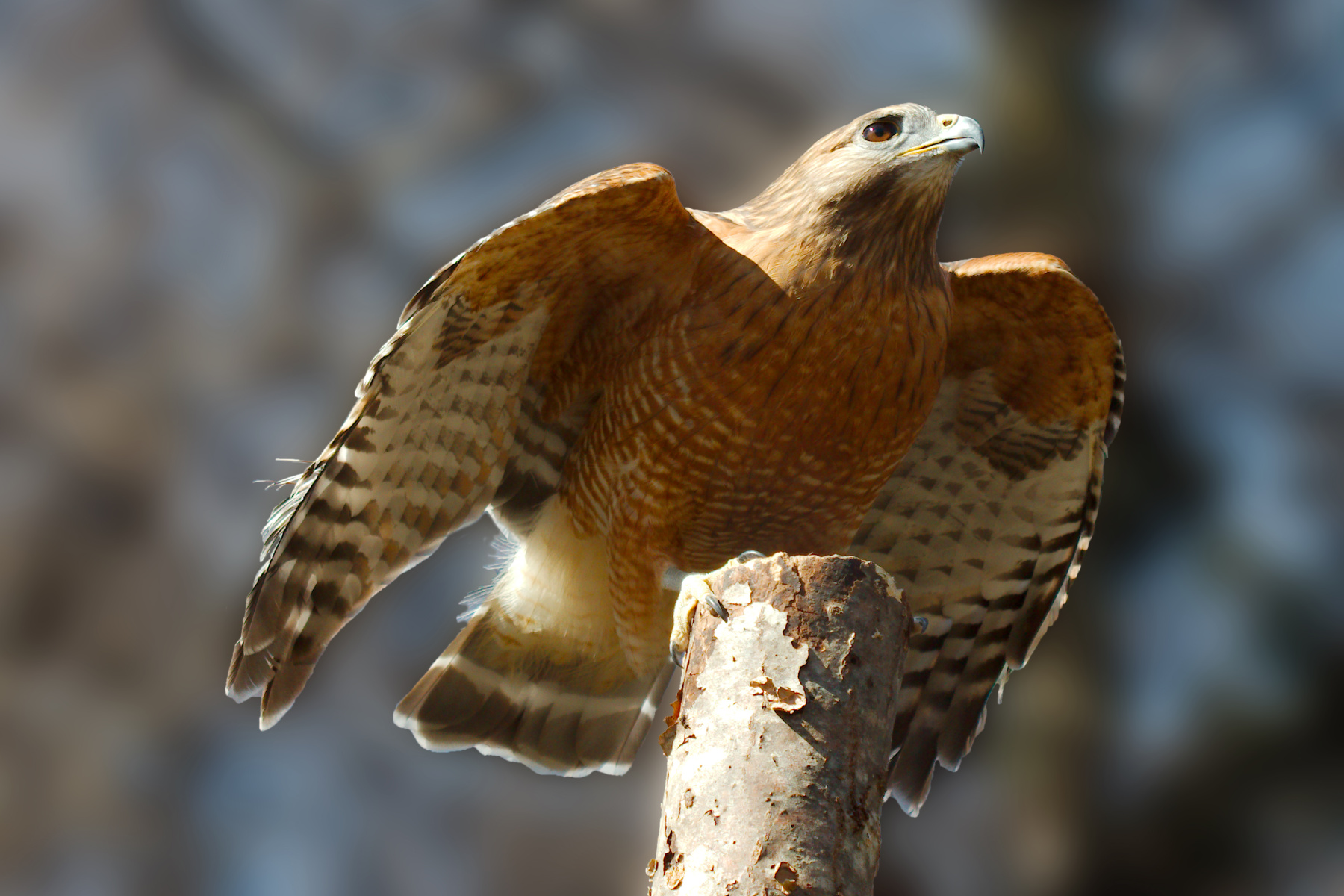
This is an Easter picture that I took seven years ago, on April 8, 2007. We were at my in-laws’ house and had eaten our meal. At about 4:10, Cathy and Dorothy were in the yard when they heard a scream. It was clearly not human but they didn’t know, at first, what it was. When they saw that a hawk had attacked a rabbit, Dorothy came running into the house to get me. She said that she and her mom wanted me to do something. I’m not sure what, precisely, they wanted me to do but I’m pretty sure taking pictures was not it. That’s what I did, though. Did they really expect me to do anything else?
I took 85 pictures before the hawk flew away. When I first went out the rabbit had stopped making noises but was still alive. It’s fate was sealed, however, and I wasn’t going to deprive the hawk of its meal simply because it happened to pick the Easter bunny for its menu.
Meandering Stream
It was a cool day today but not really cold. I took a break shortly after noon and went out into the empty lot next to my office building. I say empty lot but really it isn’t empty, it simply hasn’t been built on. There are trees, shrubs, woody and herbaceous perennials, and annuals in abundance. There are also animals, although mostly I see birds and (especially later in the year) insects and spiders. It’s clear that there are deer there and I’ve seen them on rare occasions.
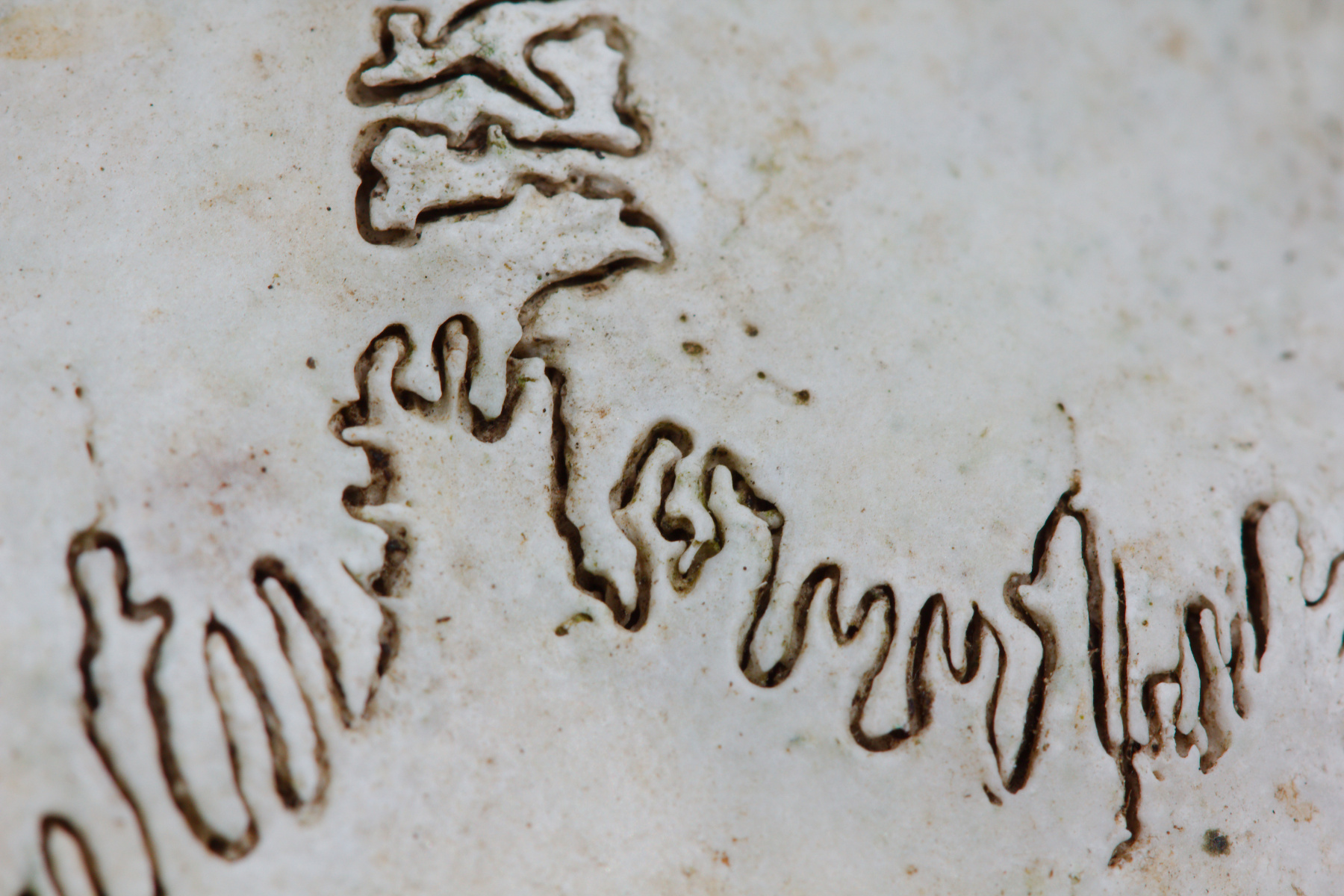
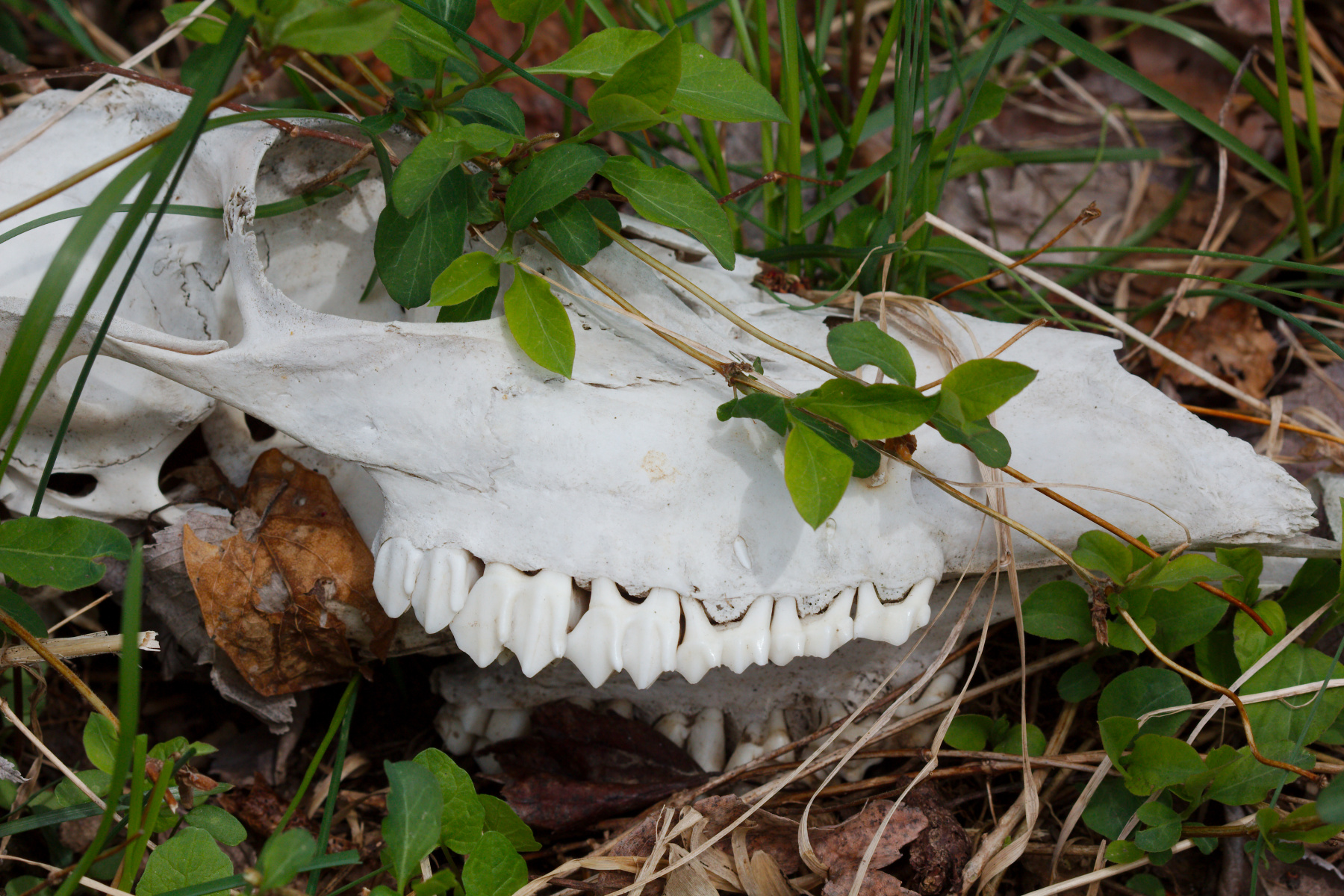
I came across one today, or what was left of one. There were a few leg bones and then I found the skull, half buried under some Japanese honeysuckle. The first picture if of the top of the deer’s skull, showing the intersection of the Coronal and Sagittal Sutures, where the frontal and two parietal bones all come together. It looks to me like a river, meandering through an arid waste. Or maybe not. The second picture shows the skull, as I found it.
A Boy and His Bee
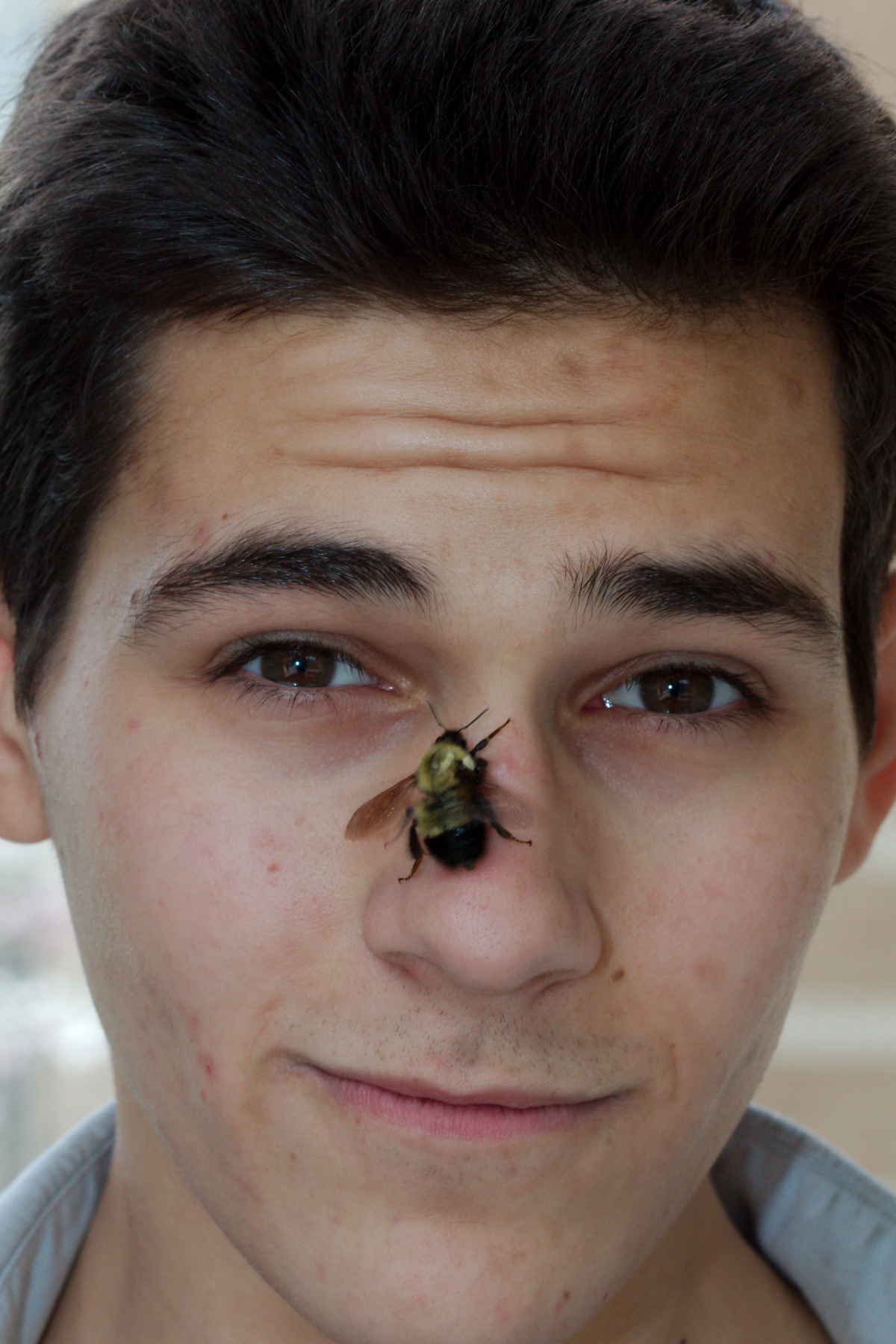
I believe that this is either Bombus pensylvanicus (the American Bumble Bee) or Bombus auricomus (the Black-and-gold Bumble Bee). Either way, it was a friendly sort of fellow. My assumption is that this was a male, because the males cannot sting, and this one was not even trying. He didn’t seem able to fly, really, either. He seems determined to get up into Judah’s hair, and he had to be moved back onto Judah’s nose a few times.
Those of you freaked out by the thought of a bee walking on your face, I understand, believe me. But most insects, even bees, are really not all that dangerous. Some, like some hornets and wasps, need to be avoided or at the very least not aggravated. Taking pictures of them, though, is usually safe enough if you don’t move too quickly and don’t try to touch them (like Judah was clearly doing here).
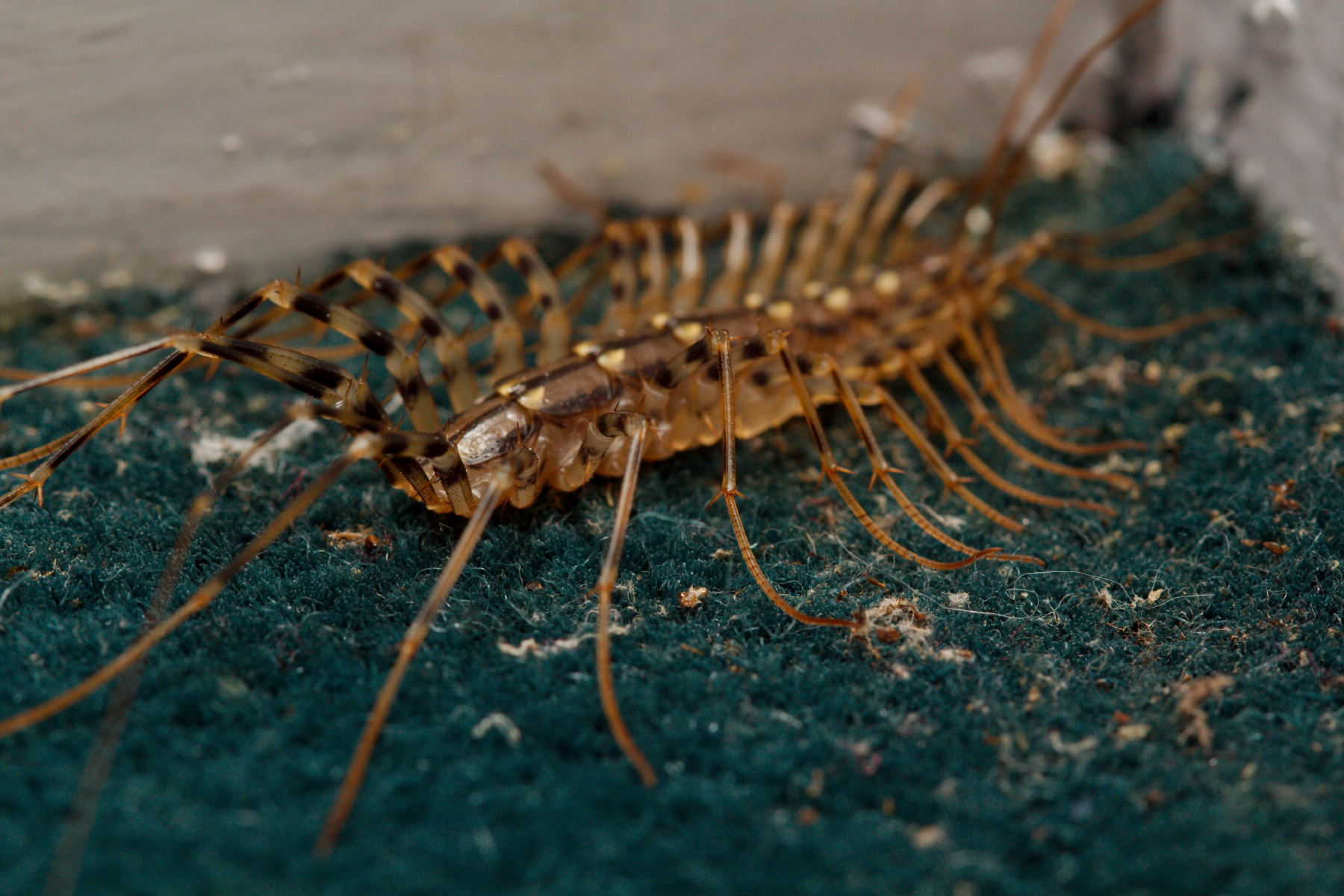
Scutigera coleoptrata (House Centipede)
I’ve seen these fairly often but I don’t think I’ve had the opportunity to get a good picture before this evening. This is in the corner of a room and she is facing into the corner (having a “time out” I suspect). While this isn’t in our house, I have seen them there, as well. If your first impulse is to squash these when you see them, you should know that they eat pretty much exclusively things that you probably want around the house even less: cockroach nymphs, flies, moths, bedbugs, crickets, silverfish, earwigs, and small spiders.
Eastern Towhee (Pipilo erythrophthalmus)
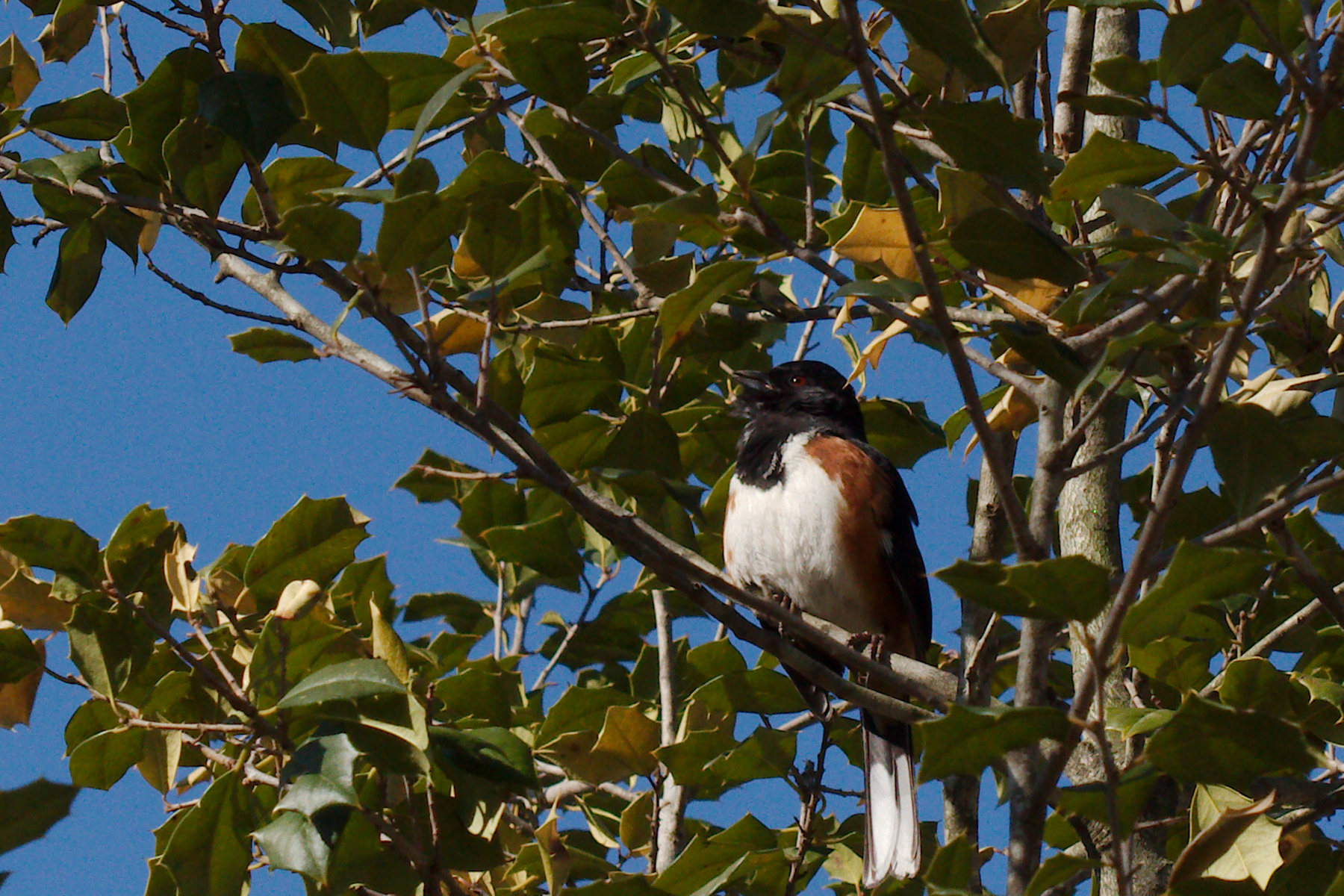
As I walked out to the car this morning I heard a very happy sounding bird chirping at the top of the holly tree in our front yard. He was right up at the very top, happily calling out, “drink your teeeeea.” I was happy to have him stay where he was long enough for me to get a few pictures, even though at this low angle, it isn’t as good a picture as I’d like. The Eastern Towhee was, until recently, called the Rufous-sided Towhee and what is now called the Spotted Towhee was considered to be the same species. If you have an older bird guide, that’s where you will find this fine fellow.
The Foxes are Back
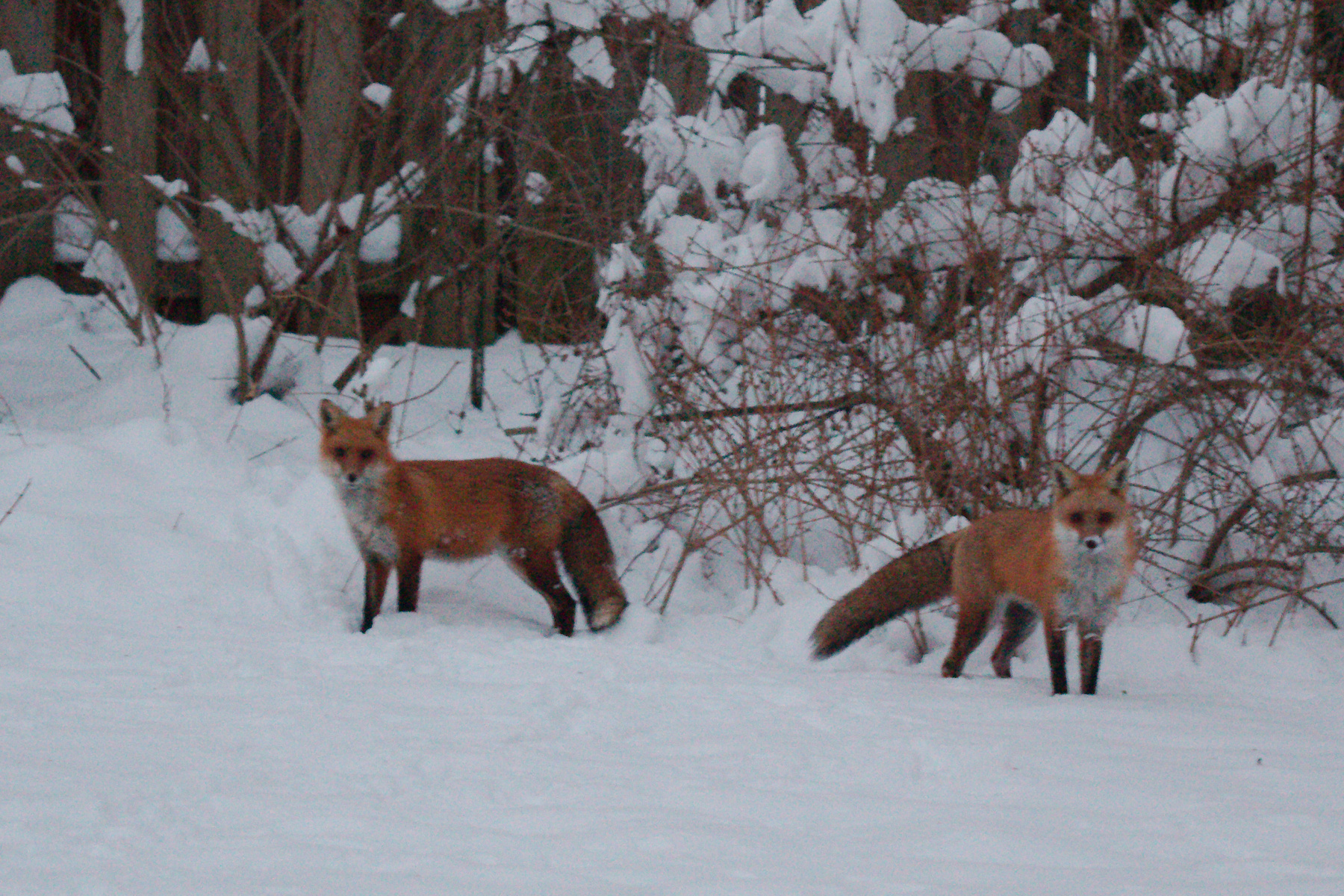
The foxes were back this morning, cavorting in the snow. The back yard is filled with their tracks. It was still fairly dim light so I took this at ISO 3,200 and it was still a 1/15 of a second, which explains the softness of this picture. This was the second of three pictures I got of them. After the first one, they stopped and turned towards me. So, even through the glass of our kitchen door they heard the camera and it alerted them to my presence. After that they left for the day.
White-throated Sparrow
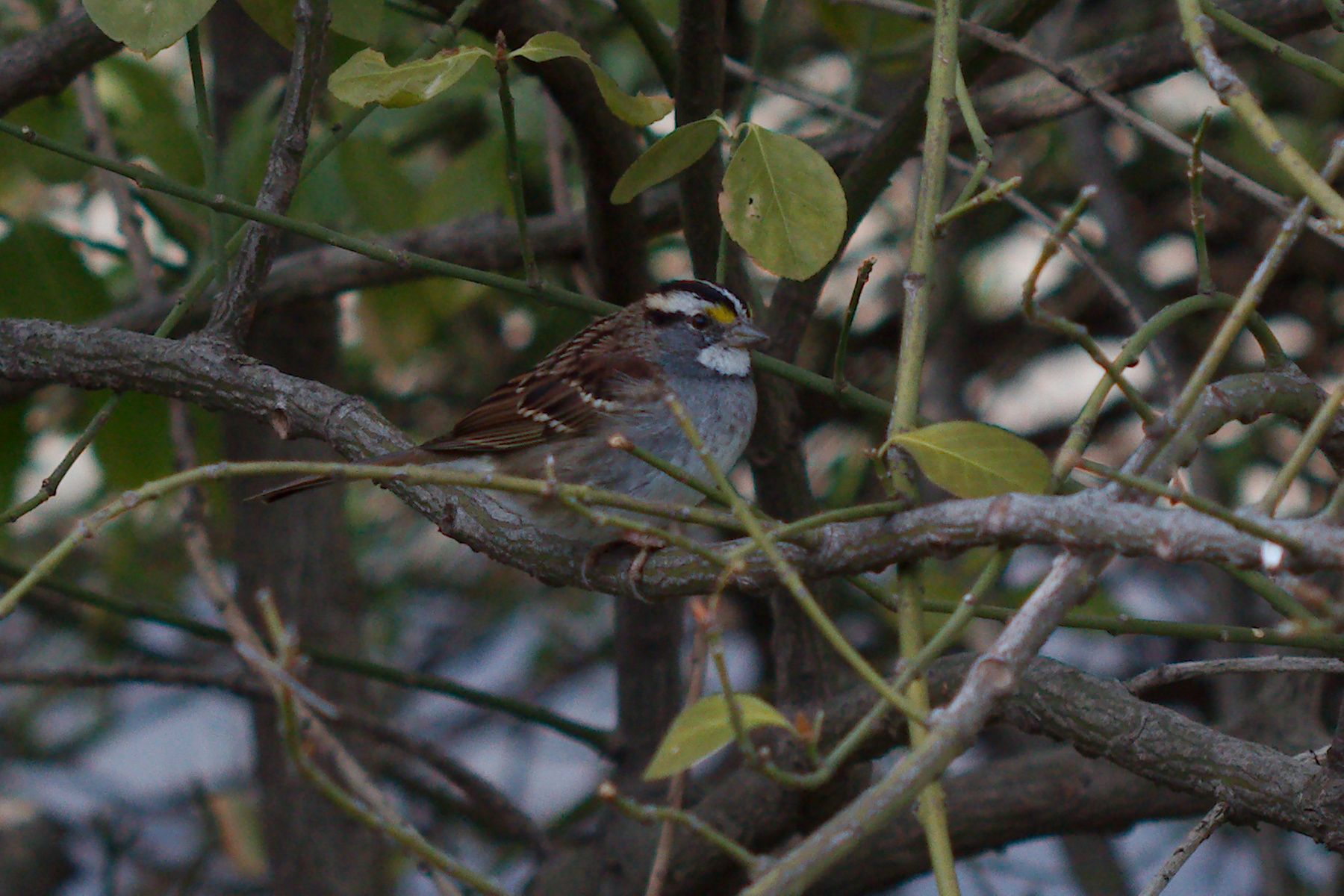
The snow is basically all gone. There are batches in shadier spots and wherever it was piled when shoveling or plowing but the lawn is basically clear of it. Yesterday there was standing water in parts of the yard but now most of that has drained or soaked into the already waterlogged soil. It’s still quite wet out, but that’s normal and good this time of year. I walked around the yard looking for things to photograph. There are the snow drops but I posted their picture yesterday, so I wanted something else. I was looking at last years fern leaves when this little fellow landed in the hedge and let me take his picture. This is a white-throated sparrow (Zonotrichia albicollis), a friendly winter visitor, probably getting ready to head back to Canada for the summer.
Foxes
Yesterday it was snowing and there was about an inch of new snow on the ground. We looked out the back window and saw two foxes playing in the back yard. I was going to post one of those pictures for yesterday but before getting it posted, today happened. Yesterday the pictures were taken through two panes of glass in an upstairs window with a 100mm lens. Today I had time to go down stairs, switch to the 75-300mm zoom lens, and take the picture through one pane of glass.
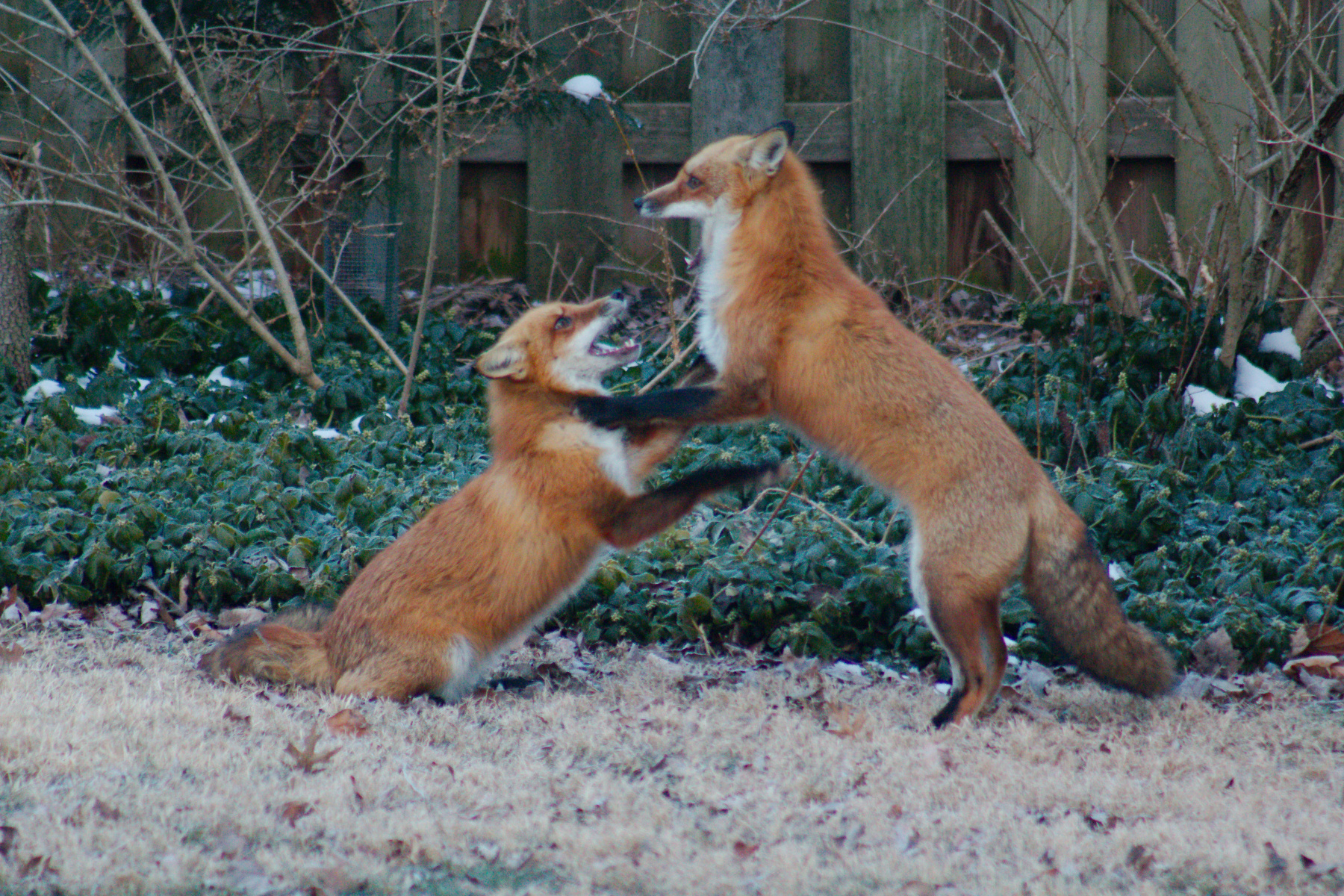
These two foxes are living in the area, obviously, and I couldn’t be more pleased. I’m looking forward to a rabbit free (or at least greatly diminished) spring and summer. That is unless some busybody decides that foxes aren’t safe to have around. Look, I understand that these are wile animals and not pets (or Narnians). But they aren’t going to attack and we aren’t raising chickens. They run away when I even just start to open the back door. Our neighbors have small kids but they also have a dog. The foxes aren’t going to hang around when he’s in the yard. Anyway, for now, I’m enjoying the foxes, long may they prosper. They may look like they are fighting in this picture, but they are playing.
A Walk In The Park
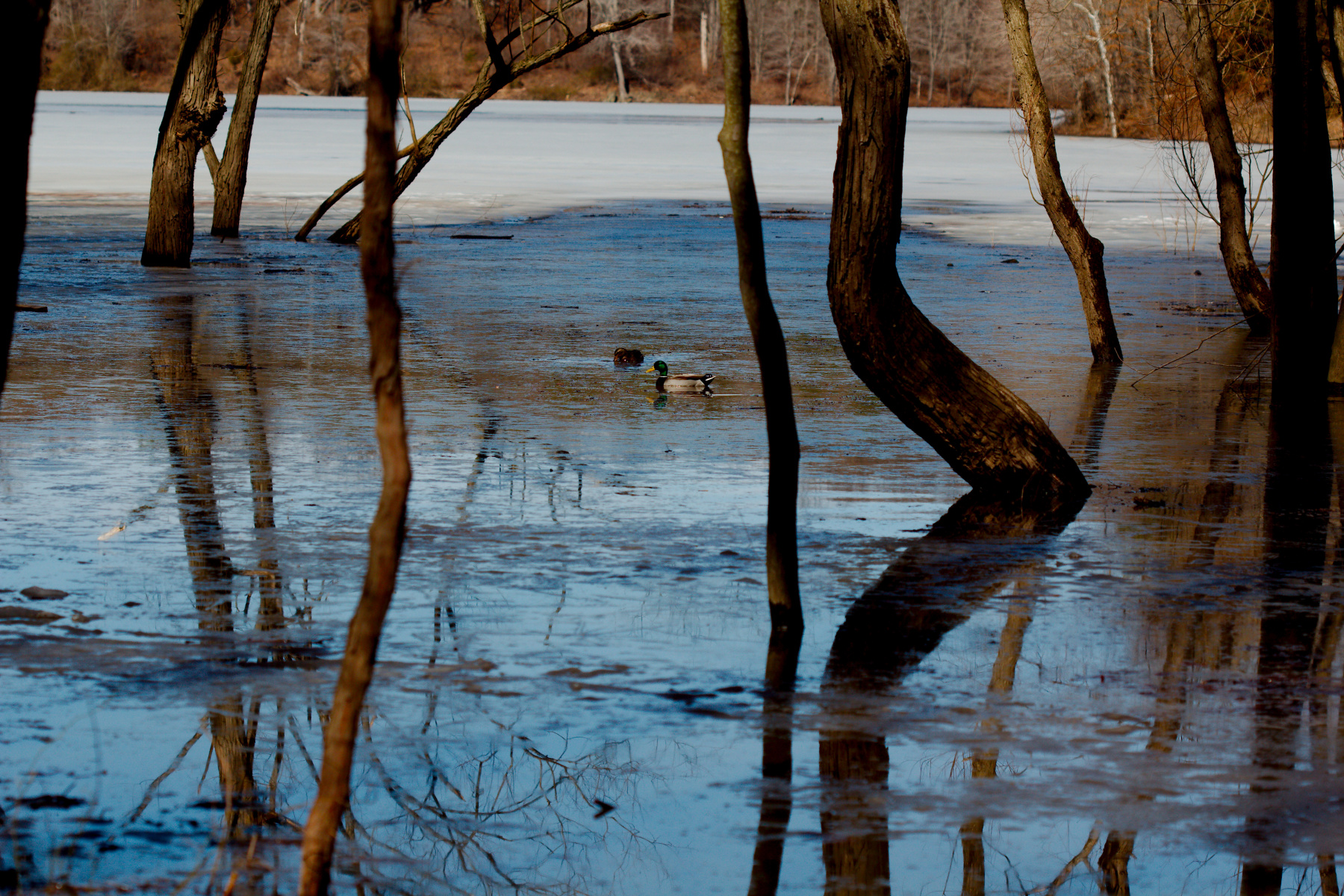
What a beautiful day it was. The sky was mostly a clear blue, it wasn’t too cold, and it was a great day for a walk in the park. Everything is still very wet because the snow is melting and the ground is saturated, so we decided we’d take the paved route to Lake Frank and from there down to the Rock Creek Trail (or at least a spur of it). Well, that was a good idea but the paved route still had ice and snow on it for most of the way, so it wasn’t the easiest walking we could have chosen, but it was nice to get away from traffic and into the woods.
The lake is quite high, as you might expect with the snow melting and the rain we had. As you can see in the first picture, this little arm of the lake is up into the trees where there usually is just a little stream flowing. There is also still a layer of ice on the lake. These two ducks found some open water where it’s still possible for them to swim around a bit.
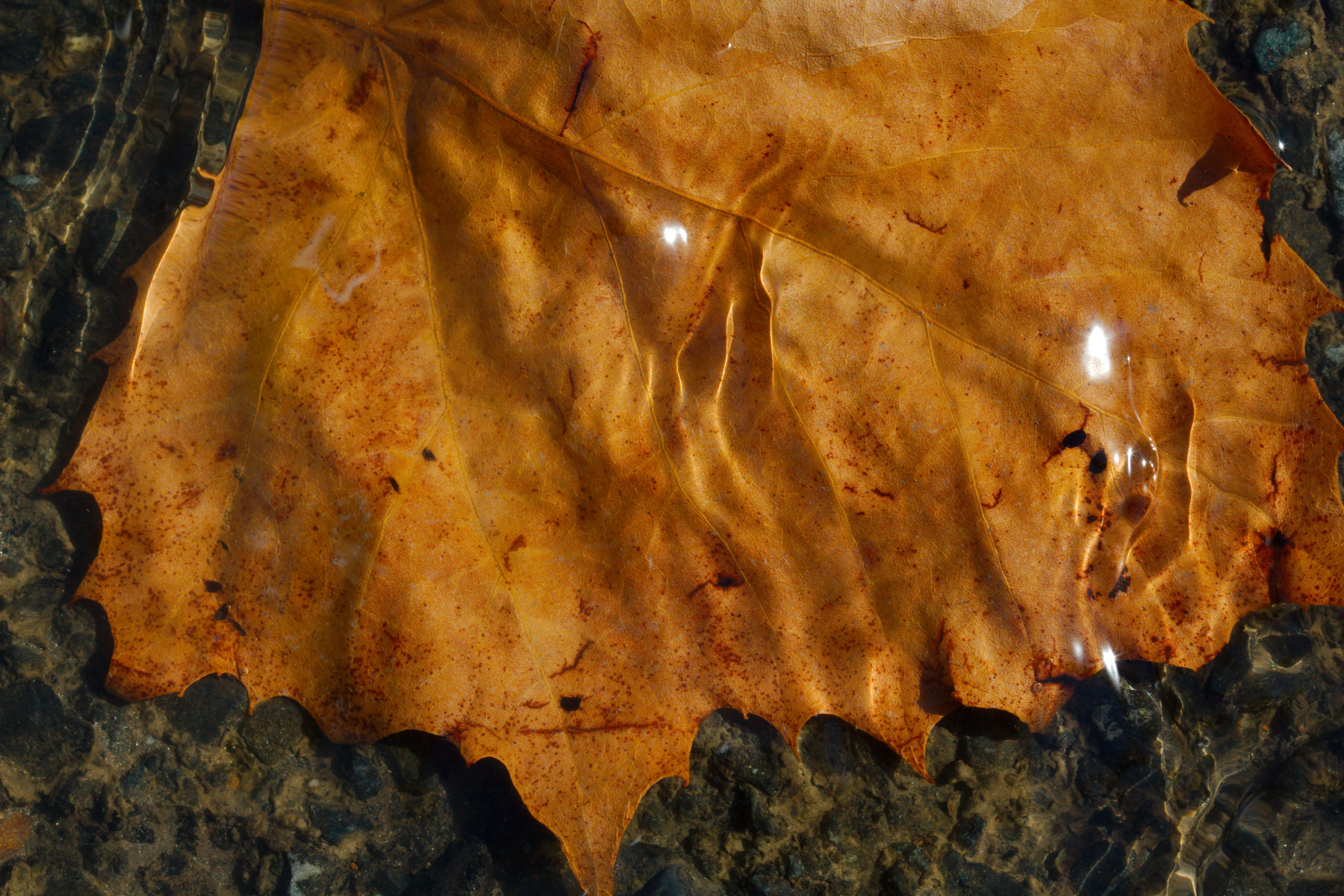
The second picture is of a sycamore leaf with water flowing over it. The water is so clear and makes the leaf look so clean and bright. I just love the texture of the water and of the leaf and the picture makes me happy.
Maymont Park
I thought I’d post a second set of picture for today in addition to those I posted from downtown Richmond. After we walked around a little downtown, we drove out to Maymont. From Wikipedia:
Maymont is a 100 acre Victorian estate and public park in Richmond, Virginia. It contains Maymont Mansion, now a historic house museum, an arboretum, formal gardens, a carriage collection, native wildlife exhibits, a nature center, and Children’s Farm.
In 1893, Major James H. Dooley, a wealthy Richmond lawyer and philanthropist, and his wife, Sallie, completed their elaborate Gilded Age estate on a site high above the James River. According to their wishes, after their deaths Maymont was left to the people of Richmond. Over the next 75 years, additional attractions were added.
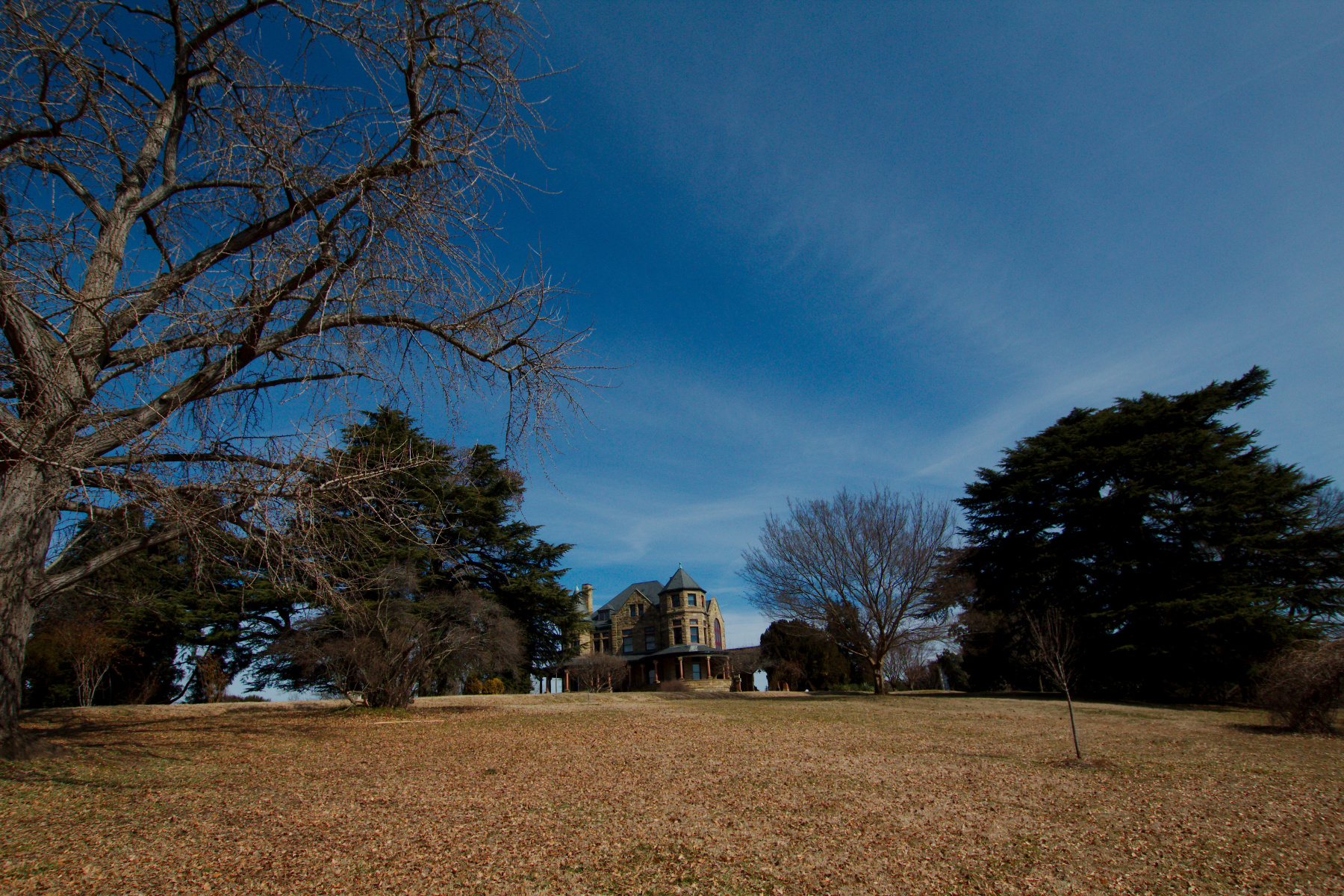
The first picture here is the mansion, up on the bluff overlooking the James River (as mentioned in Wikipedia). It really is beautifully situated and it’s a remarkably nice park. Many of the attractions are closed on Mondays, so we were not able to go into the mansion, for instance, but the grounds are open daily and that was enough for us.
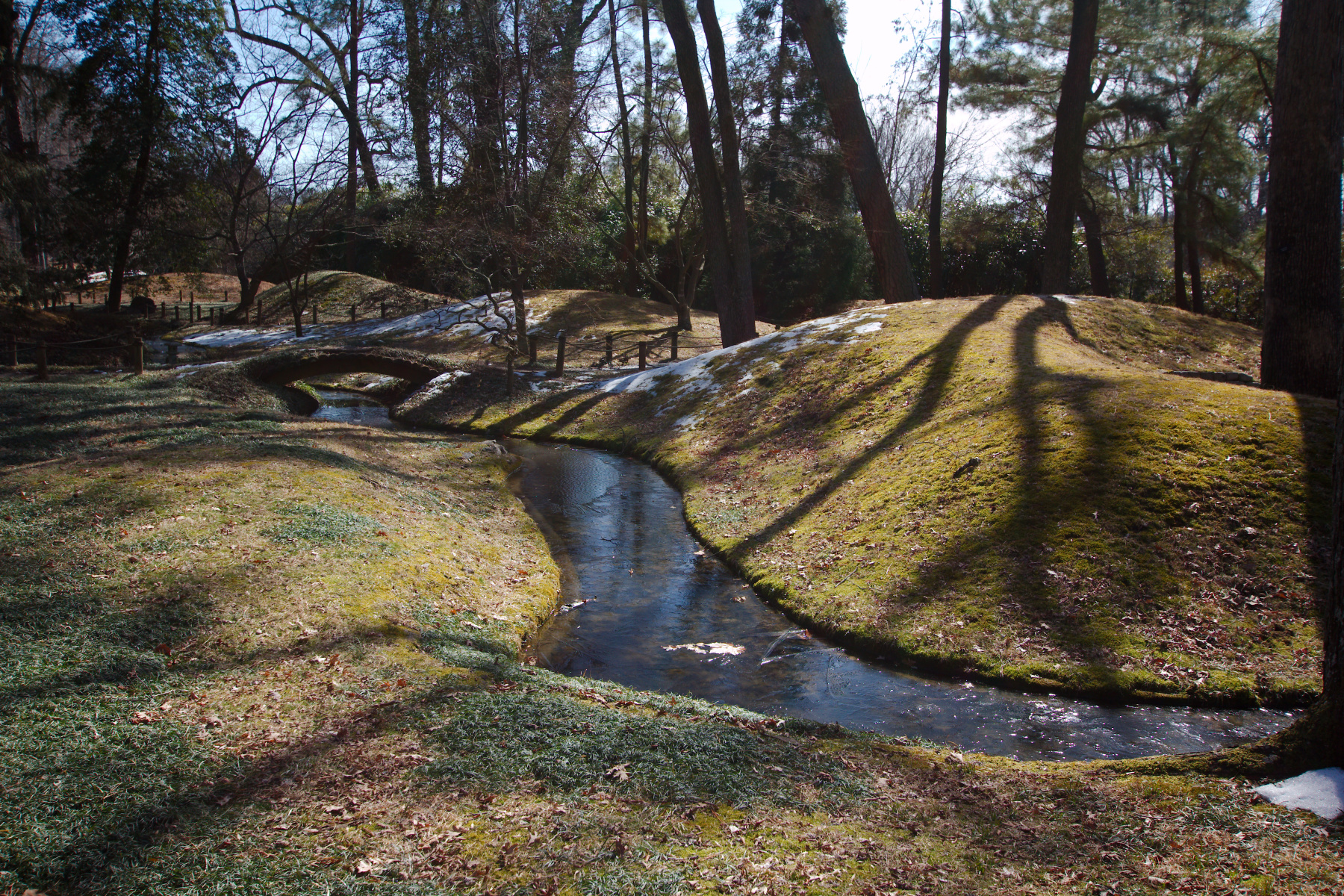
We started by walking down past most of the animal exhibits to the Japanese garden. While this can’t be the best time of year to see the garden, we really enjoyed it and would recommend it highly. The only thing to keep in mind is that if you visit in the summer, when it is quite hot, getting from the Japanese garden back to the parking area is going to be a lot more tiring. There is a tram that runs, which would take care of that, but again, not on Mondays.
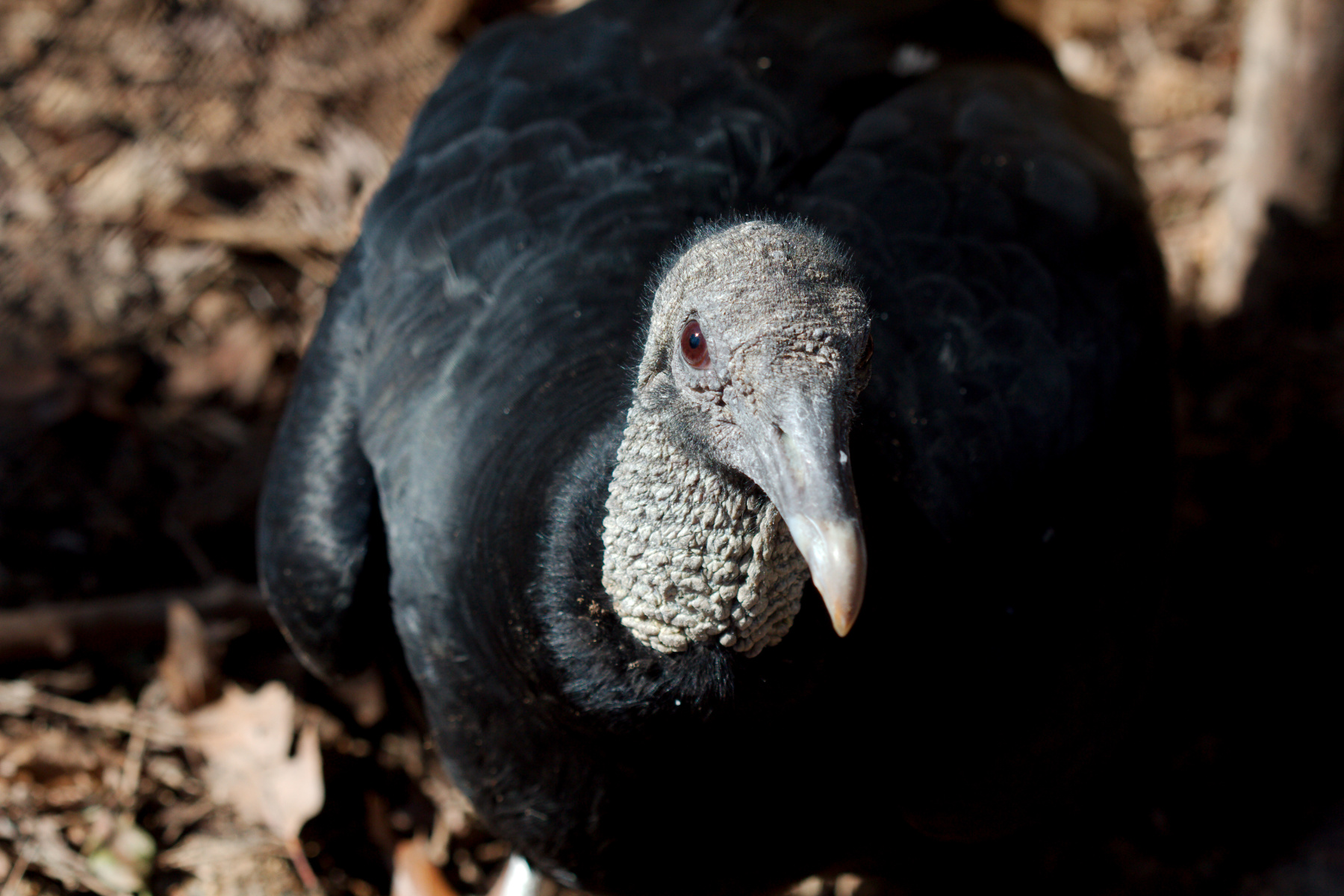
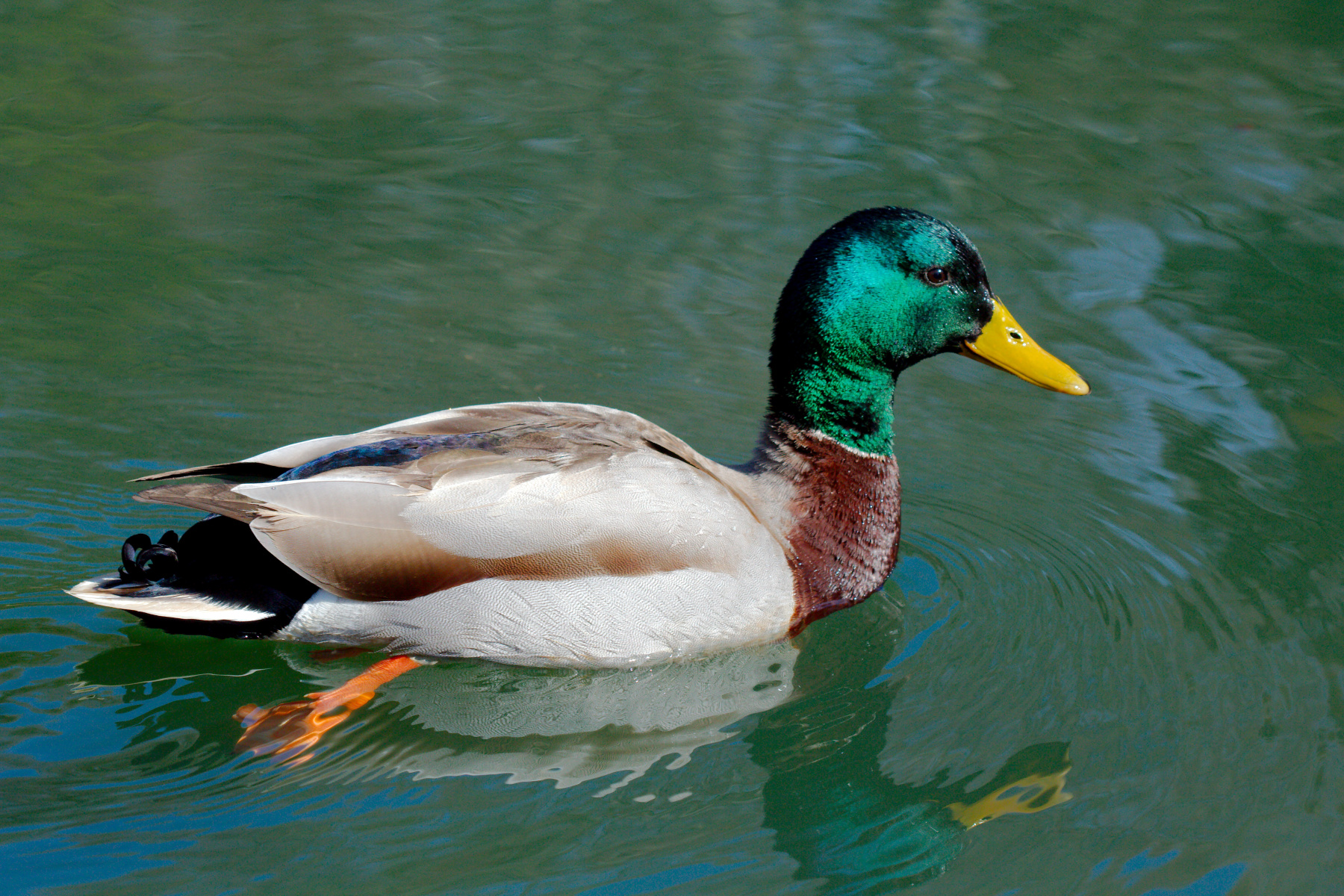
The other three pictures are of birds (obviously). The first two are in aviaries, the third was a wild mallard on one of the ponds in the Japanese garden. I also enjoyed the collection of trees on the property, including quite a few very large Lebanon cedars (Cedrus libani) and some pretty impressive bald cypress (Taxodium distichum). My favorite two tress, however, were a golden Hinoki cypress (Chamaecyparis obtusa ‘Tetragona Aurea’) and a very large incense cedar (Calocedrus decurrens). I have three of the later planted along the fence in my back yard and it was nice to see such a big version of what they can become.

Downy Woodpecker (Picoides pubescens)
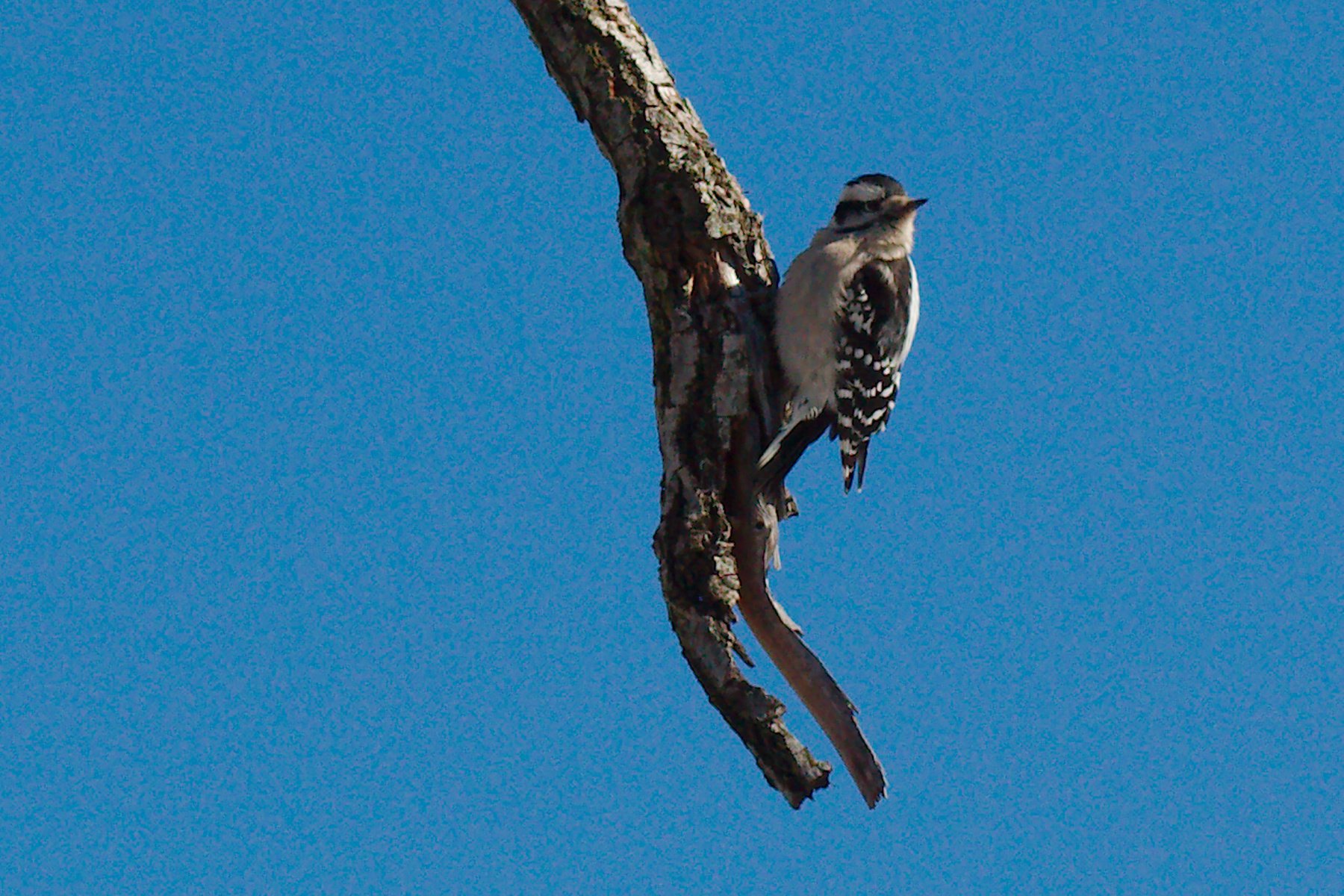
It was a little chilly out today but I went out for a bit because the snow was so pretty. I walked around my office building, looking for things to take pictures of. At one point I heard a tap, tap, tap sound and looked up to see this little downy woodpecker on a dead branch hanging on a tree. She was quite busy looking for things living in the branch and most of my pictures aren’t very good. She kept moving around the branch, and of course I was looking up at a fairly steep angle. This one turned out pretty nicely, though, when she looked over her shoulder.
American Robin (Turdus migratorius)
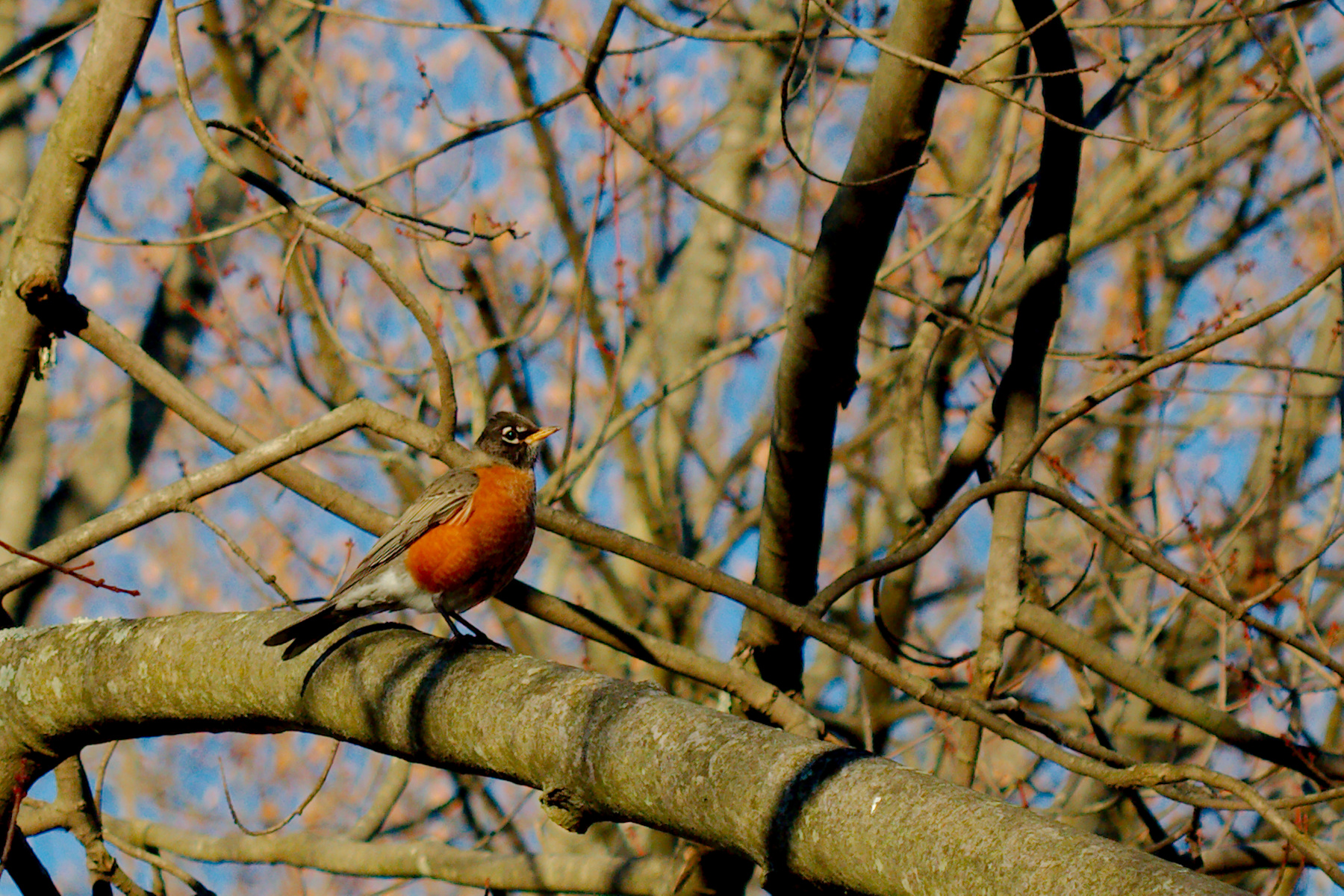
When I was little I thought that the appearance of robins was a sign of spring. They do migrate and that even contributes to their Latin binomial. Turdus migratorius translates as migratory thrush. In our area, however, they are pretty much a year round feature. Those we have now probably travel to the north in summer, to be replaced by their sun-bird relatives coming up from Florida. The American Robin is not to be confused with the smaller, daintier, and in my mind prettier European robin, Erithacus rubecula.
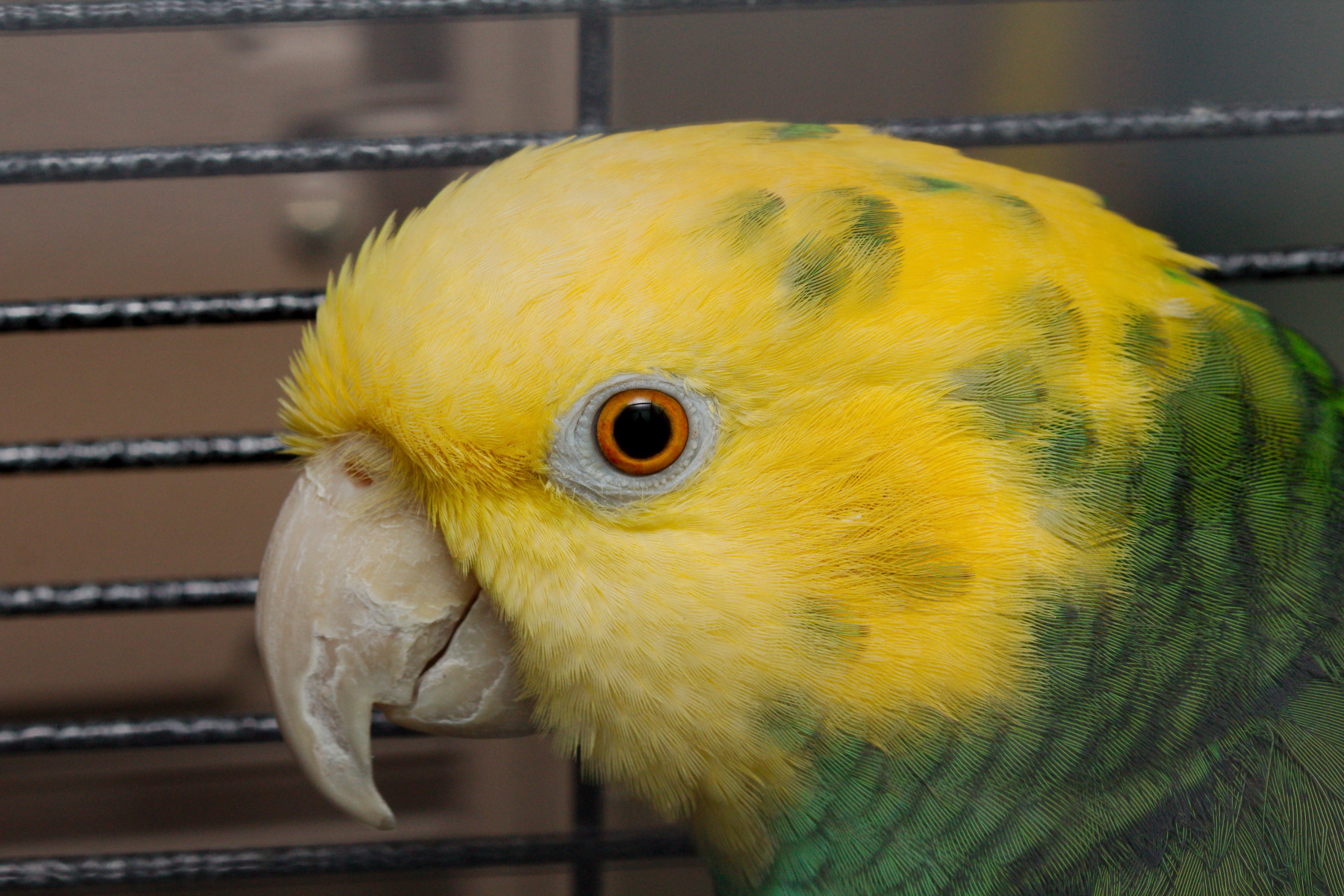
Cæsar
I went over to Cathy’s mom’s this evening to work on her computer. Between doing things I took some pictures of the birds. This one of Caesar was taken through the bars, which is what makes the lower part of the image a little soft. The bars are about 3/4 inches apart, so I can’t just shoot between them. By keeping the depth of field low, I was able to mostly ignore them. I did take a few of Roscoe through the opened cage door, but didn’t risk it with Caesar.
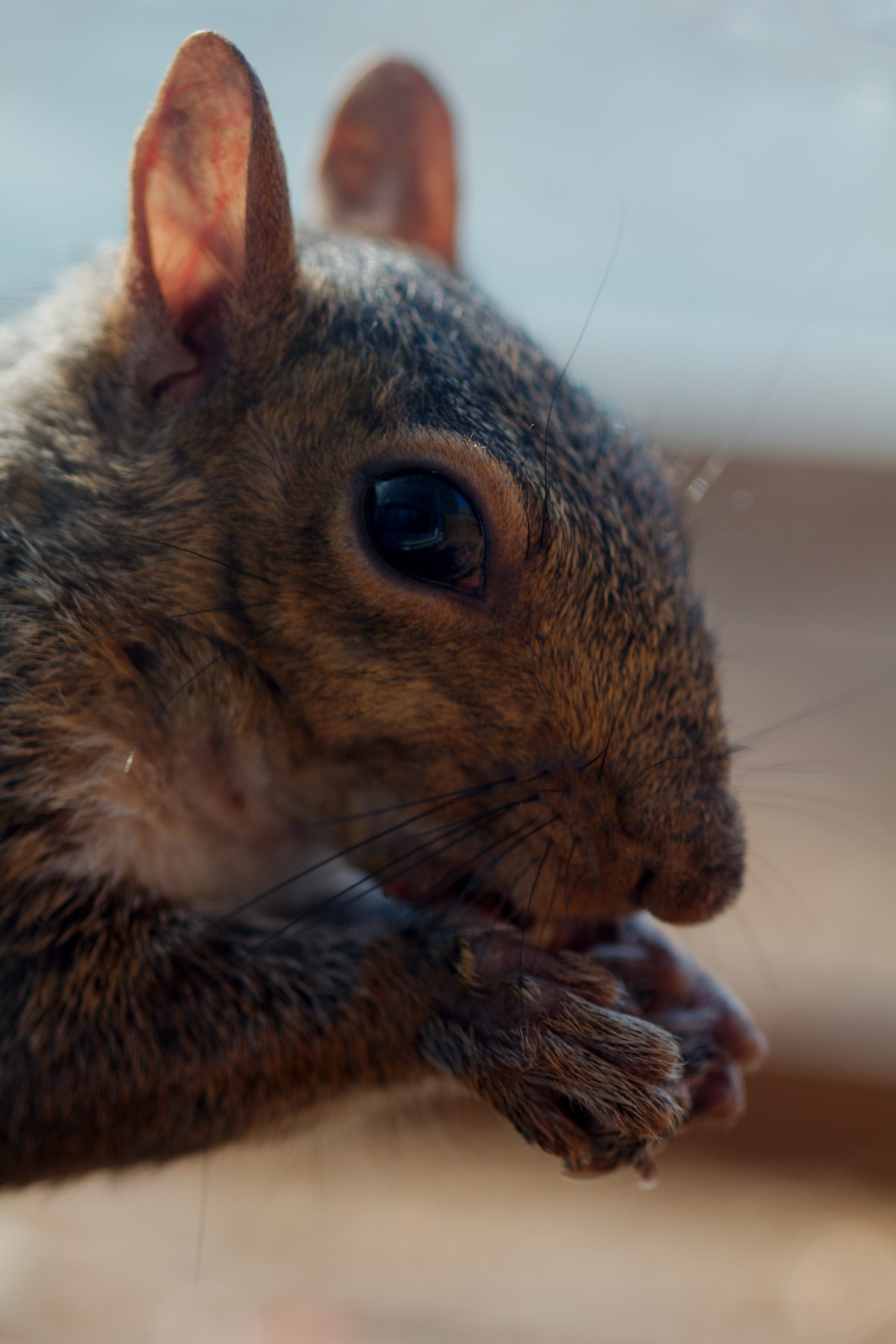
Furry-Tailed Rat
Yes, squirrels are cute. They can be hugely fun to watch. They run around, up and down trees, leaping from branch to branch, and when it comes to getting food, particularly food left out for birds, they are ingenious. We have a bird feeder outside our dining room window. It’s a nice platform feeder with a glass top and really good for feeding birds when there is snow on the ground. Of course, the squirrels know about it and in fact, they end up eating most of whatever is left there. I’ve been meaning to rig up something to discourage the squirrels but haven’t gotten around to it yet. So, this morning I enjoyed watching a squirrel eat a few leftover wasabi peas. Yes, wasabi peas. They had gone a little soft from being left out and without the crunch of the dried pea, they just were not the same. This fellow, however, didn’t seem to mind at all. At least he didn’t actually complain. This is, of course, our own furry-tailed rat, the eastern gray squirrel (Sciurus carolinensis).
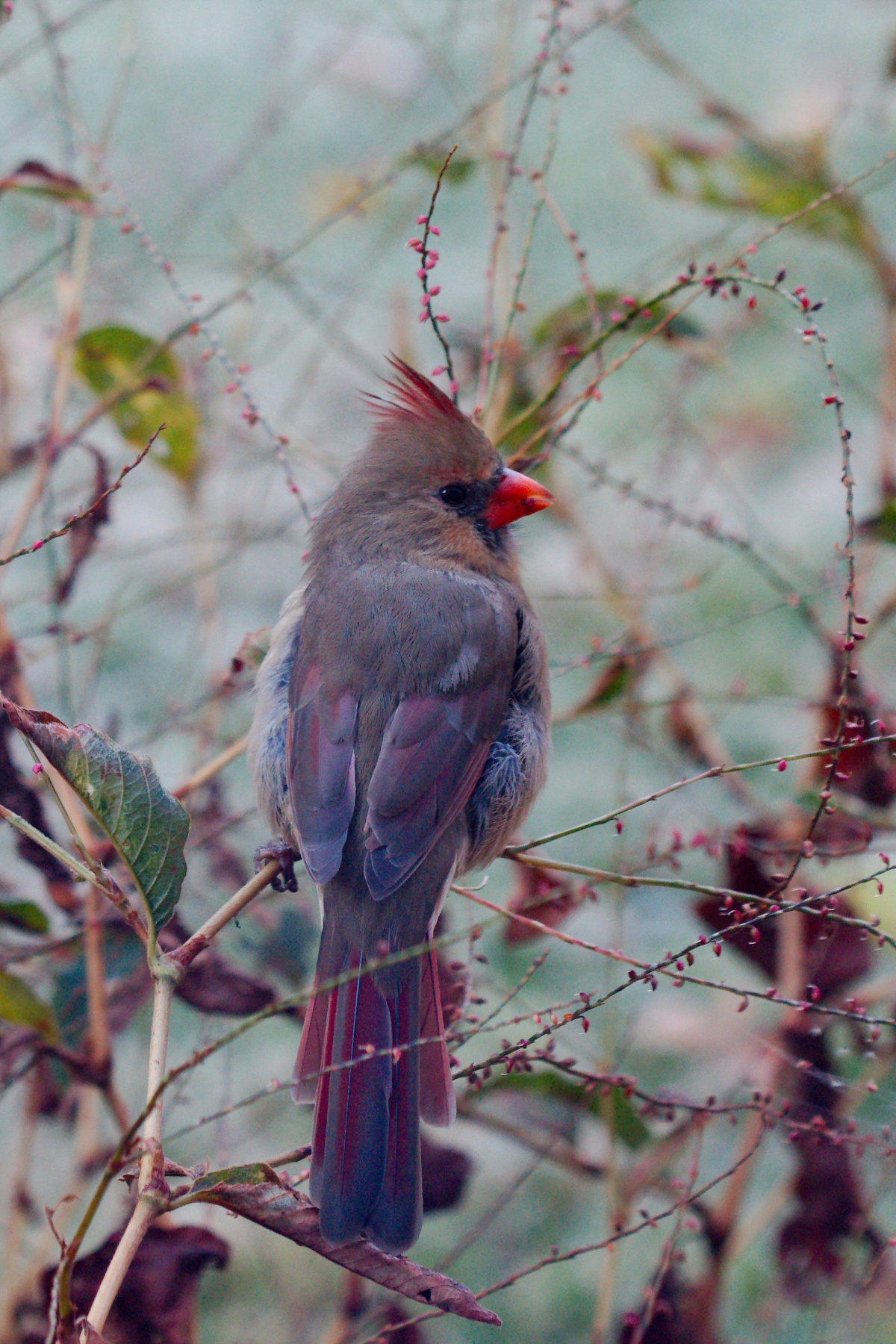
Female Cardinal
Outside our dining room window is a small garden bed that doesn’t get a lot of special care. It’s partially under the eaves so the back is fairly dry but that doesn’t seem to deter the things growing there. We have a clump of maidenhair fern (Adiantum pedatum) that came from our old yard in Gaithersburg and before that from my parents’ house. There is a big clump of blackberry lily (Iris domestica) that blooms wonderfully through the middle of the summer. There is also a huge butterfly bush (Buddleja) seedling that would be nicer if it were not so huge. All the spare space in the bed is taken up by Virginia Knotweed (Persicaria virginiana var. filiformis ‘Painter’s Palette’). That has loads of very tiny red flowers followed by brown seeds (achenes, technically). Apparently, and I didn’t realize this, the birds love the seeds. I’ve noticed cardinals (Cardinalis cardinalis) and white-throated sparrows (Zonotrichia albicollis) on them a few times over the last few days and managed to get a few decent photographs through the dining room window. So far, only the female cardinal has sat high enough in the them to be clearly visible.
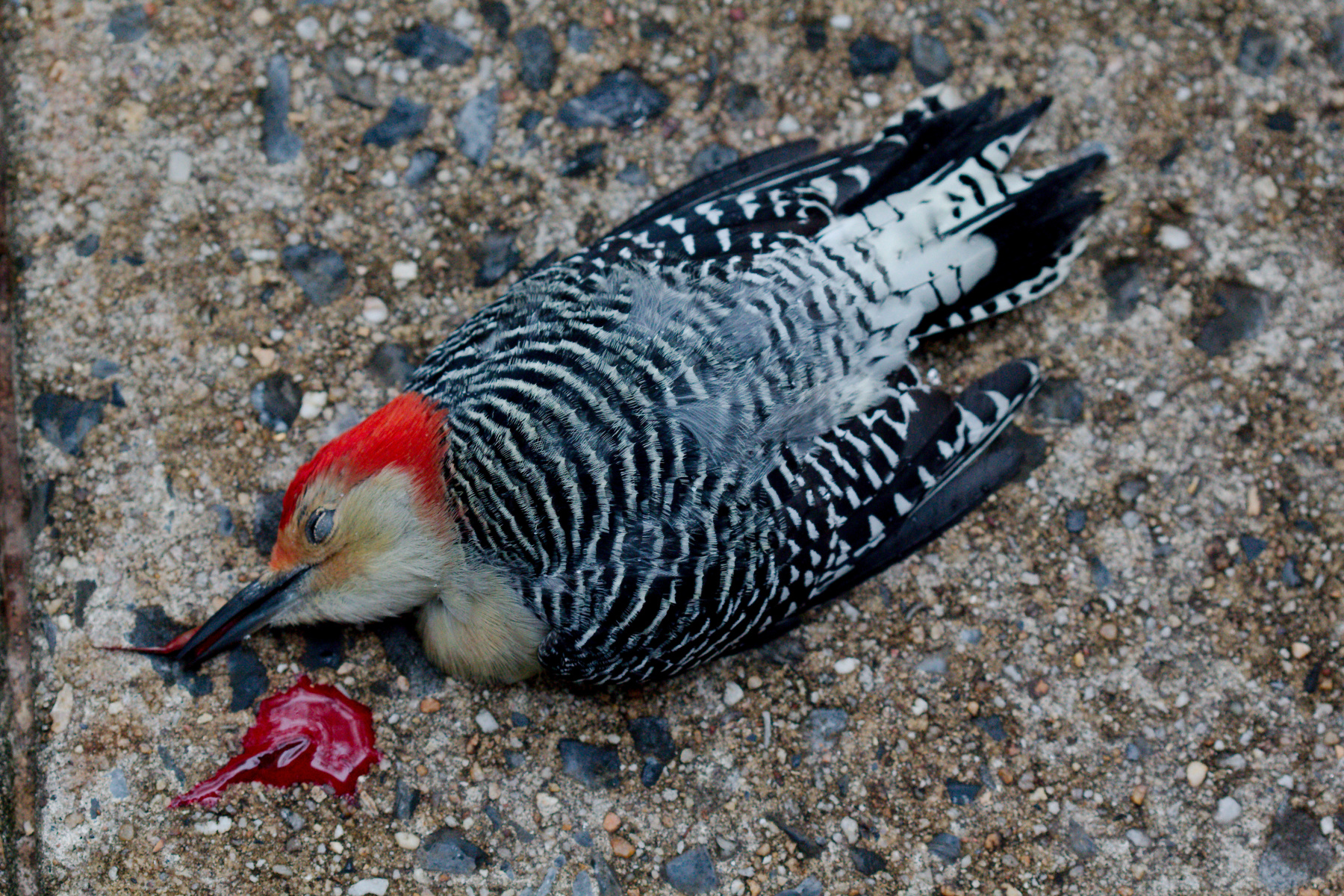
Dead Woodpecker
My apologies to those of you who are a bit squeemish. As I left work today, this is what I found on the sidewalk outside the back of my building. I’ve posted pictures a few times of the mirrored glass on the back of my building — January 31, April 02, and June 20, 2012. I have to assume this fellow (or lass) saw an ideal perch in a tree that was simply a reflection in that glass. I felt sad, of course, but that didn’t stop me from taking a few pictures. Have I been doing this too long, do you thing?
Update: I labeled this as a flicker without really stopping to think. It is, as Albert so quickly pointed out, a red-bellied woodpecker, not a flicker. Thanks, Albert. I hate it when I do that.
Woolly Bear
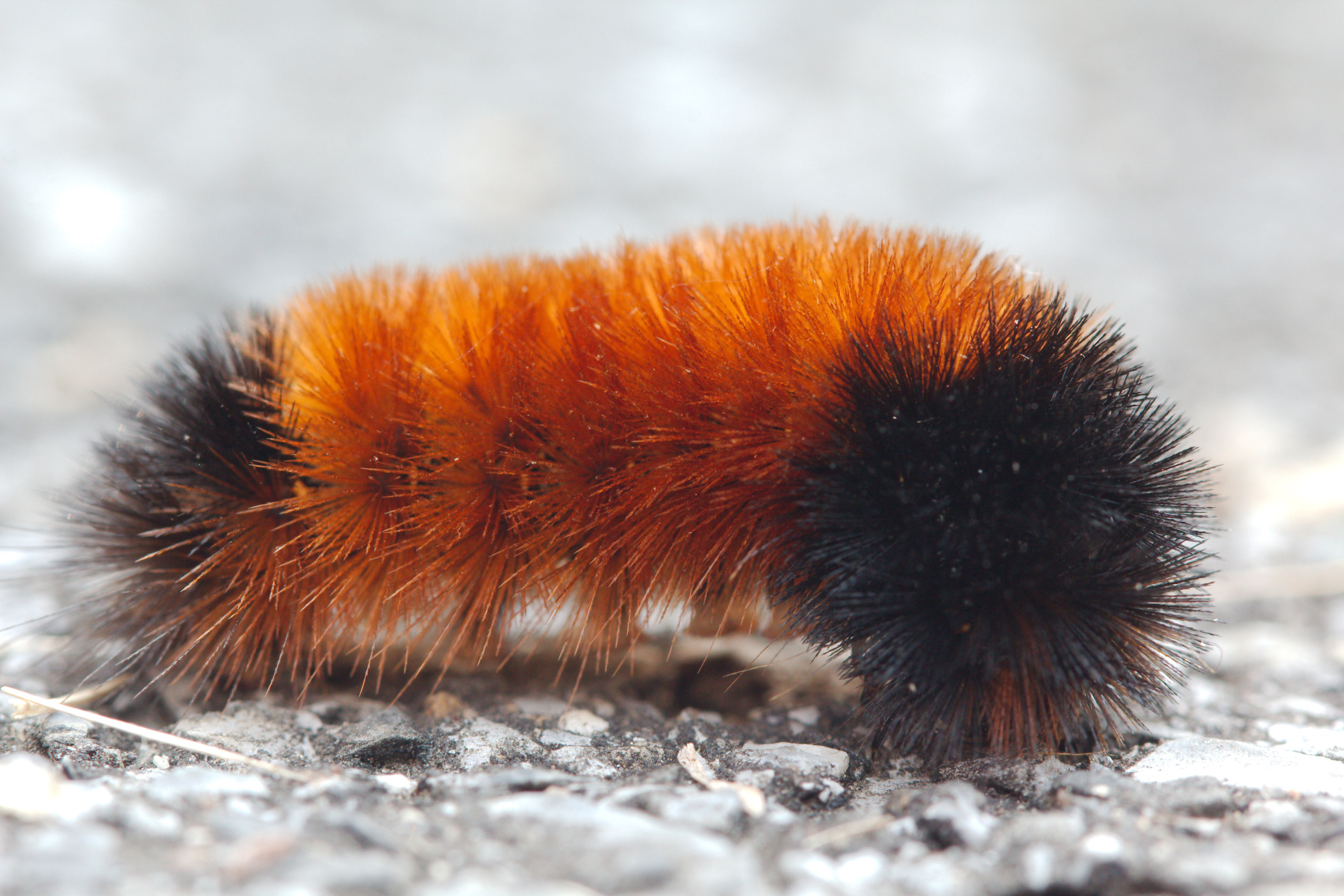
This woolly bear caterpillar was speeding across my driveway this afternoon. I got out my bean bag and got down at his (or her) level to take some pictures. He (or she) was moving so fast that the first few pictures were blurred! Seriously. I touched him and he stopped and played dead for about a minute. I was able to get a few close pictures and then he took off again. The woolly bear is the larva of the Isabella Tiger Moth, Pyrrharctia isabella. According to folk lore, the wide brown strip on this little fellow indicates a mild winter ahead. Of course, what it actually means is that he inherited the trait for a wide brown stripe from his parents.
Solomon Visits Kindergarten
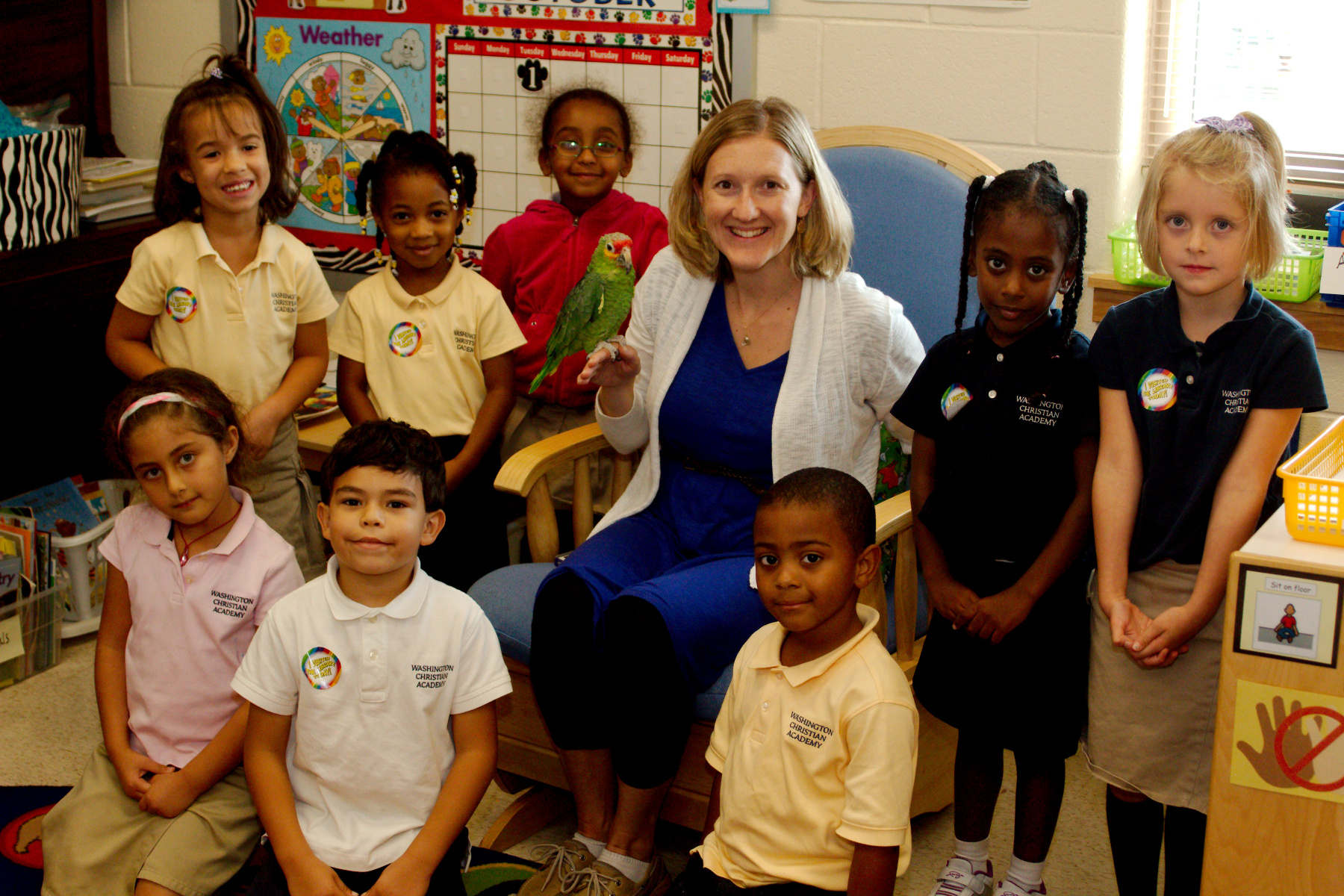
Today, our bird Solomon visited Angie’s kindergarten class for the second time (the first time was on Septermber 25, 2012). This year we got a little bolder and the children each got to pet him on the head. He’s a little shy and you have to approach him in just the right way or he screeches at you, but they were all very good, being quiet and moving slowly. We also took a class picture with all the children, Angie, and Solomon.
Neoscona crucifera (Again)
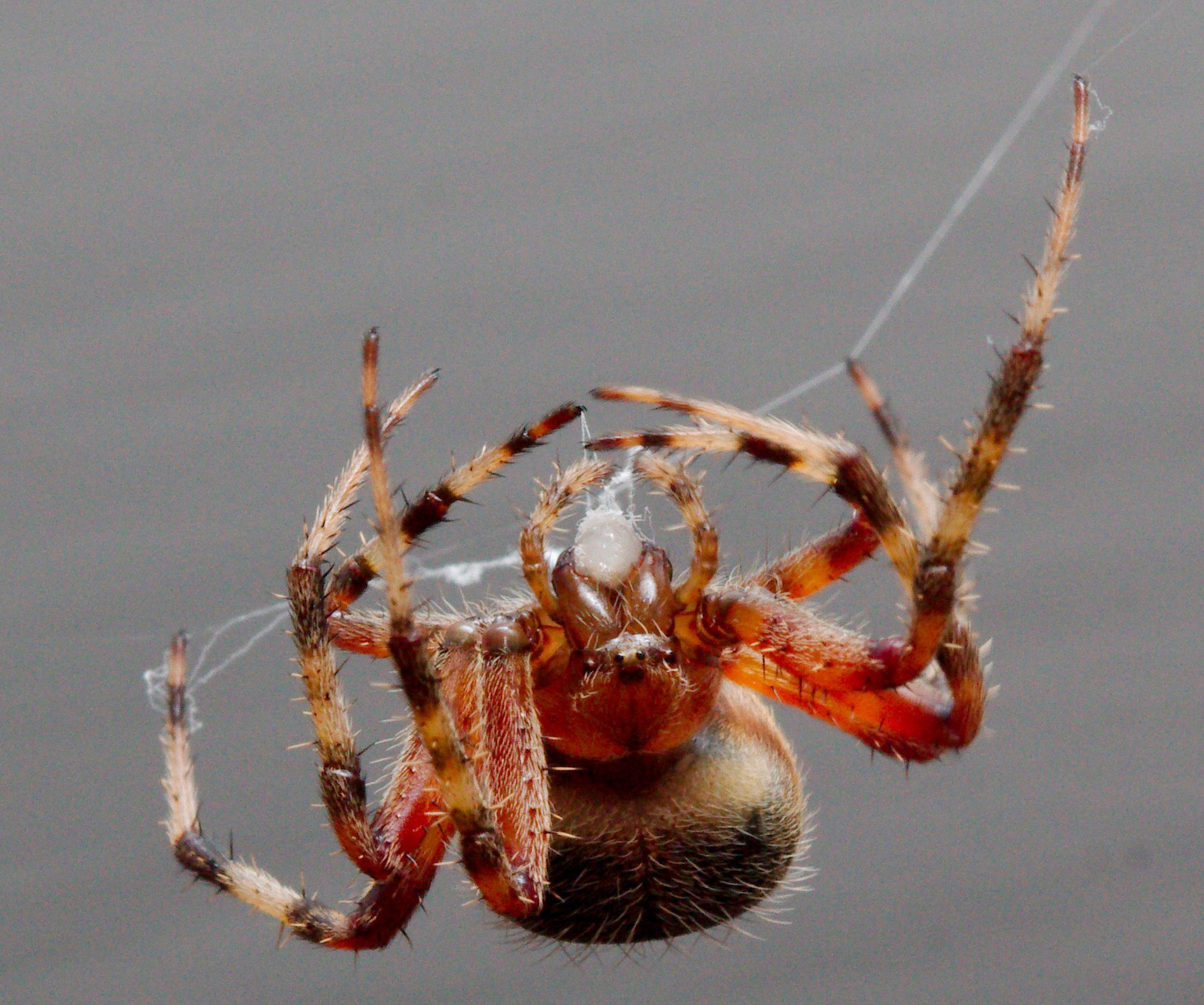
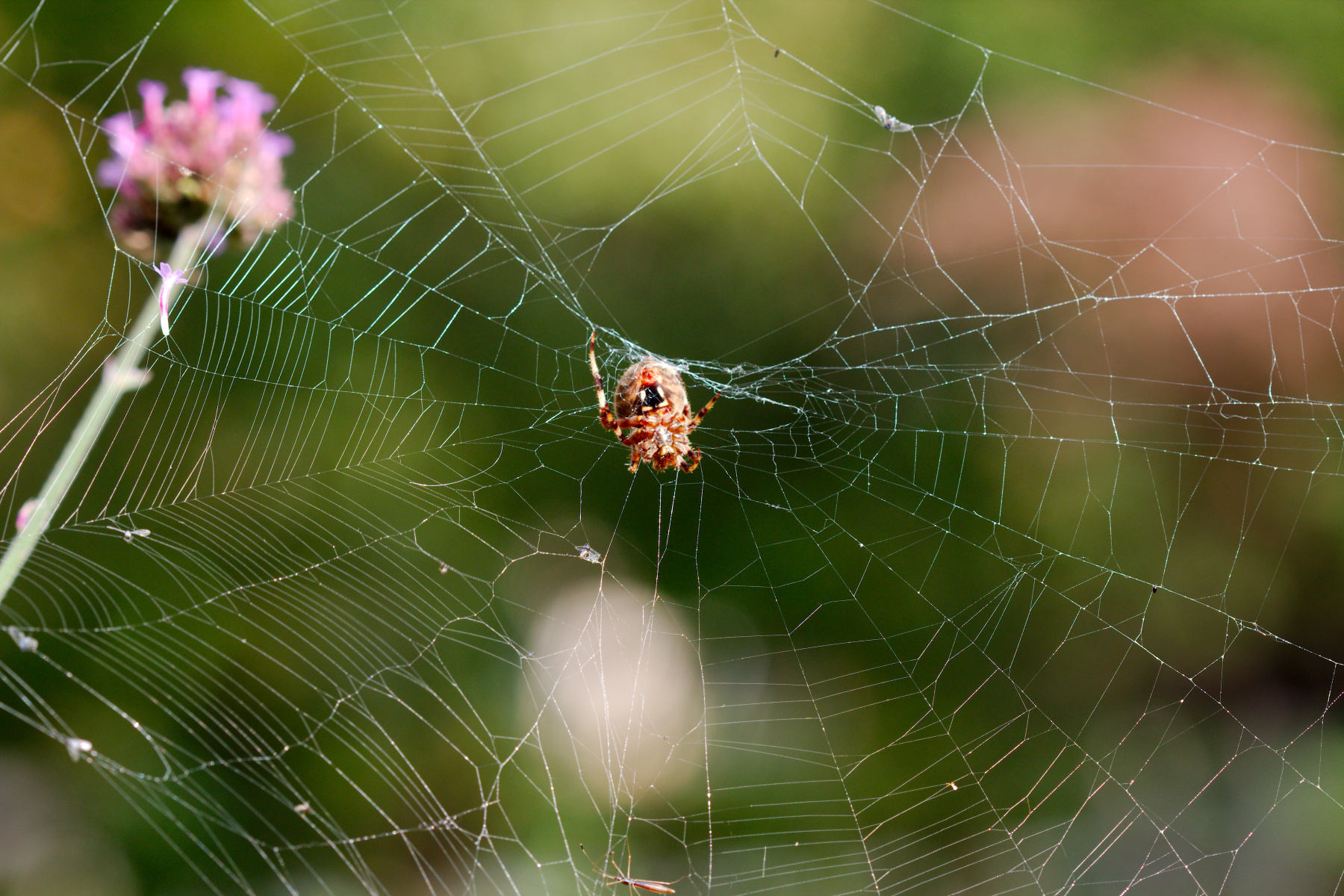
This is the same spider I had a picture of on September 13. At least it’s the same species. I don’t actually know if it’s the same one, but it certainly could be. This time it is in the back yard with its web between the flower stalks of Verbena bonariensis. I find that to be a much better place for a spider than across the entrance to my house. I tried to get pictures of it from the other side but it wouldn’t let me get close enough. Also, I was shooting into the sun from that side, which was difficult.
Neoscona crucifera
Yesterday Cathy noticed this spider out in front of our house. There are two pillars holding up our front porch and it was between one of those and the house, to the side of where we walked. Since it wasn’t bothering anyone and since in general I consider spiders a force for good, I left it alone. This morning as I came out I didn’t see it there where it had been yesterday. With the heavy rain we had last night (and it was still coming down this morning, off and on) I wasn’t too surprised to find it gone. As I walked out from under the porch, though, I found where it had moved when I got a face full of web. As much as I like spiders, I’m not a big fan of spider webs in my face, especially when they are patrolled by a spider as big as this one.
This is a common spider in the Neoscona genus, the Spotted Orbweavers.
Philanthus gibbosus (Beewolf)
I saw a new type of wasp today. Well, new to me, anyway. They’ve been around for a while. The genus Philanthus are known, collectively, as beewolves, because they prey on bees. The female hunts for bees, buries them in brood tunnels, and lays an egg on each. When the larvae hatch, they have a nice, readily available food supply.
This particular species, Philanthus gibbosus is the most common of the north American species. It’s not all that big, between 15 and 18mm in length but it’s brightly marked with yellow. You can see the three simple eyes (ocelli) on the top of the head, although if you didn’t know they were there, you might not notice them. This wasp, like many others in our yard, it particularly fond of the mountain mint (Pycnanthemum muticum).
Fawn at Work
I didn’t get outside during the day today but I did get this picture from my office window. There were two fawns, actually, both along the side of the parking lot between our lot and the empty lot next door. I’ve seen deer in that empty lot a few times and have come across the bones of deer quite a few times. This is the first time I’ve seen them out in the open on our side of the fence (not that the fence is going to stop them — it’s low enough that I can step over it without any trouble).
D’Argo
We went over to my mom’s for dinner this evening. There wasn’t really any special occasion. She had been at a sort of mini-family reunion in Virginia and had made quite a bit of curry chicken salad and had a pretty good amount left over. It needed to be eaten so we obliged and ate some. It was nice to get together just for the fun of it and nice that Steve and Maya are in town now, which I sometimes don’t remember for some reason. They brought their not-quite-new-any-more corgi, D’Argo, with them and that’s who is in this photo. I’m not sure whose hand that is.
Eastern Tiger Swallowtail
Mostly when I’m photographing insects, or animals of any kind, I’m mostly interested in getting a sharp image, in focus, without blurring from movement, with plenty of depth of field, etc. I don’t always achieve it, but that’s what I’m aiming for. Sort of the field-guide-type photograph. Something that will show you all the distinguishing features of the creature.
This time, though, I was trying to capture the essence of butterfly-ness and I think I’ve done a halfway decent job of it. If you’ve ever followed a butterfly from bush to bush, trying to get close enough for a picture, trying to get it at the right angle, with the sun behind you, without a lot of hard, man-made objects in the picture, you know how mobile they are. Their wings are often a blur, as they move around on an individual flower, to say nothing of when the take off and flit to another flower, just around the back of the bush and out of sight. This, I believe, is a lot of what it is to be a butterfly.
Mushrooms and Cabbage Whites
Two pictures today, unrelated except for the fact that they were both taken in our back yard. The first is of some mushrooms. We’ve had these for the last few summers and I assume they are growing on the rotting roots of the trees we’ve had in the back yard. We lost a pretty big tree in July of 2010, right in the middle of the back yard. That would have had roots spreading throughout the back yard and I’m pretty sure the mushrooms started to appear after that died. We’ve take out two more big trees, so I’m guessing we’ll have even more of these mushrooms over the next few years.
They come up overnight in little bunches and last a day or two at the most. Then they turn to a rotting mush, all filled with maggots, which is really quite disgusting. All part of the cycle though.
The second picture os of two cabbage white butterflies mating. What I find most interesting about this is that they can fly around, still connected tail to tail. I’m not sure if only one of them does the flying and the other just hangs on, or if they both contribute to the flying effort. This is a family blog, so I won’t ask any more questions or make any more comments.
Skipper on Black-eyed Susan
The black-eyed Susans in the back yard are past their prime but are still providing a good splash of color. They continue to be magnets for the skippers and the whites. I haven’t looked closely at this one to decide which skipper it is, of the many varieties that seem to be in such abundance. I like the hairy head and half folded wings as it perches lightly on the black-eyed Susan, basking in the late afternoon sun.
Oncopeltus fasciatus Nymphs (Large Milkweed Bug)
We have a few butterfly weed plants (Asclepias tuberosa) in our back yard. They are mostly done blooming and actually have mostly gone to seed. One of them is totally covered with these beautiful little nymphs of the large milkweed bug (Oncopeltus fasciatus).
Calycopis cecrops (Red-banded Hairstreak)
I went out after butterflies this afternoon. It was quite warm and they were all over the place, especially on the black-eyed Susans. This is one of two that I photographed. The other was an Eastern Tailed-Blue (Cupido comyntas) but they were not as good so that will have to wait for another day. I’m pretty happy with this picture, though. The tricky thing is to get both the head and the trailing edge of the wing in focus at the same time. I also like the fine line shadow of the antenna on the wing.