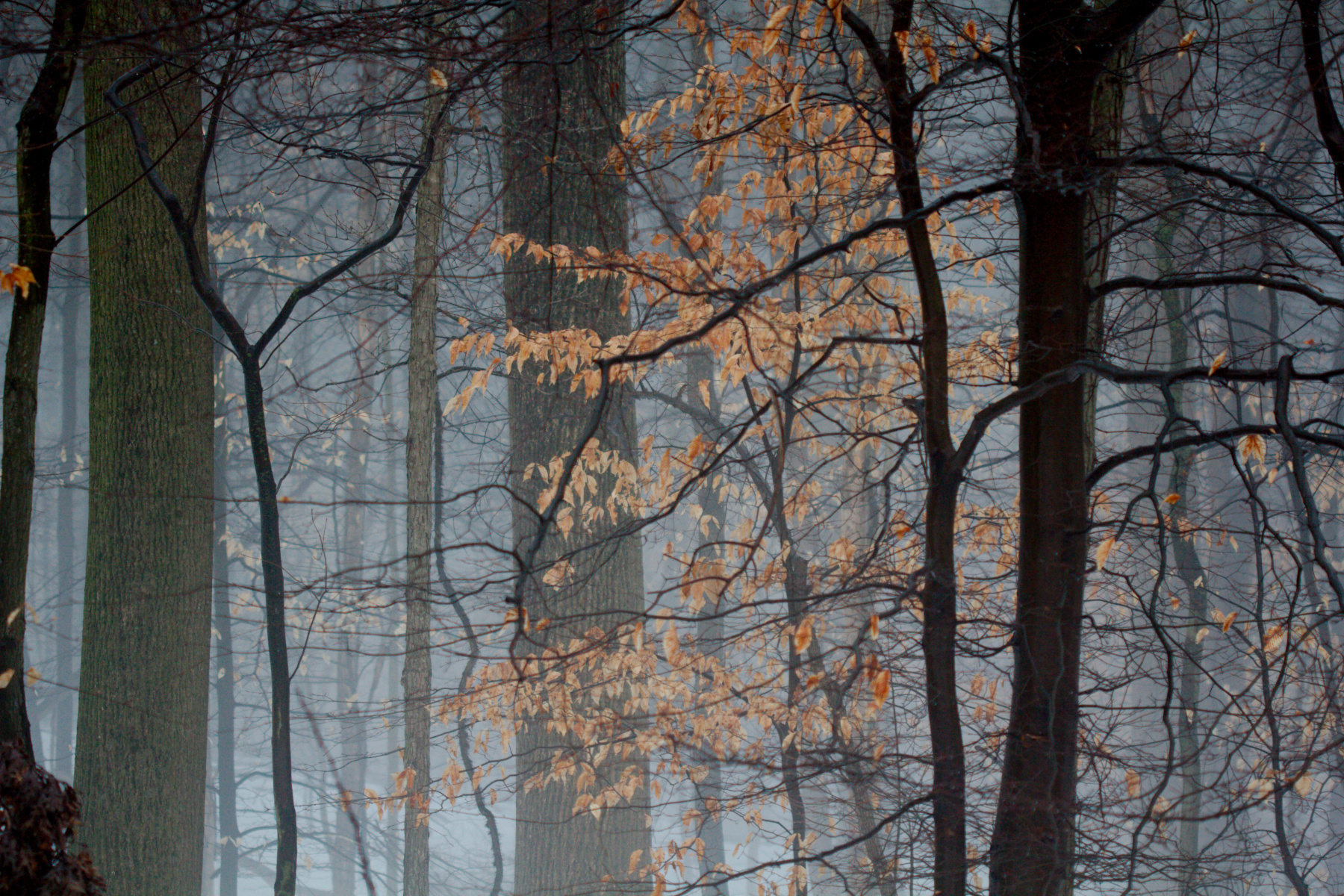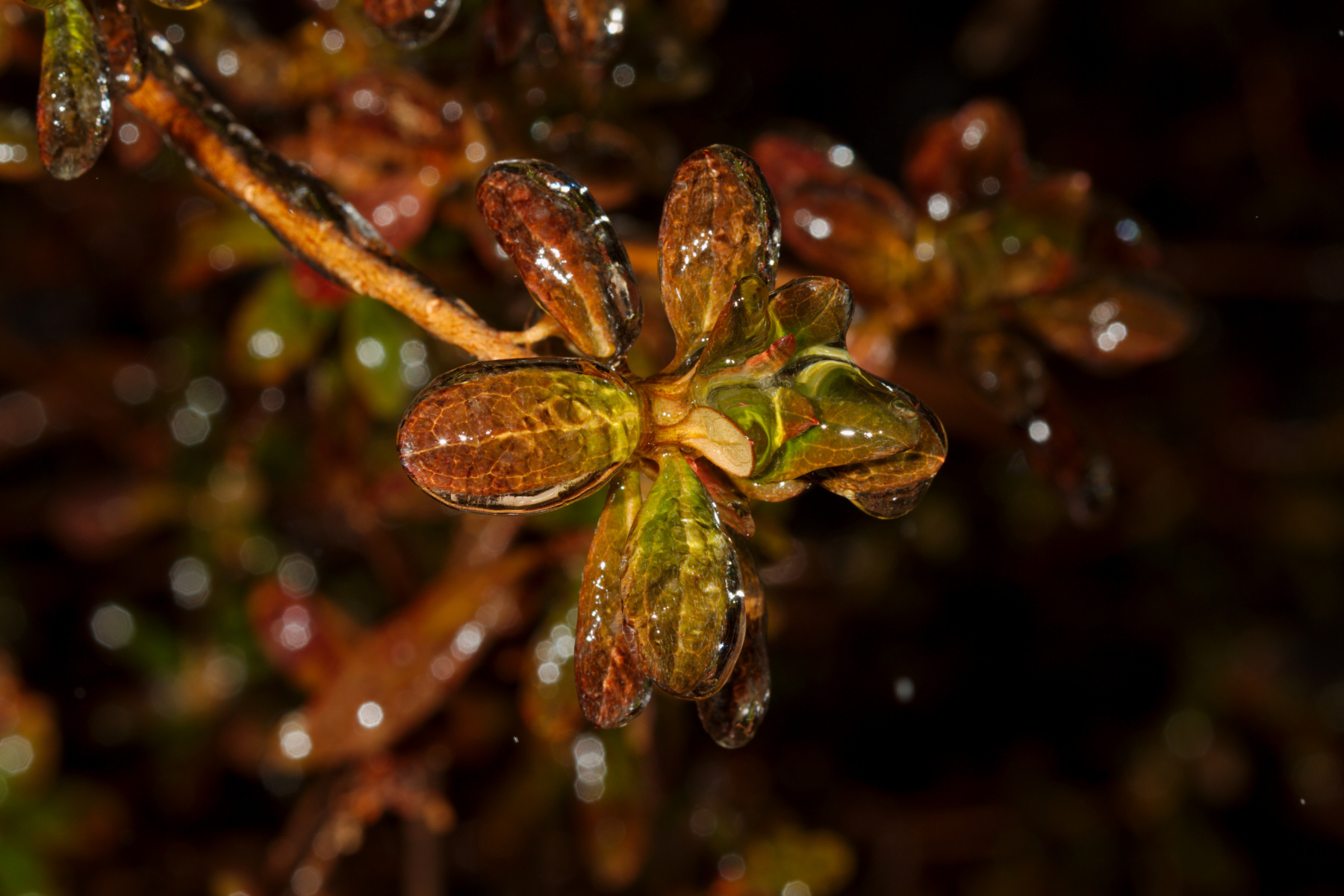
A lot of people make a big deal of the autumnal equinox being the beginning of fall. Of course, that’s mostly just a marker and we don’t go from summer one day to winter the next. Also, the transition happens at a different time in different places (and there really isn’t a winter in the tropics). It’s been fairly warm lately, although the daytime highs are supposed to be down into the 70s by the end of the week. Some trees are showing some color here, but for the most part, it’s still green. This maple tree in our back yard just has this hint of red, teasing us with the prospect of what’s to come. I’m ready.
Flowers and Plants
Hardy Begonia (Begonia grandis)
Originally planted in a pot outside our front door, this hardy begonia (Begonia grandis) has been coming up around the front step every year since and getting a little larger each year. It isn’t what I’d call invasive, but it’s certainly found a spot where it is very happy. The leaves have wonderful, red veins and the flowers are a delicate pink. The male flowers have bright yellow stamens and the female flowers are pendulous and pink with less obvious yellow stigmas. Overall it’s less than two feet tall and very welcoming as we come home. The relatively cool and protected spot is probably important to its doing so well.
As I was writing this I got to wondering where the name Begonia comes from. It is in honor of Michel Bégon (1638-1710), a French government official and avid plant collector.
More Physostegia
The light was really pretty this afternoon, shining on the Physostegia virginiana (a.k.a. obedient plant, but that’s not nearly as fun to say). I took some pictures of the flowers by themselves but really what I was looking for was a picture with a bee or wasp or something. There was actually quite a lot of activity, mostly from eastern carpenter bees (Xylocopa virginica) but getting a good picture proved elusive. They kept moving, for one thing, and most of the pictures I got are not in focus. They also spent most of their time with their heads buried in the flowers which meant all I could see was their backs.
Hardy Hibiscus (Hibiscus moscheutos)
We’ve been wanting to have one of these for a while and last year Cathy finally got one and planted it in the back garden. We’ve only had a few flowers this year and they only last a day, but today I managed to get some pictures of one. Hopefully as it gets better established we’ll have more flowers over the course of the summer. This is related to the rose of Sharon (Hibiscus syriacus), which we’ve had growing for a while, as well as the tropical hibiscus (Hibiscus rosa-sinensis) which has to be brought in for the winter. The flowers on the hardy hibiscus are larger than on either of the other two and quite striking, even from all the way across the yard. Definitely a good choice for the back of the garden.
Dahlia ‘Dracula’
This dahlia is one of two that Cathy has growing in containers at the top of our driveway. It is one of seven dahlias in the Dark Angel line from the Dutch company Verwer-Dahlias. The seven cultivars in the Dark Angel series are named for what they consider to be edgy films and in addition to ‘Dracula’ are ‘American Pie’, ‘Braveheart’, ‘Pretty Woman’, ‘Pulp Fiction’, ‘Star Wars’, ‘Taxi Driver’. I’m not sure those are the edgiest films you could come up with, but the flower themselves are quite beautiful. Of course they have other series, as well, such as Karma, Meloda, Happy Days, and Gallery.
Dahlias are, in general, a bit more work than some flowers, but they sure are beautiful when grown well. The genus name Dahlia is in honor of Dr. Anders Dahl (1751-1789), a Swedish botanist and pupil of Linnaeus.
Skipper on Rudbekia
The skippers are a constant source of attraction pretty much all summer and into the fall in our yard. They may have their favorites but they are generally everywhere, from the black-eye Susans (Rudbekia) as seen here, to the Verbena bonariensis, the mountain mint (Pycnanthemum muticum), and the Buddleia. They are everywhere and it pretty huge numbers. If you walk along the edge of the black-eyed Susans, they fly off en masse and alight again, further along or behind you. It’s enjoyable just to watch them flitting about, sometimes two or even three on a flower, but not usually for long, as they are so often on the move.
Physostegia virginiana
The Physostegia virginiana, otherwise known as obedient plant, is a North American native herbaceous perennial, hardy as far north as USDA zone 3. The Missouri Botanical Garden Plant Finder says that is it “easily grown in average, moist, acidic, well-drained soils in full sun.” It certainly is easily grown in our yard. They also mention that it tends to flop over “in rich soils, too much shade or hot summer temperatures.” I don’t know about the heat this summer but ours certainly did flop over this year. But that hasn’t prevented it from blooming very nicely, providing a welcome contrast with all the black-eyed Susans. The bees, particularly the carpenter bees, it seems, really love it.
Broccolini
Writers get writer’s block. I sometimes get photographer’s block. I just can’t seem to find anything interesting to photograph. In generally I’m interested in a wide variety of things and find it pretty easy to find some detail to look at. Occasionally it’s hard and today was such a day. So, as I was making dinner, I photographed the broccolini that I was getting ready to cook. It got me wondering what, exactly, broccolini is. Well, according to Wikipedia (which you cannot always trust, but in this case it’s probably right or at least close), broccolini is a hybrid between two cultivars of Brassica oleracea. One of those is regular, old broccoli and the other is called kai-lan or Chinese broccoli, which has been bred for it’s leaves instead of its flower buds. This gives broccolini it’s longer stems and smaller flower clusters. The way I like to fix broccolini is to parboil it briefly and then put it in a sauté pan with a little olive oil and some garlic and salt.
Hydrangea
This hydrangea has taken a few years to get established. Last year it was eaten back by the deer, which didn’t do it a whole lot of good. We’ve managed to protect it (or have simply been lucky) this year and it’s doing much better. We planted it and another, blue hydrangea a few years ago but the other didn’t make it. This seems happy and the flowers, white and pink, are quite nice against the green of our back border. We’ll need to do a little pruning to keep the forsythia from covering it up, but I think it’s well on its way to being a favorite late summer bloomer.
Lantana
Lantana is a genus of about 150 species. The mostly commonly grown species is Lantana camara, a tender, woody shrub native to tropical regions of Central and South America. It has become an invasive weed in many parts of the world but here, where winter temperatures are too cold for it, there’s no chance of any real problem and it is grown as an annual. It is toxic to livestock but it does not appear to be toxic to humans (although I don’t think I’ll be doing any experiments on that). The flowers are quite beautiful, changing colors as they progress from bud to open flower, leading to some wonderful color combinations. This one is sitting on our driveway and is quite happily brightening up the place with its yellow and pink blooms.
Rose ‘Perle d’Or’
I don’t think I’ve posted a picture of this rose yet this year. It’s such a reliable little rose and I’m really happy that I got one to plant just outside our front door. The flowers are small but quite beautiful, with a delightful fragrance. It had a tough time the last few winters. This last was relatively mild overall but there was a week when temperatures were below zero fahrenheit and that’s tough on plants that otherwise do well in our zone 6a climate. It’s bounced back pretty well and has had a few flowers on it pretty much non-stop all summer and should continue until the first frost. What’s not to love.
Water On A Leaf
I know that the title for this post is a little unimaginative. That’s sort of me, though. Generally straightforward and simple (mostly simple). I went out to take pictures of reflections of black-eyed Susan flowers in the water in our back yard birdbath. I got some that were reasonably nice but nothing I was excited about. I also took a handful of pictures of this leaf of grass, an ornamental grass growing in a container on the corner of the patio. I love water droplets on pretty much anything and I’m pretty happy with this picture. I hope you enjoy it, too.
Grass Seeds
Generally we don’t let our grass get quite this tall. This isn’t in the lawn, though, it’s growing in the midst of the black-eyed Susans and Verbena bonariensis in the back garden. There are a few places where grass gets itself and it’s hard to keep up with. This is one of them, not least because mowing right up against the garden is made more difficult by the flowering plants leaning out into the lawn. We don’t want to cut any more of them than is absolutely necessary. But maybe we’ve let it go a little too much. Anyway, I actually think this is quite beautiful, with the afternoon sun shining on the awns (the ‘hairs’ extending from each floret).
Black-eyed Susan
We have a lot of black-eyed Susans growing in our yard. Mostly in the back but they self-seed and are here and there throughout the yard. I suspect our neighbors are not overjoyed with them, but they aren’t as invasive as some things we have (<cough>goose-necked-loosestrife<cough>). I love having all that yellow-orange in the back yard from early July on and even as they start to fade, they are still beautiful. Most of them are not looking like this, although they will be before too long.
Cosmopepla lintneriana (Twice-stabbed Stink Bug)
I came across another new bug today (new to me, that is). This is the twice-stabbed stink bug (Cosmopepla lintneriana), so called because of the two red ‘wounds’ the apex of the scutellum. There were at least three of them on the American beautyberry (Callicarpa americana) in our back garden, including the two shown here. I had a hard time photographing them because they kept crawling around to the underside of the branches and under the bunches of purple berries. My camera, with a 100mm macro lens and two off camera flashes is a little unwieldy and takes two hands to manage properly. So, I’d use one hand to scare the bugs onto the upper side of the branch and then let go to get the picture. By the time I had found them again through the viewfinder and focused on them, they were half way back to the underside of the branch.
Ginkgo biloba Leaf
From the Missouri Botanical Garden:
Ginkgo biloba is a deciduous conifer (a true gymnosperm) that matures to 100′ tall. It is the only surviving member of a group of ancient plants believed to have inhabited the earth up to 150 million years ago. It features distinctive two-lobed, somewhat leathery, fan-shaped, rich green leaves with diverging (almost parallel) veins. Leaves turn bright yellow in fall. Ginkgo trees are commonly called maidenhair trees in reference to the resemblance of their fan-shaped leaves to maidenhair fern leaflets (pinnae). Ginkgos are dioecious (separate male and female trees). Nurseries typically sell only male trees (fruitless), because female trees produce seeds encased in fleshy, fruit-like coverings which, at maturity in autumn, are messy and emit a noxious, foul odor upon falling to the ground and splitting open.
This one is in my mom’s front yard. It’s a tree that dad planted many years ago but which has grown very slowly. It appears to finally be starting to grow taller.
Verbena bonariensis
I only took a handful of pictures today and not until about 7:30, when the best light was gone. We had quite heavy rain today throughout the morning. It cleared up later but I was pretty busy and didn’t get a chance to go out. I’ve posted pictures of the Verbena bonariensis (tall verbena) growing in our yard before but I thought I’d do it again. I do love this color combination, the purple of the verbena against the yellow of the black-eyed Susans behind and below it.
Bee on Asclepias
I haven’t had a chance to look up this bee and I’m not sure this picture is good enough for a positive identification, in any case. There are a lot of little bees that look somewhat like this. This is the best of the pictures I got and it is still not very sharp. It’s a pretty little bee and I’m happy with the picture overall, though. I love the bright orange of the butterfly weed (Asclepias tuberosa). It generally makes a nice contrast to the dark colors of bees. I didn’t take a lot of pictures today, though, so there were not a lot to choose from.
Lobelia siphilitica (Blue Cardinal Flower)
After being off a week, it’s shaping up to be a very busy week at work. We’re three days in and I’m definitely ready for the weekend. But I’m sure I’ll make it through, as I usually do. After work I went out back and chased a monarch butterfly (Danaus plexippus) for a while. He wouldn’t let me get close enough for any decent sort of picture. So, I moved on to the blue cardinal flower (Lobelia siphilitica) growing in the back bed. That didn’t have any problem with my presence and I got a few nice pictures. Then I noticed that the monarch was back and I managed to get a few pictures, but the die was cast and I’m going with the Lobelia picture.
Cathy and Black-eyed Susans
Cathy and I relaxed in the back yard this evening and I took a few pictures of her with the black-eyed Susans that are having the time of their lives this year. Actually, this year is nothing special, as they are pretty spectacular every year. In fact, I’m not convinced we wouldn’t have the entire yard full of them if we allowed them to spread uncontrolled. The goose-necked loosestrife (Lysimachia clethroides) would give them a good fight and might actually win out, as it spreads considerably more quickly. But the black-eye susans (Rudbeckia fulgida) spreads fairly readily.
You could argue that our garden doesn’t have enough variety and you might have a point. On the other hand, the parts of the garden that do have variety tend ultimately to be dominated by whatever plant is the most vigorous. Either that or nothing is vigorous enough and the weeds take over. I have plenty of Canada thistle (Cirsium arvense), pokeweed (Phytolacca americana), American burnweed (Erechtites hieracifolia), and goldenrod (Solidago species) to deal with (just to name a few). But where the black-eye susans are growing well, very few weeds have a chance to get started. That’s pretty nice. And, they’re pretty.