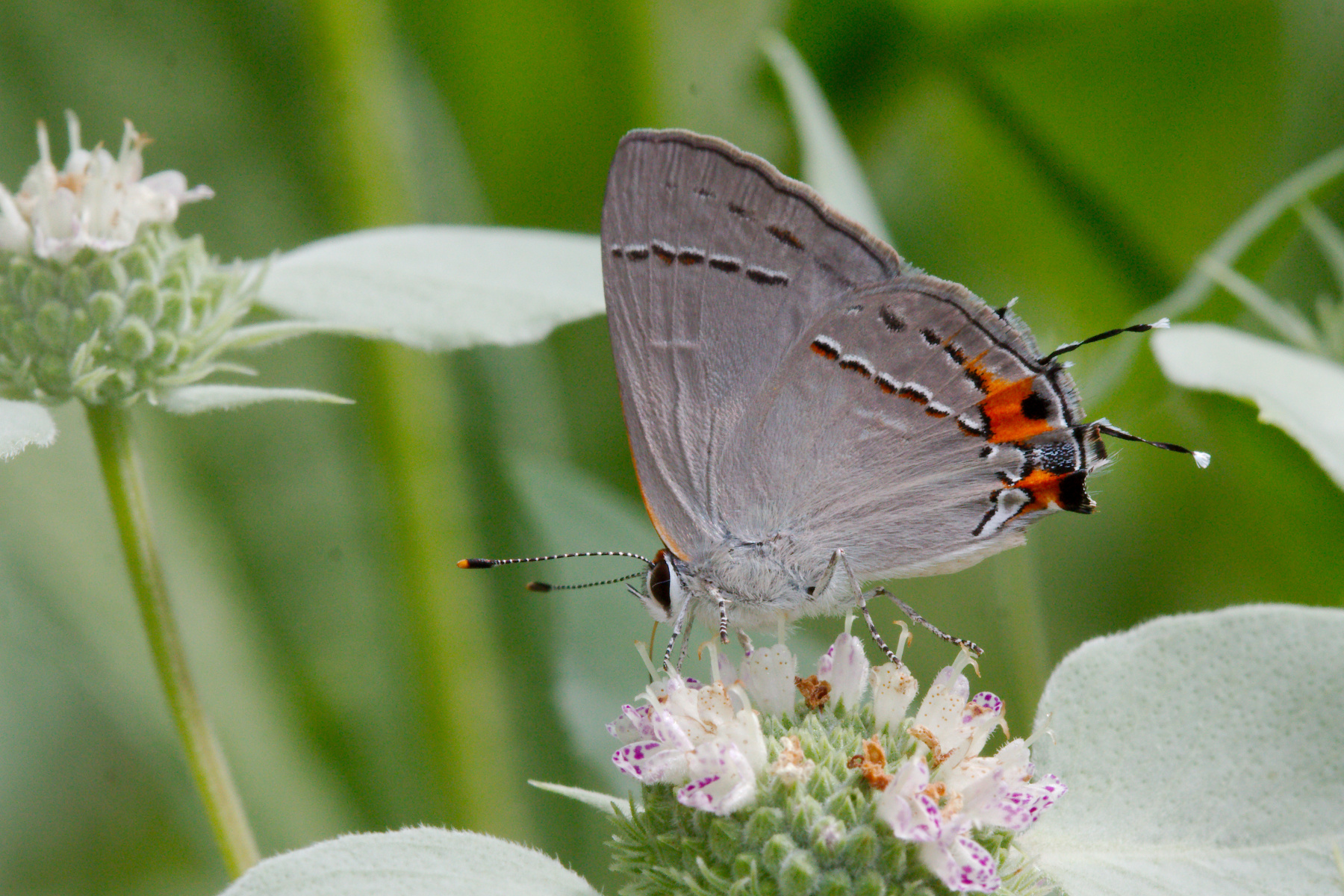
I went out to photograph bees on the mountain mint (Pycnanthemum muticum) and did get some, but the best pictures I got were of this male gray hairstreak (Strymon melinus). The light wasn’t perfect, but it was pretty good and with my camera on a tripod I was able to get as close as my macro lens will allow. I’ve posted a picture of a gray hairstreak once before (on Saturday, August 11, 2012) but I think this picture is a bit better. I hope you enjoy it as much as I enjoyed watching it move about on the flowers.
Creatures
Strymon melinus (Gray Hairstreak)
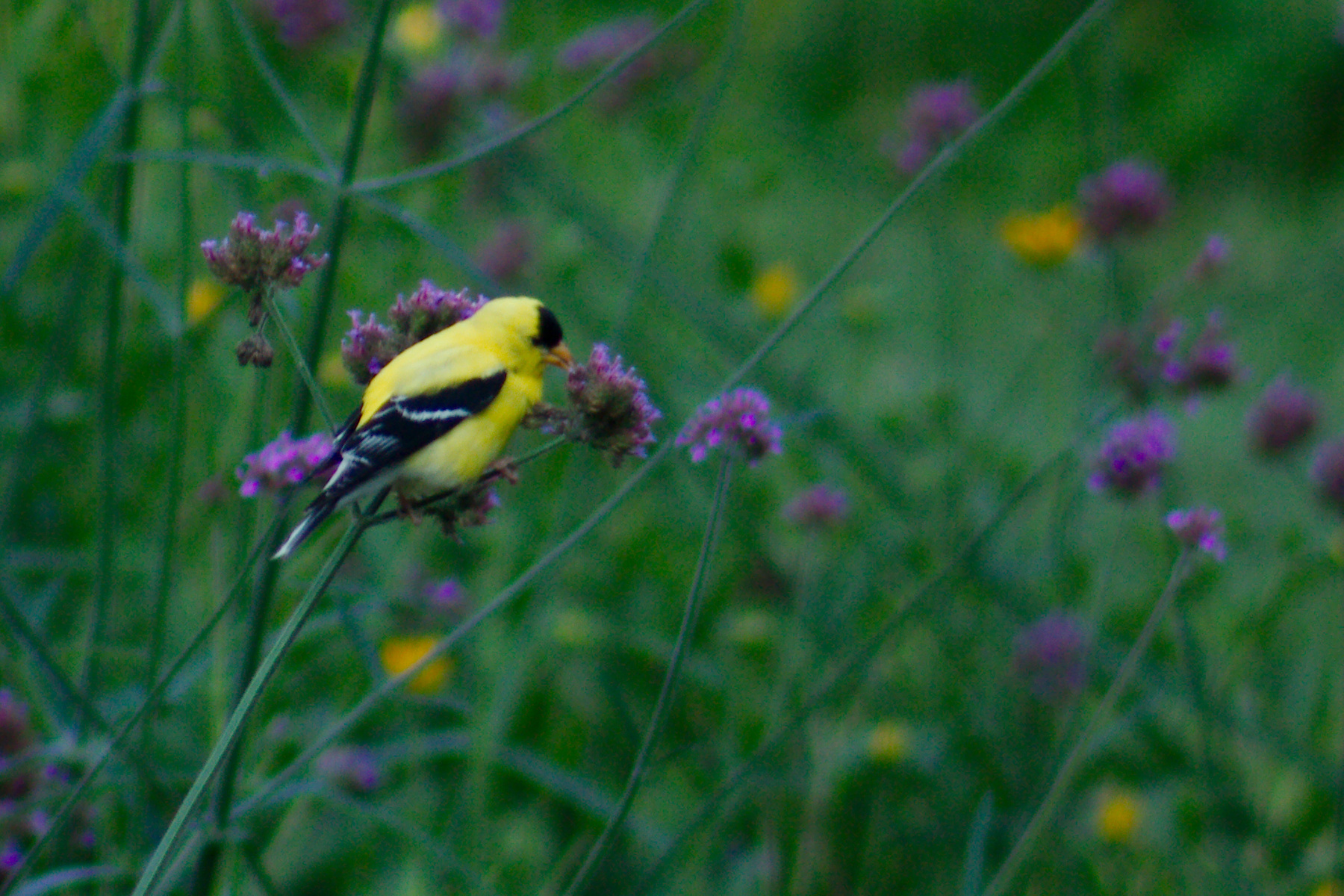
American Goldfinch (Carduelis tristis)
We often see goldfinches (Carduelis tristis) on the purpletop vervain (Verbena bonariensis) in our back yard. This morning he stayed long enough for me to get some pictures. Not terribly good pictures, but pictures, anyway. This was taken hand held with a not-very-sharp zoom lens at 300mm through a pane of ordinary glass in the back door. I guess this is all I could hope for. I’d really like to get something just a little longer and considerably sharper, but that’s going to have to just be on my wish list for now.
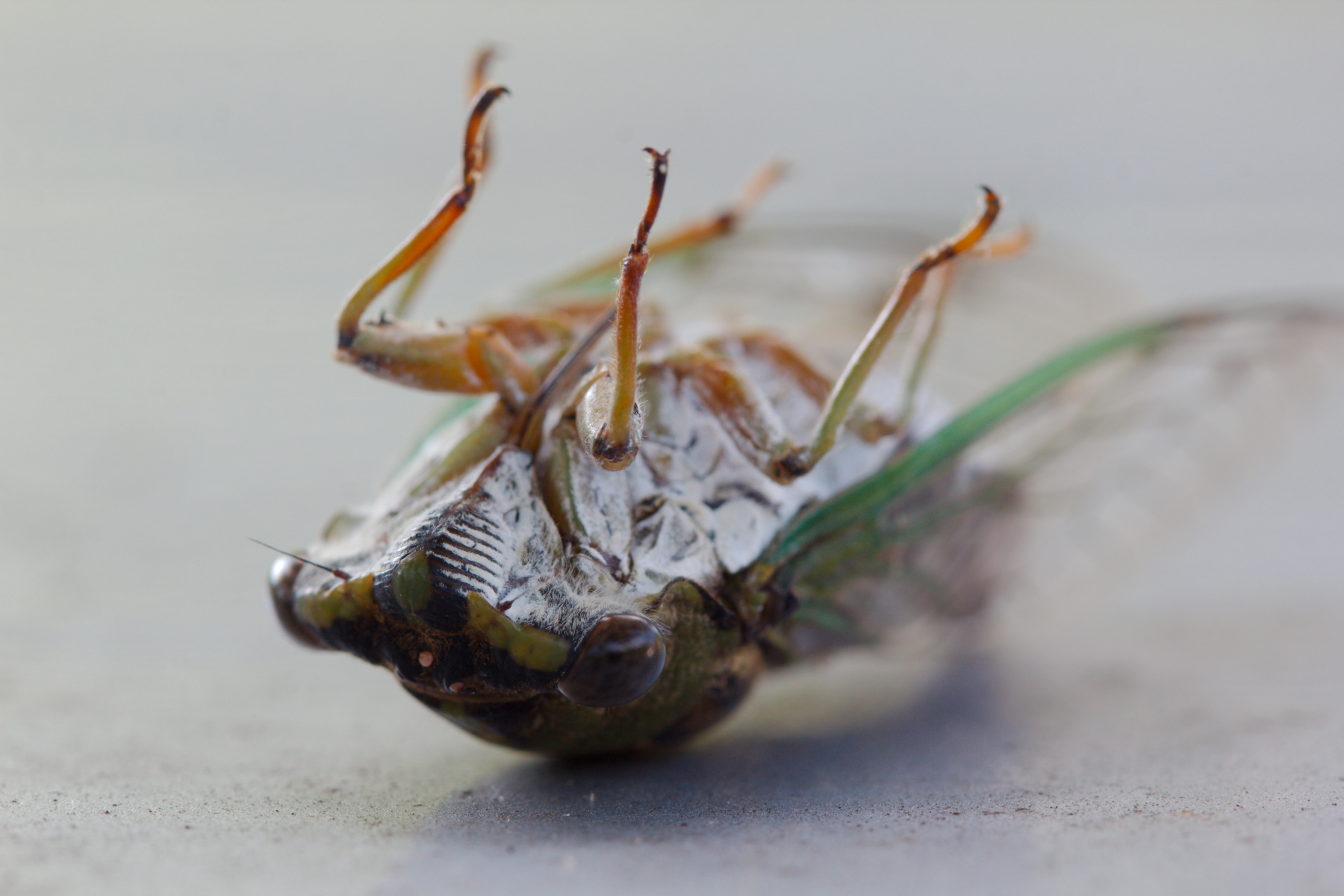
(Mostly) Dead Cicada
What a beautiful day. It’s the middle of July and it’s in the mid 60s in the morning, getting up only to about 80°F in the afternoon. For my money, it doesn’t get any nicer than this. I could take a little cooler, but it’s July, for crying out loud. The sky was blue with cottony, white clouds. After the heavy rain on Tuesday and the heavy hearts yesterday, this is what I needed.
I went to the car to drive to work and this is what I found on the roof. This is one of the Magicicada species, the 17-year periodical cicadas. It was actually only mostly dead. For the record, it doesn’t taste like chicken.
Update: Albert rightly pointed out that the periodical cicadas all have red eyes, so this is probably one of the many annual cicadas in the family Cicadidae but not in the genus Magicicada.
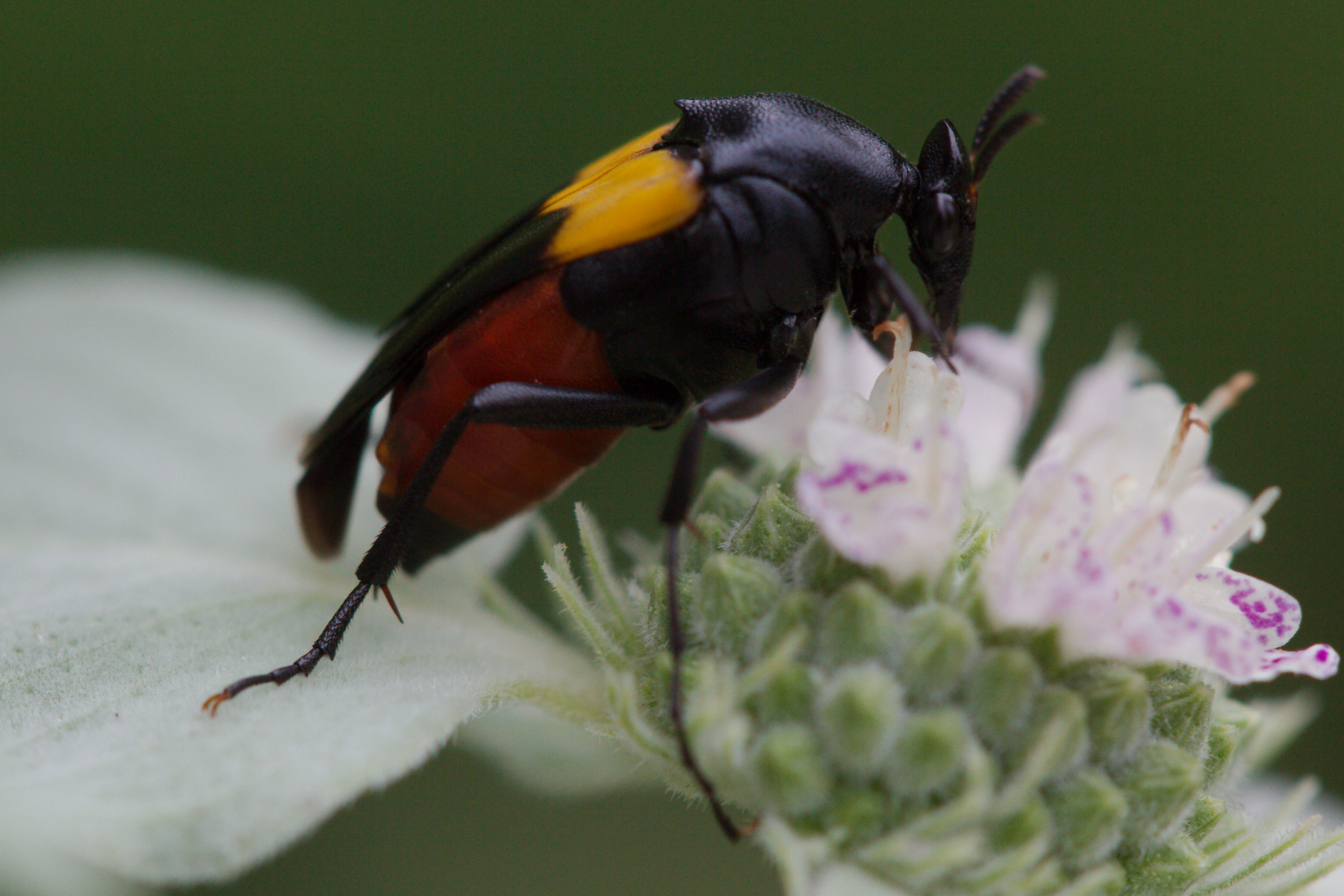
Macrosiagon flavipennis (Wedge-shaped Beetle)
This is one of the wedge-shaped beetles (Family Ripiphoridae) but one without a particular common name. It’s Latin binomial Macrosiagon flavipennis comes from the Greek word for large jaw bone and the Latin for yellow wings. These beetles parasitize wasps and bees, by laying eggs on flowers. When the eggs hatch, the larva attach themselves to a visiting bee or wasp. It is then carried back to wasp nest where it burrows into a host larva.
There is a closely related and very similar species, M. dimidiata, but the “fin or cup-shaped tubercle on the posterior of the pronotum” (the plate between the head and the yellow of the wings), is indicative of this species.
Tradescantia virginiana (Virginia Spiderwort)
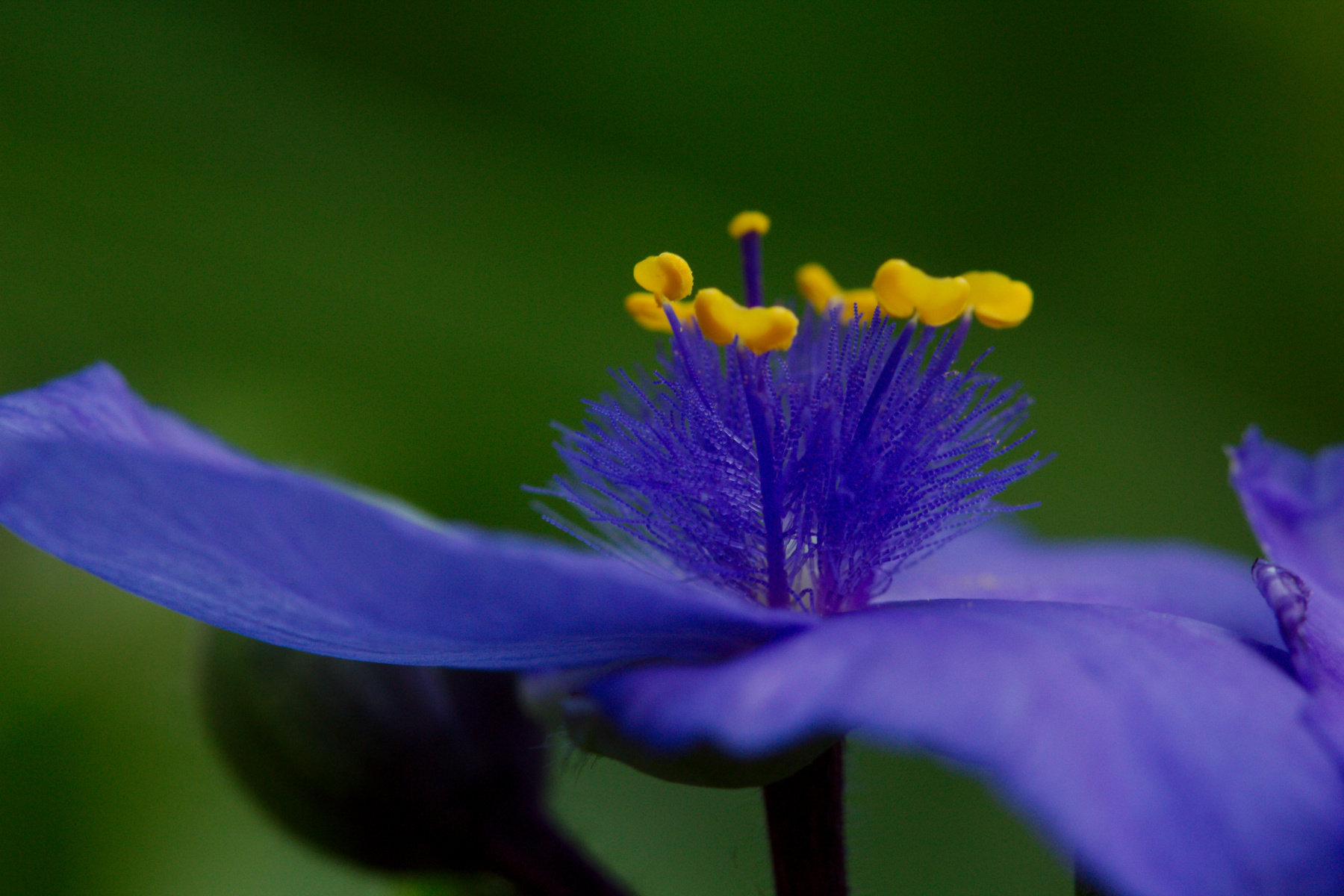
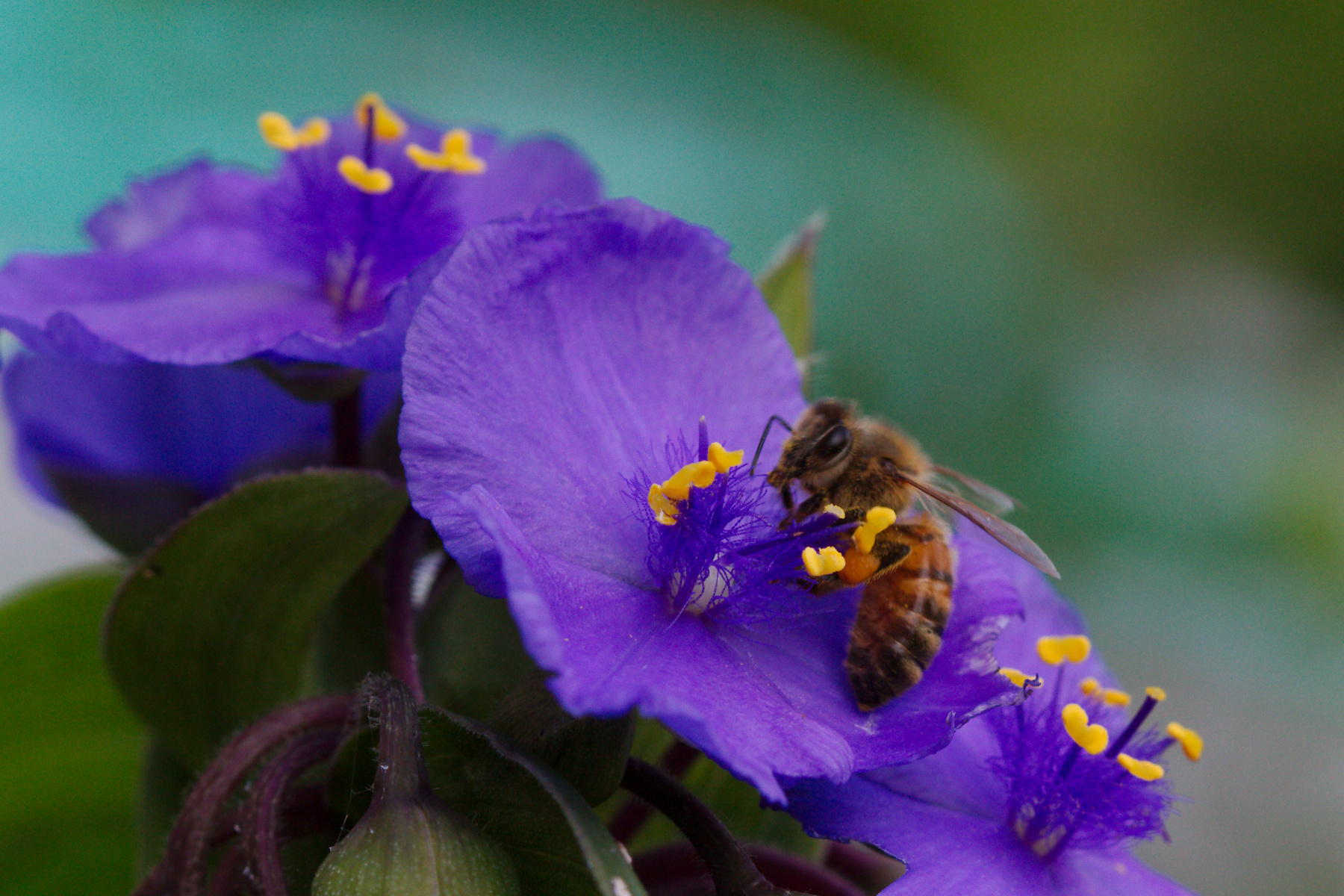
Two pictures today for the price of one and hopefully worth the price of admission. I really like Tradescantia virginiana (Virginia spiderwort). It’s a very vigorous grower but it doesn’t take over the garden. It’s very happy in our climate, not needing much in the way of special attention or soil conditions. And it blooms over a long period with deep, dark, slightly purple blue flowers. They open in the morning and in the evening are all closed up, only to be open again the next morning. I also love the the blue stamen hairs with the bright yellow anthers.
I went out to take pictures this morning and thought I’d get a view across the flowers, as in the first picture here. I think it turned out quite well and really shows the feathery stamen hairs well. They are unique, as far as I know, in that they change color to pink when when exposed to radiation. I don’t know how sensitive they are, so don’t know if they can act as a canary in a coal mine, but I think it’s a cool fact.
I also enjoyed watching a honey bee going from flower to flower, so figured I better get some pictures of that, as well, and I’m please with the results.
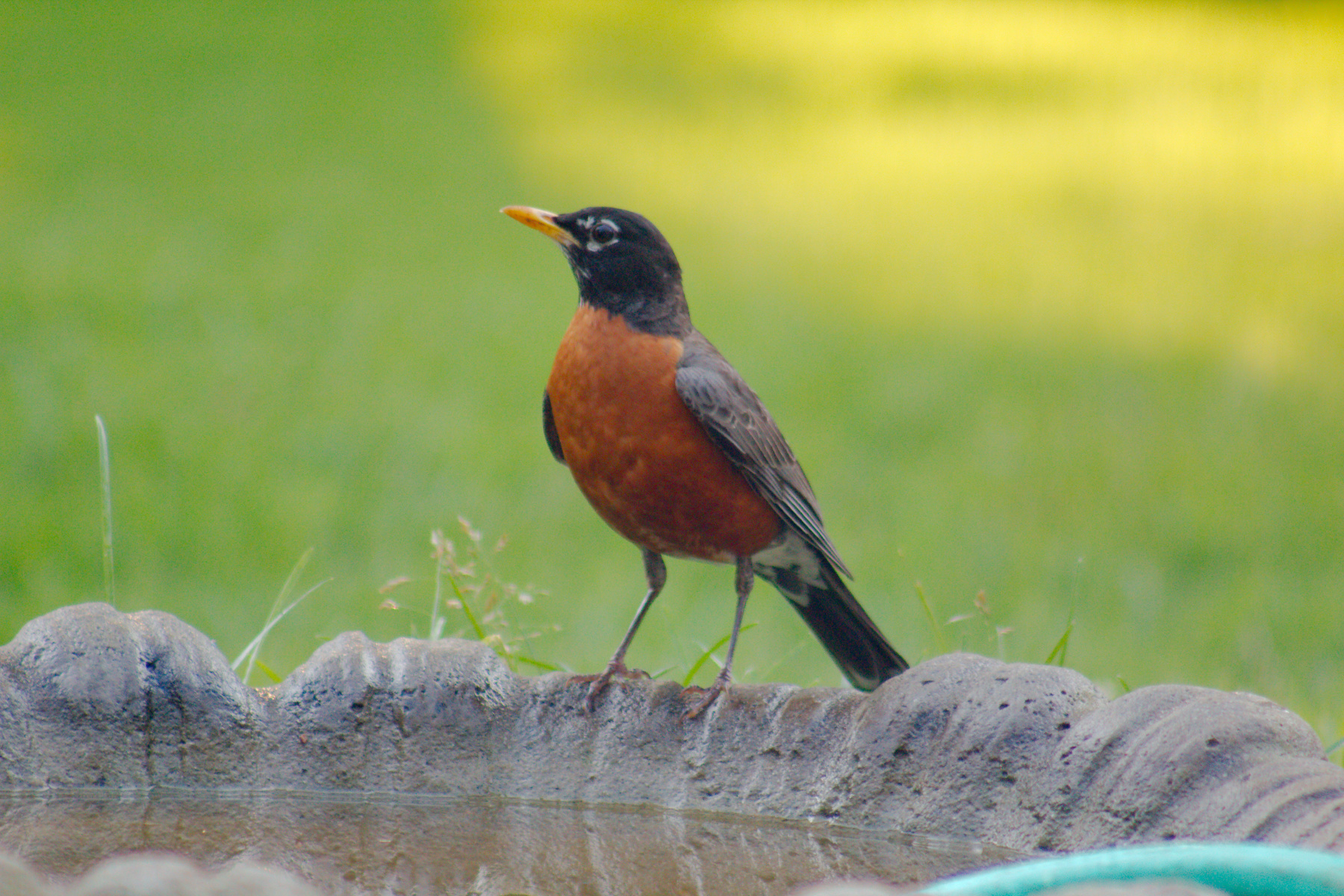
American Robin (Turdus migratorius)
The other day I posted a picture of a catbird in my mom’s bird bath. Since then I’ve been enjoying birds in ours, which is in the back yard, just outside our kitchen door. When I got home this evening there were some grackles in it but they flew off when I came into the kitchen. A little while later there was a catbird there. I went and got my camera and took some pictures but waited a while. I got a female cardinal picking up seeds off the patio as well as this American robin who came for a drink.
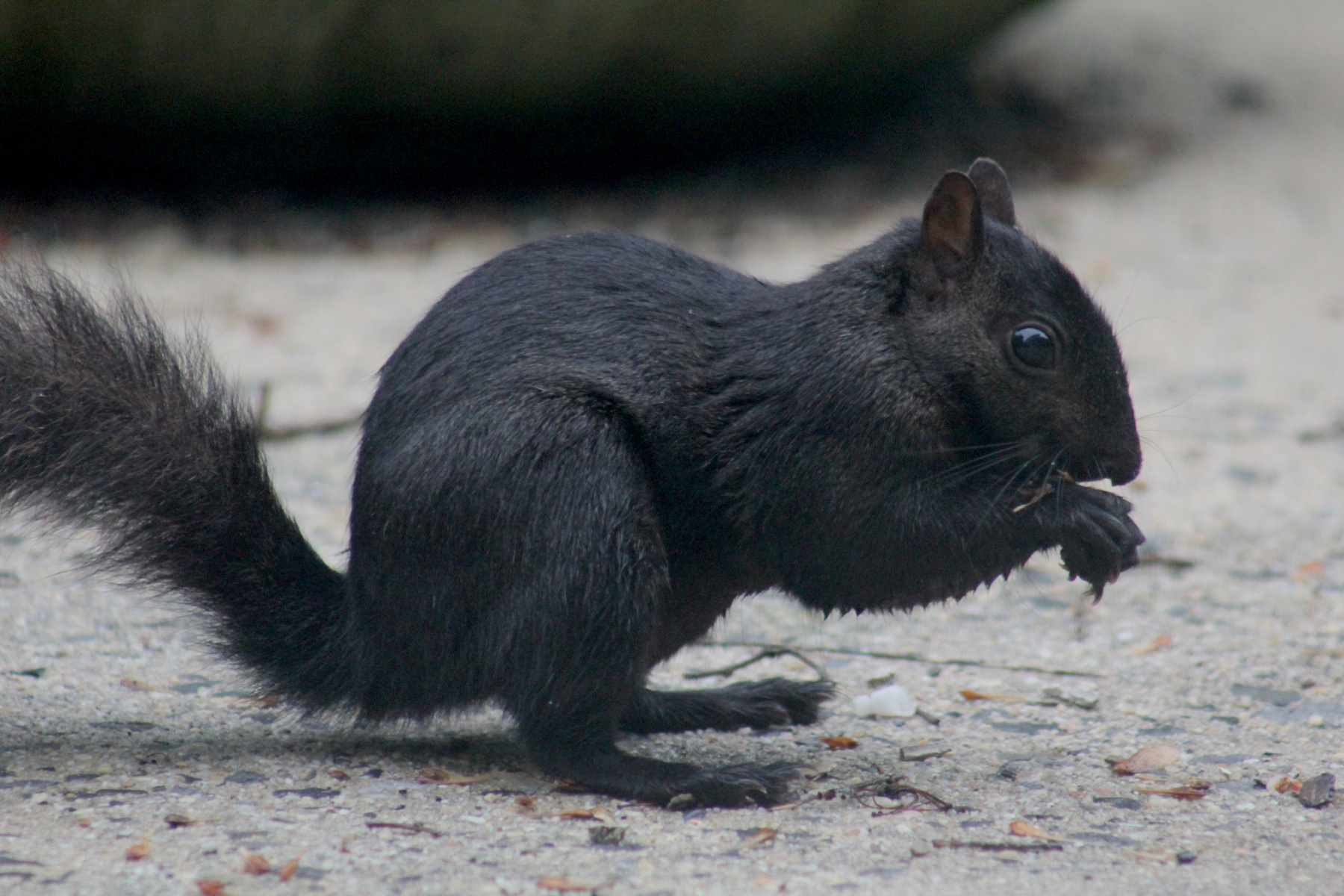
Eastern Grey Squirrel (Sciurus carolinensis)
This squirrel was eating seeds off of the back patio this morning and didn’t run away when I came up to the glass door, so I was able to get a few pictures. Unfortunately I had the camera set wrong so these pictures are a bit grainy, but I’m still reasonably happy with them. I’m not a huge fan of squirrels, which are basically furry tailed rats, but they can be fun to watch. This is the melanistic form of the grey squirrel, which is very common in our area.
Grey Catbird (Dumetella carolinensis)
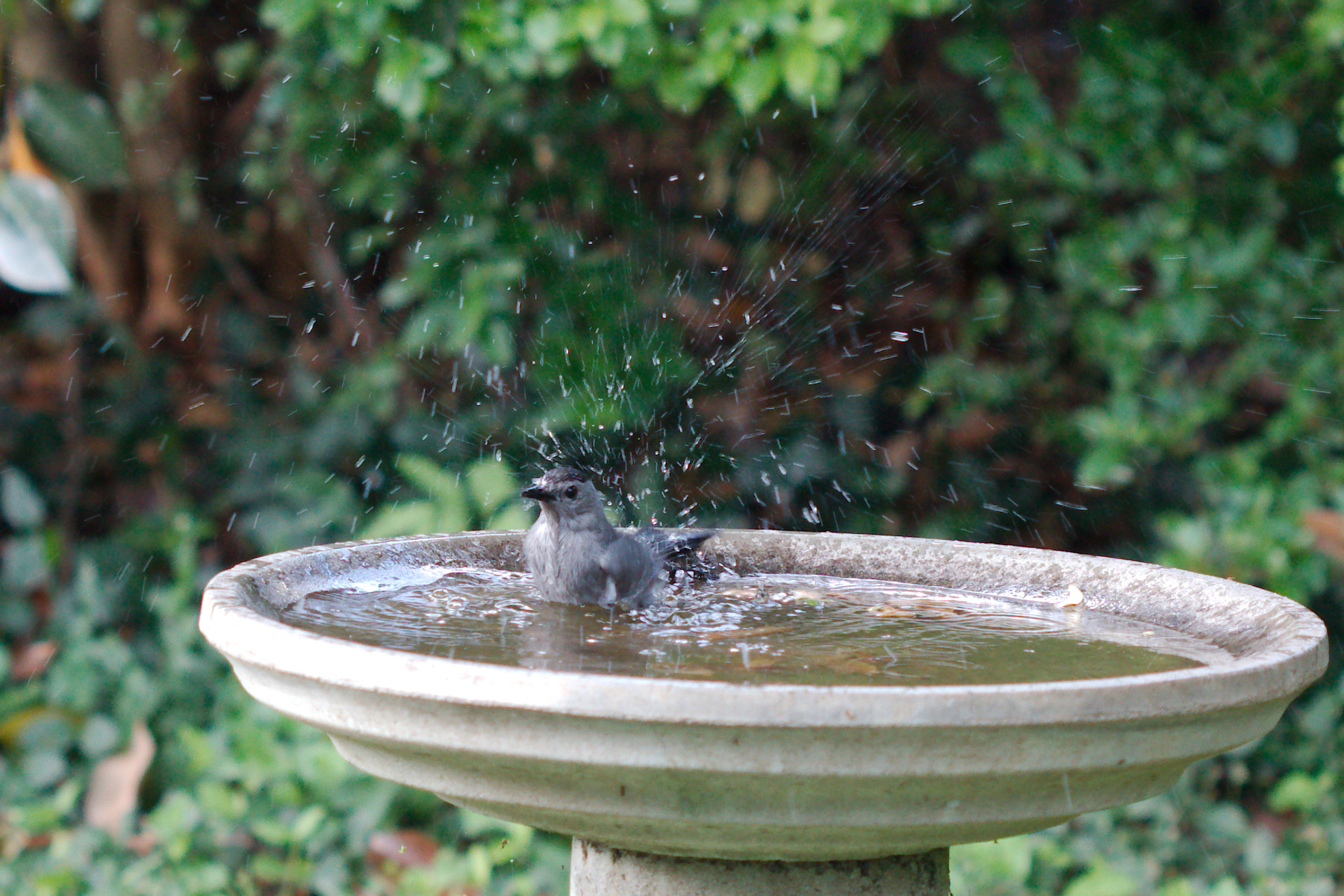
Dorothy spent much of the day at my mom’s house today and I went there to get her after work. I took a few pictures around the yard, including some of a clematis that looks very much like the one I have here (and which I posted a picture of recently). There was a grey catbird in the birdbath in the back yard and I was able to get close enough for a few good pictures before it flew up into the camellia bushes.
Syrphid Fly
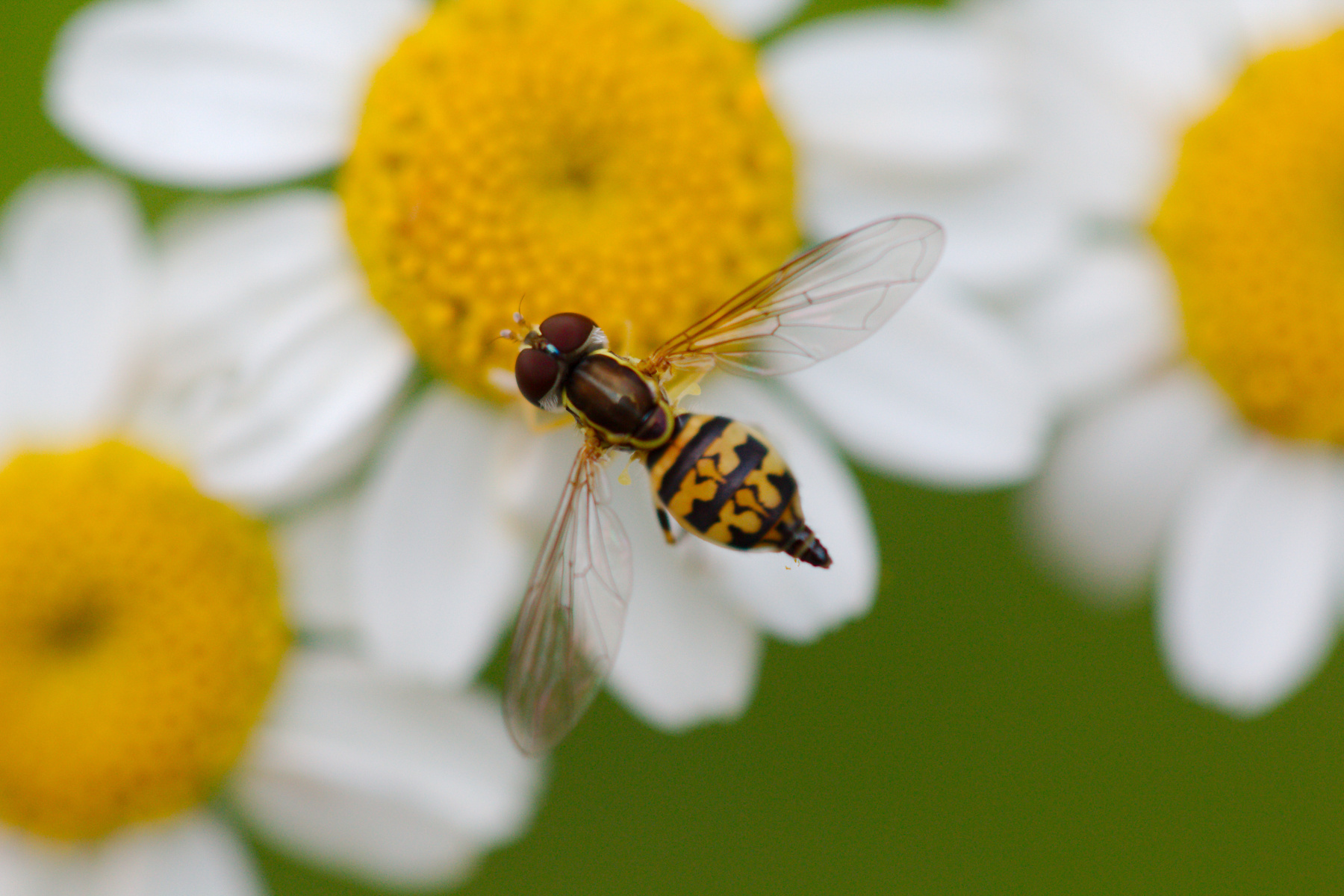
These little flies are all around but are very easy to go unnoticed. They are quite small and don’t bother people much. I think they’re pretty cool looking. In particular, I like the pattern on the abdomen. I don’t know how much variation there is in that pattern, or if it is reliable for identification of the species. There are over species 800 in eastern North America, so making a reliable ID takes more knowledge than I have.
Acanthocephala Species
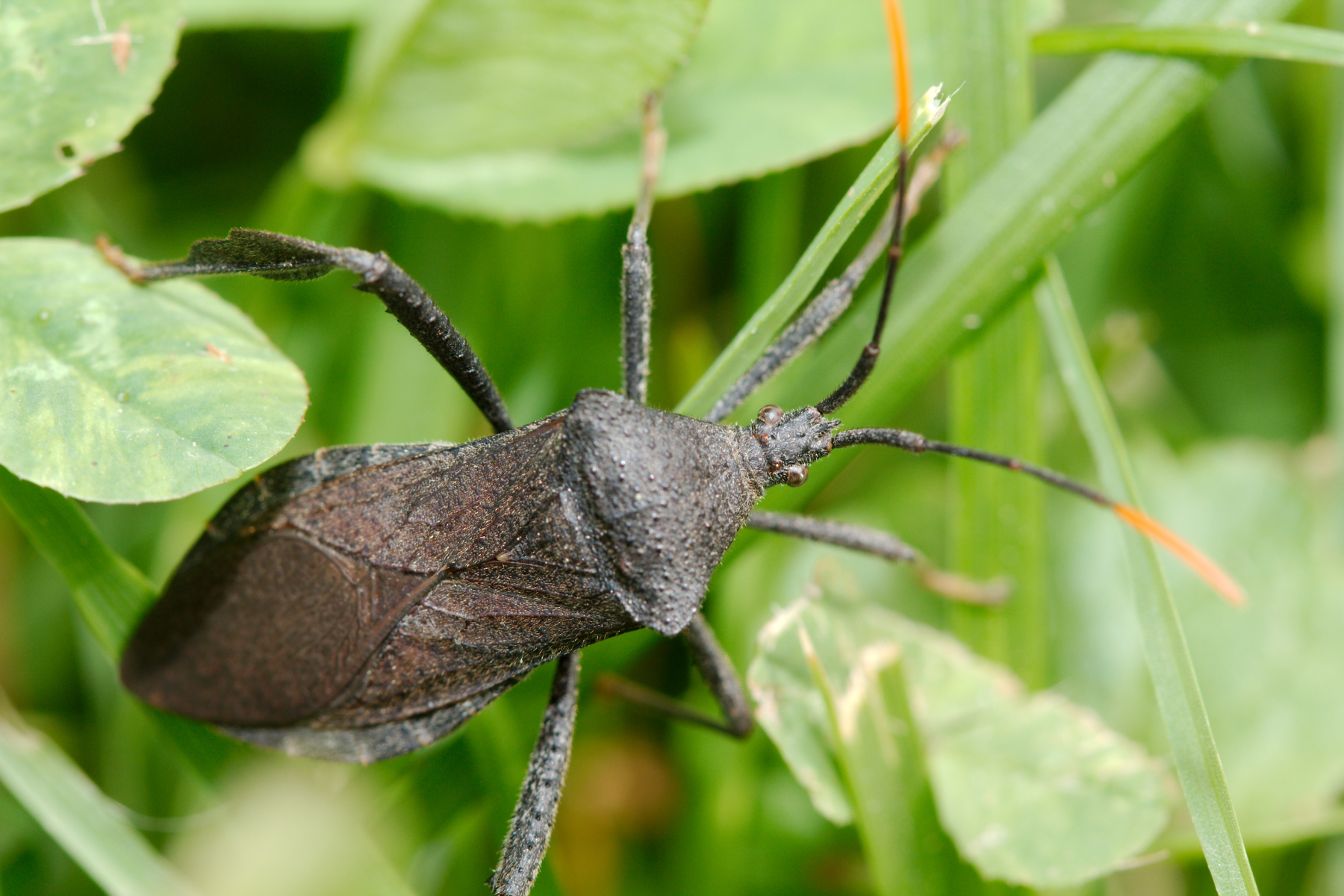
This is one of the Acanthocephala species, one of the leaf-footed bugs. I’m not sure which, although I’m leaning toward A. terminalis. It was on my pant leg but I wasn’t going to get a good picture of it while it was there, so I brushed it off into the grass. Then, of course, I got down on the ground and got as close to it as I could.
The Fox Is Back
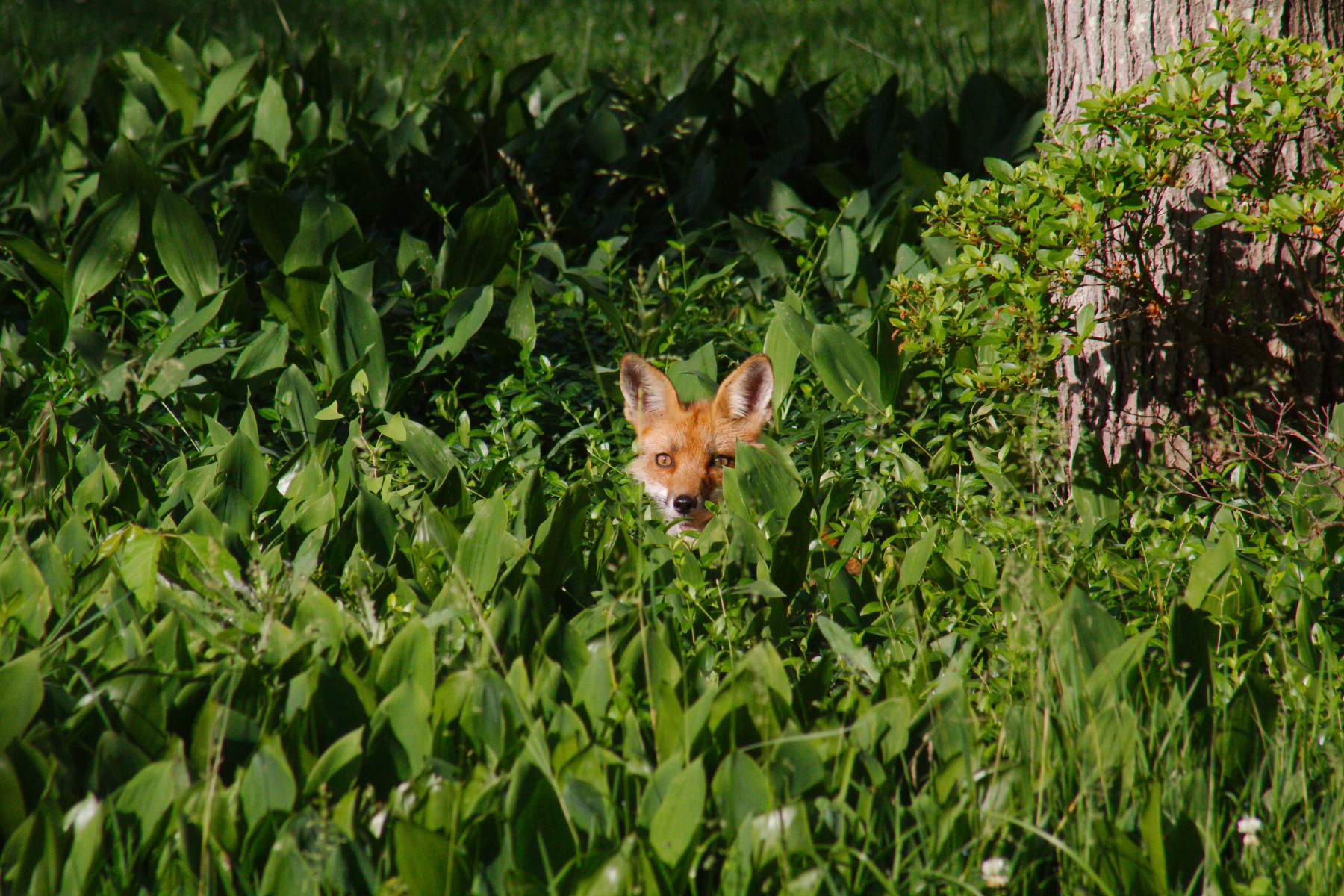
We’ve seen the fox a few times since the winter when I got pictures of two of them playing in the back yard. One of them, I’m pretty sure, was killed by a car. The other is still around and this morning was in our garden. From downstairs he (or she) could barely be seen. Cathy noticed him from upstairs. Occasionally he’d look around and I got a few pictures from the kitchen. After I had as good a picture as I was going to get, I went out the front door and slowly went around the side of the house. I was able to get a few pictures before I was seen. He looked right at me as I squeezed off two quick shots and then he was gone (like a shot).
Odontotaenius disjunctus (Horned Passalus)
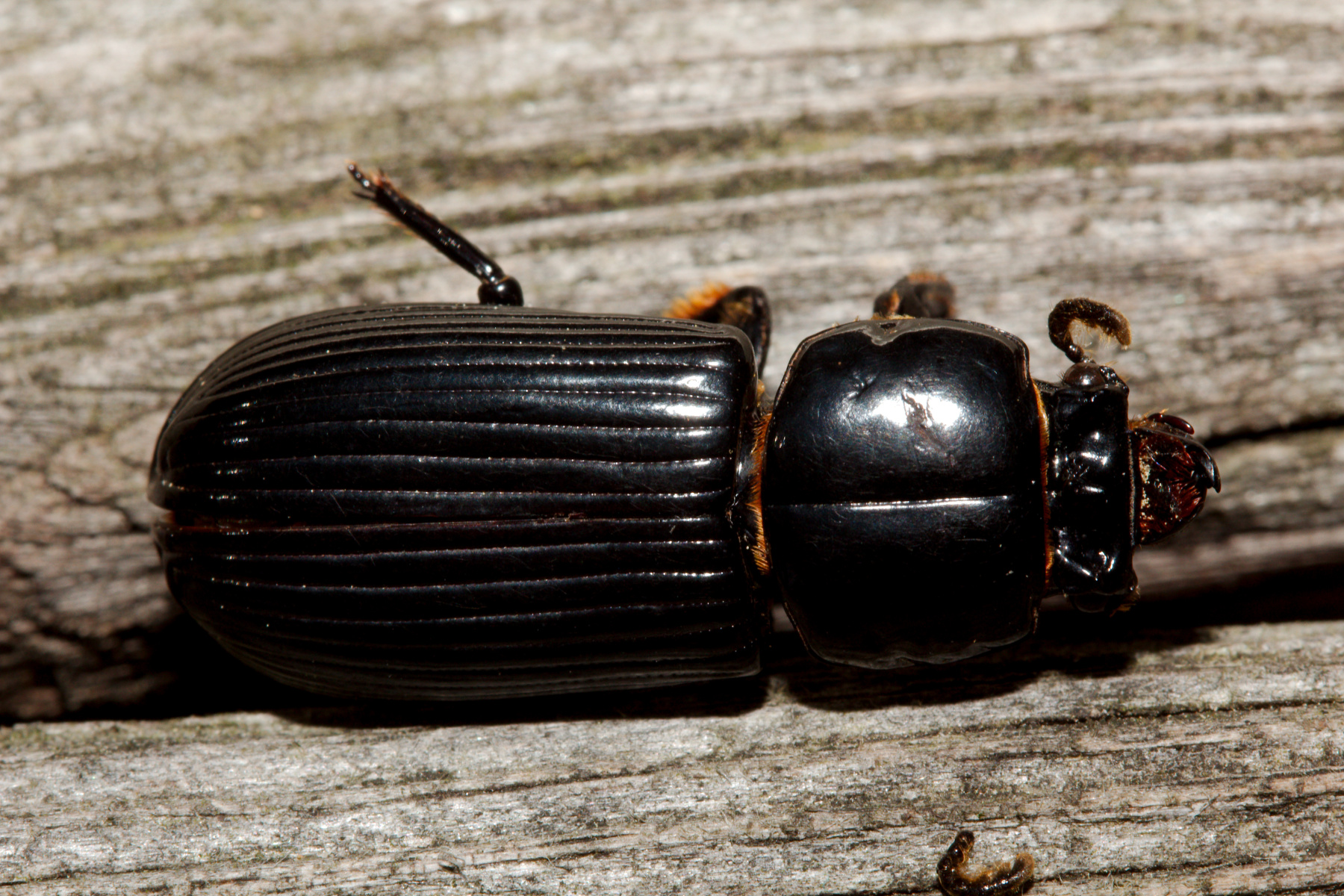
According to Bugguide.net, the common name for this beetle listed by the Entomological Society of America is horned Passalus. The common name used by laypeople, however, is Bess Bug. This apparently comes from the French word, baiser, “to kiss.” That in turn probably refers to the sound it makes (stridulation), which sounds a bit like a squeaky “kissy” sound. They eat rotting wood, so it was no surprise this was found where it was, in an area that has a fair amount of wood for beetles to eat. This one is dead, as perhaps you can tell, which made it much easier to photograph, although because of that it lacks a certain something. Still, I think it’s a beautiful beetle. It looks to me like a quilter went over the elytra (the hardened forewings on its abdomen) an put neat rows of stitches down their length.
Honey Bee on Rosa micrugosa
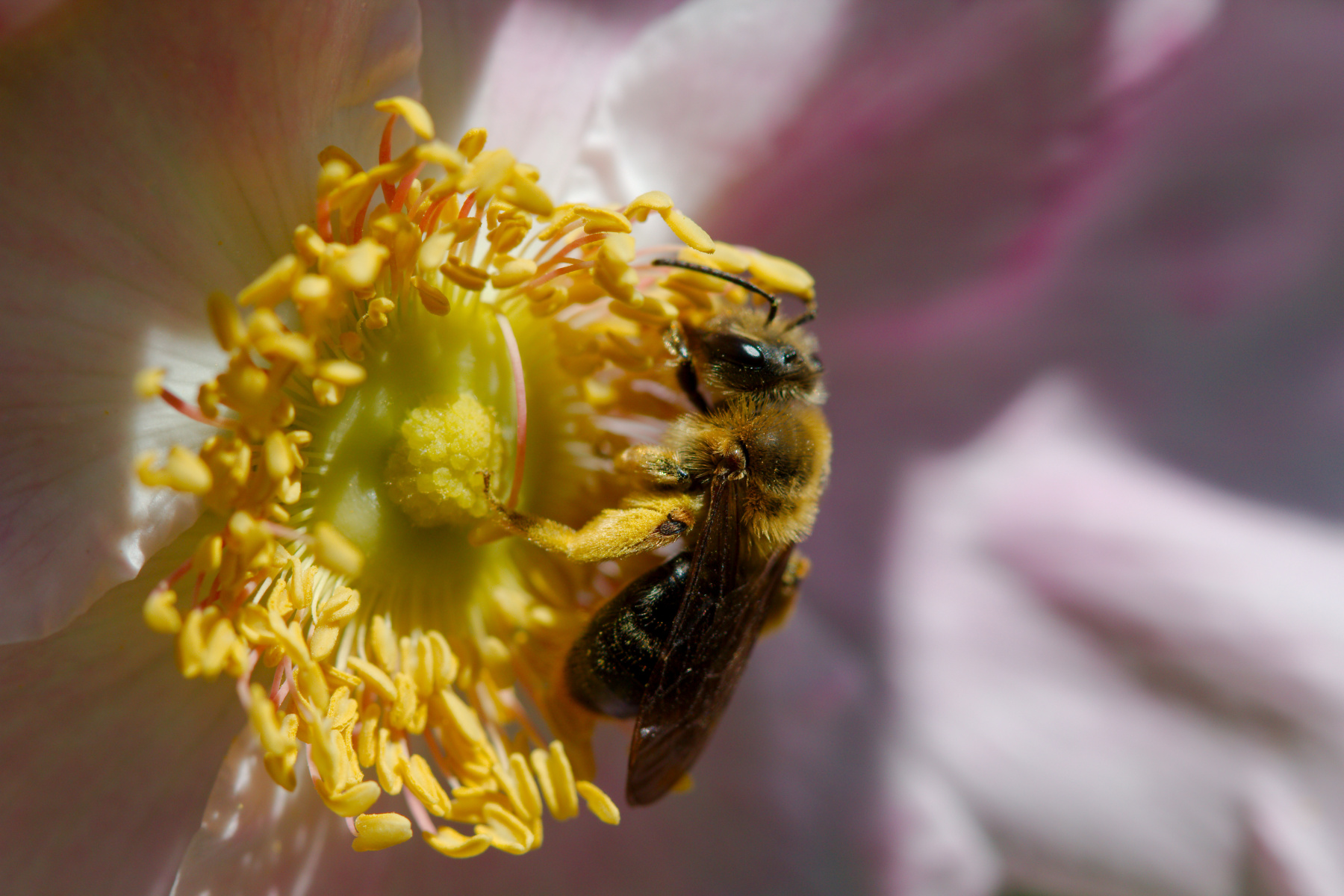
We had a late spring this year in the mid-Atlantic region with snow and sleet up to the end of March and cooler than normal well into April. Most plants have been about two weeks behind normal in terms of blooming and the roses are no exception. I have one bush in bloom (and it’s glorious) with the others just about ready to start. I visited Nick Weber’s rose garden this morning knowing ahead of time that there wouldn’t be a lot to see. Of course, 2% or 3% of Nick’s roses is still more than most people have, but the best is definitely yet to come. I got to see a few early bloomers, which was a treat, and I enjoyed this honey bee on a R. micrugosa bloom.
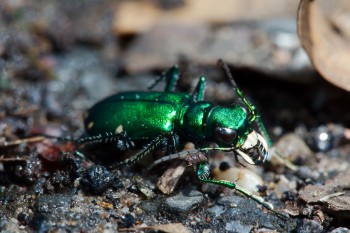
Cicindela sexguttata (Six-spotted Tiger Beetle)
What a beautiful day we had today. Just as well that we had a lot of yard work to do, and we spent much of the day outside. Two of my roses (both Noisettes, ‘Crépuscule’ and ‘Jaune Desprez’) died over the winter. They were both climbers and were pretty good size and very well established but the combination of unusually cold weather and the repeated snow (but mostly the cold, I think) did them in. ‘Crépuscule’ in particular, was more than covering a 10 by 12 foot frame on the end of the house. I need something new for that spot.
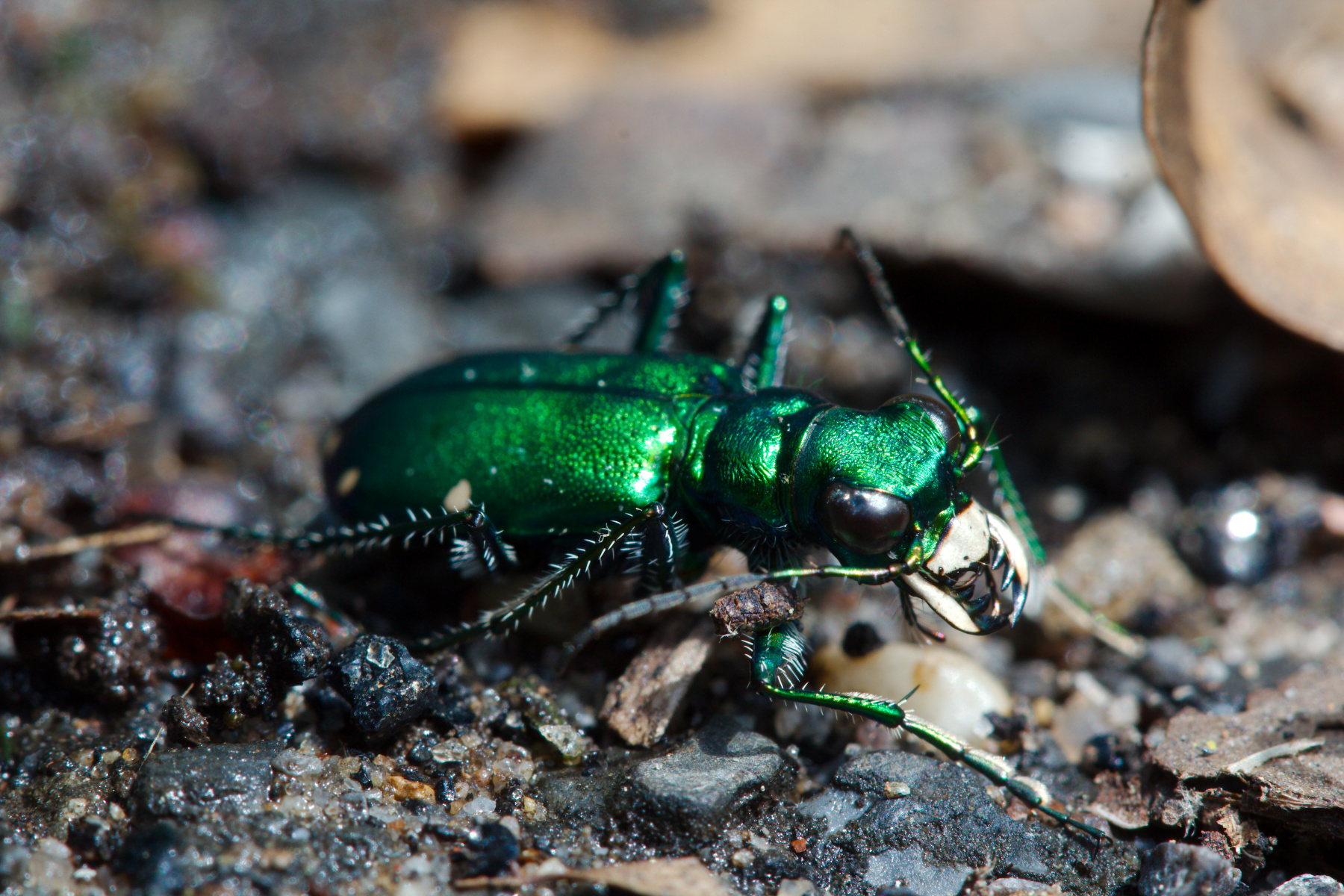
Anyway, that has nothing to do with this picture, except Cathy was potting up some seedling lilies and we were moving potted plants around on the driveway. This metallic, green beetle, a six-spotted tiger beetle (Cicindela sexguttata), was under one of the pots. I ran to get my camera but didn’t think it was all that urgent, because it appeared to be dead. After taking a half dozen pictures, though, it moved. I got three more, very quickly, and it flew away. The most impressive thing about this beetle, I think, are its serious mandibles. The eat small insects, spiders, and other arthropods, including other beetles, springtails, sawflies, caterpillars, flies, ants, and grasshoppers.

Luna
Luna came to stay with us for a long weekend, while Albert and Brady were out of town. As I post this on Monday, May 19, they are back and Luna is at home, but the evening the picture was taken, on the Ides of May, she was relaxing on our living room sofa. She’s an easy dog to care for, not being particularly excitable, except possibly by other dogs. We did have one “near incident” on a walk, when another largish dog came running towards us, not on a leash. Fortunately that dog was obedient and came as soon as his master called, although a dog that runs loose in the neighborhood is probably destined for a shorter than natural life. In this instance, all was well.
Terrapene carolina carolina (Eastern Box Turtle)
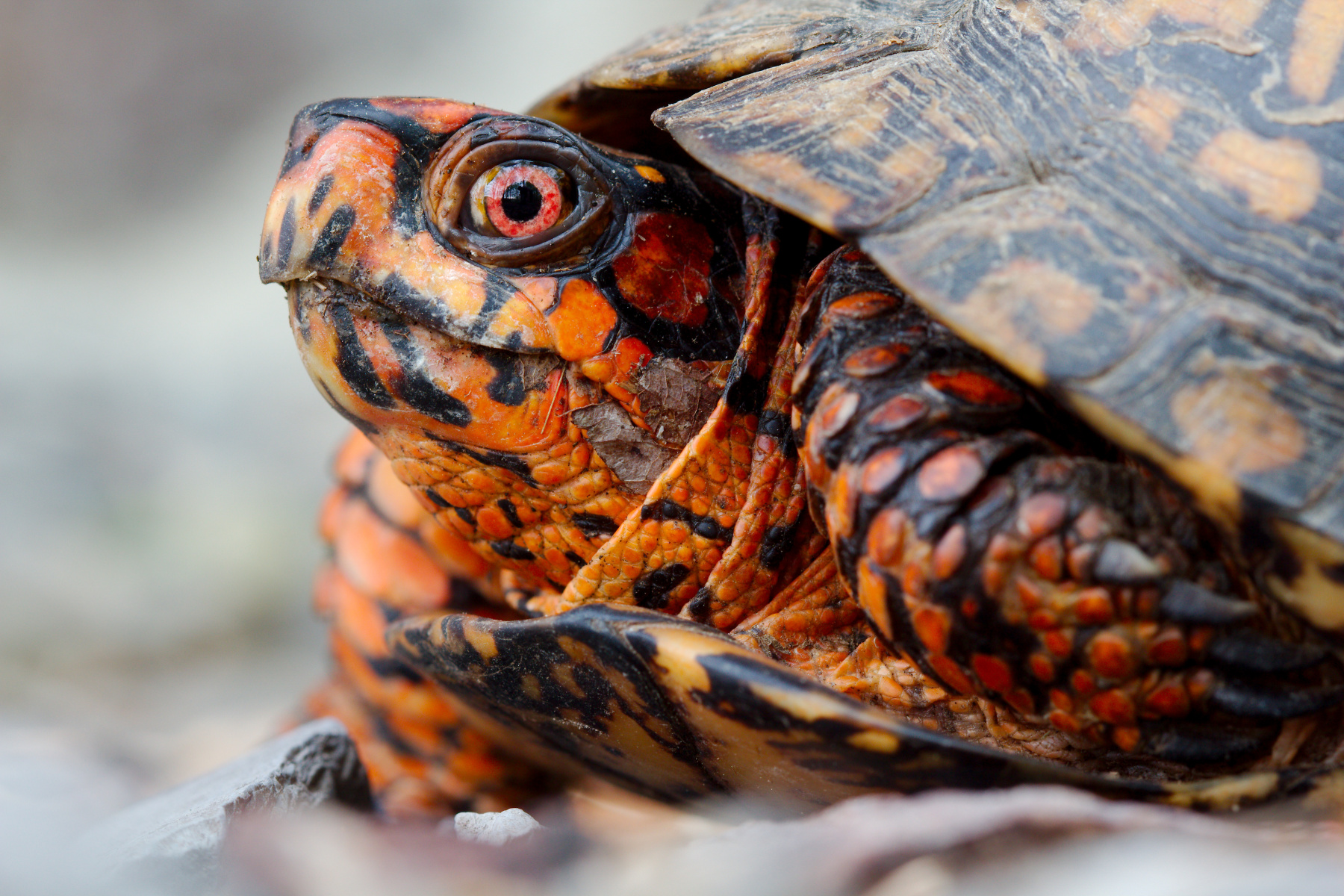
I saw two box turtles today, this one and another that was much more yellow. This one closed up a fair amount when I first found him (I think this is a male) but with a little patience, I was able to get a few pictures of him. I set my camera down on the ground fairly close and waited for him to open up again. I also saw a newt but didn’t have my camera with me at the time.
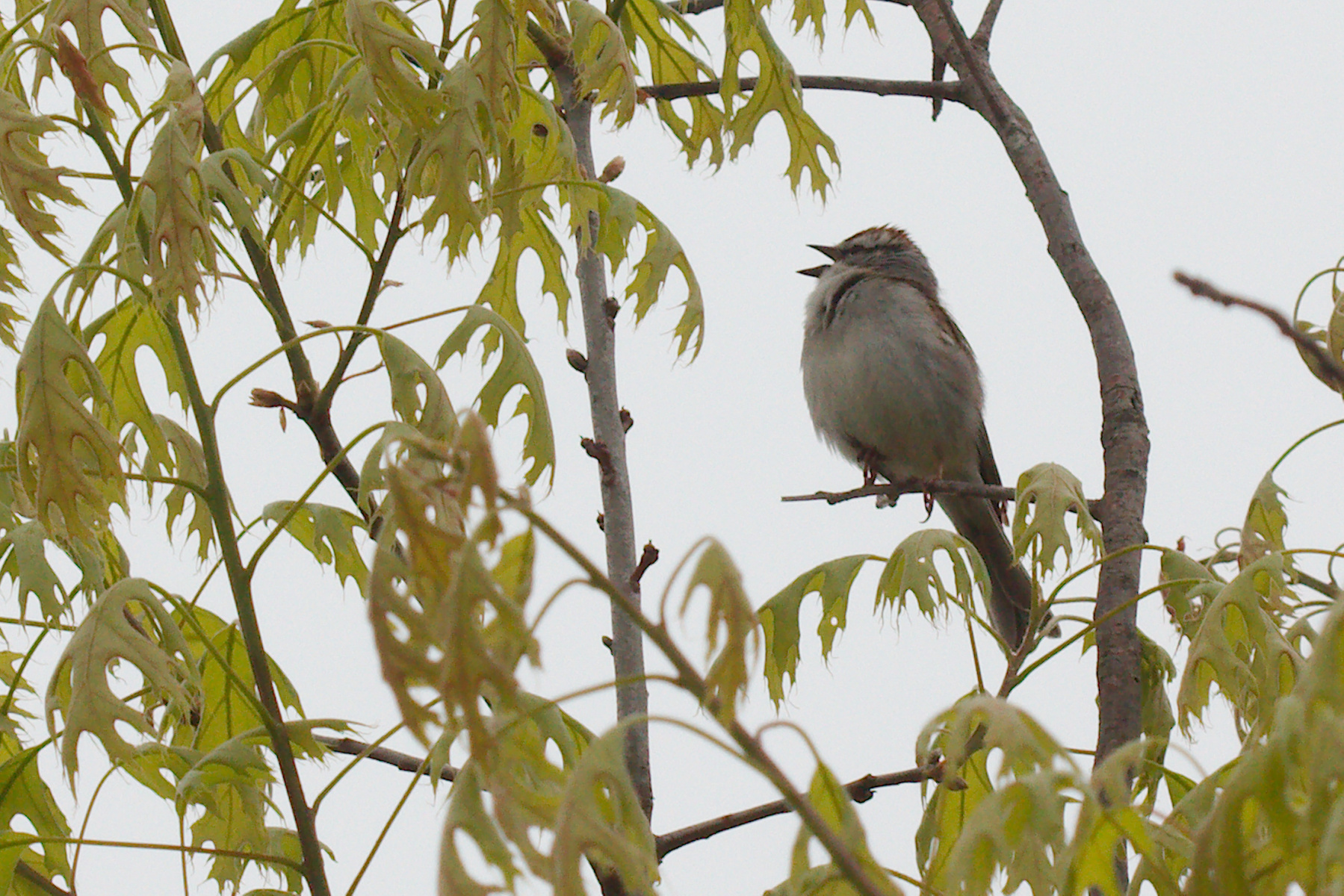
Chipping Sparrow (Spizella passerina)
I dropped Dorothy off at school today for one of her finals (AP Literature, I think) and went in to visit briefly with a few of my friends in the lower school and office. On the way back to the car I heard a high-pitched chirping coming from the top of a small oak tree next to my van. This is the source, sitting high in the tree. I wasn’t sure what it was, partly because of the angle from which I was seeing it but mostly because I don’t know my birds nearly as well as I might. So, I did what any self-respecting person would do, I asked my brothers. Albert and George both thought it looked like a chipping sparrow (the dark line through the eye) and Albert asked if the song sounded like those presented at the All About Birds page for the chipping sparrow. Indeed it did. Quite recognizably.
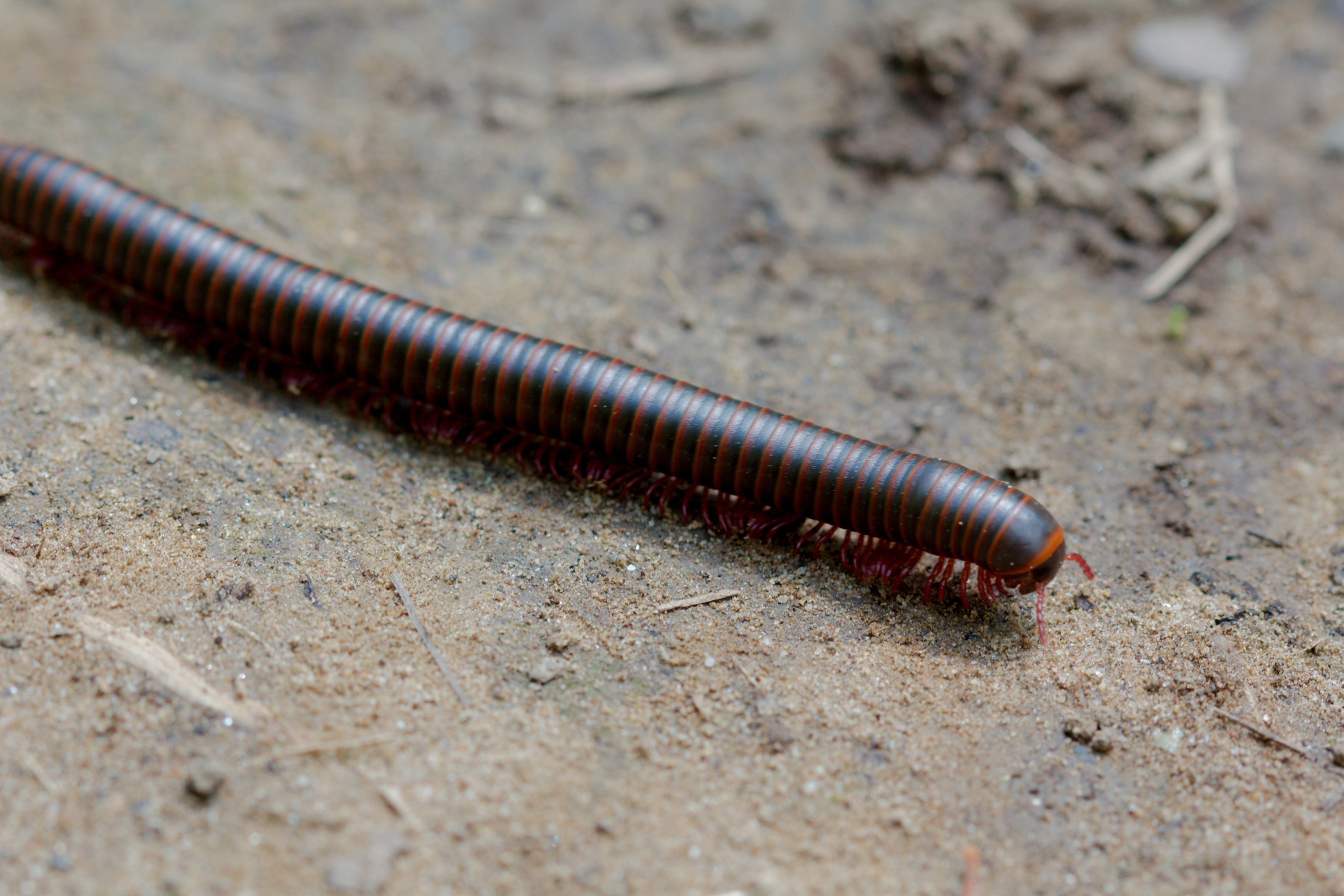
Narceus americanus (American giant millipede)
I thought I’d post a second photograph from our walk on the Billy Goat Trail. This is an American giant millipede (Narceus americanus, also called an iron worm) and it really is quite large, about four inches long. We saw a few of them and they are fairly common.
These millipedes do not have venomous stingers or fangs and are not dangerous to humans. They can secrete bad-smelling and bad-tasting chemicals from pores in the sides of their bodies. These chemicals help keep many predators away.
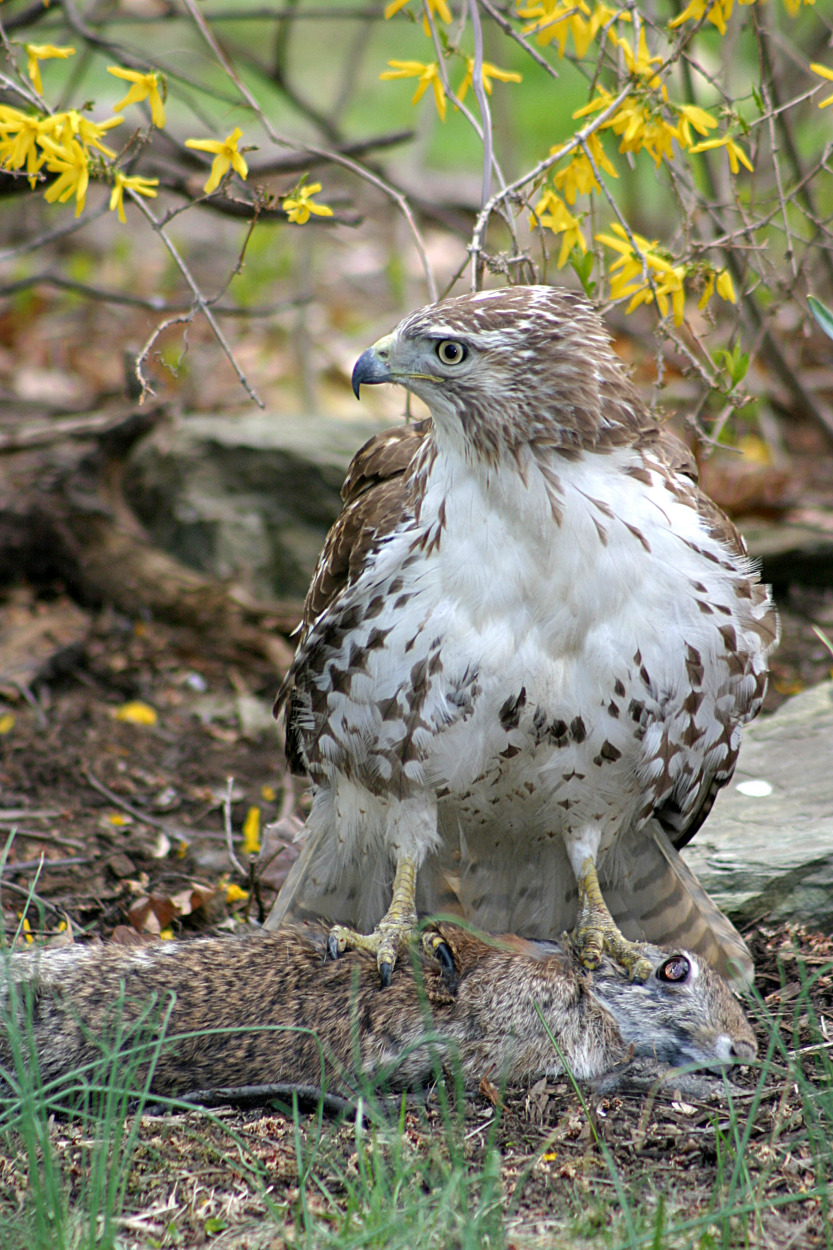
Easter Flashback
This is an Easter picture that I took seven years ago, on April 8, 2007. We were at my in-laws’ house and had eaten our meal. At about 4:10, Cathy and Dorothy were in the yard when they heard a scream. It was clearly not human but they didn’t know, at first, what it was. When they saw that a hawk had attacked a rabbit, Dorothy came running into the house to get me. She said that she and her mom wanted me to do something. I’m not sure what, precisely, they wanted me to do but I’m pretty sure taking pictures was not it. That’s what I did, though. Did they really expect me to do anything else?
I took 85 pictures before the hawk flew away. When I first went out the rabbit had stopped making noises but was still alive. It’s fate was sealed, however, and I wasn’t going to deprive the hawk of its meal simply because it happened to pick the Easter bunny for its menu.
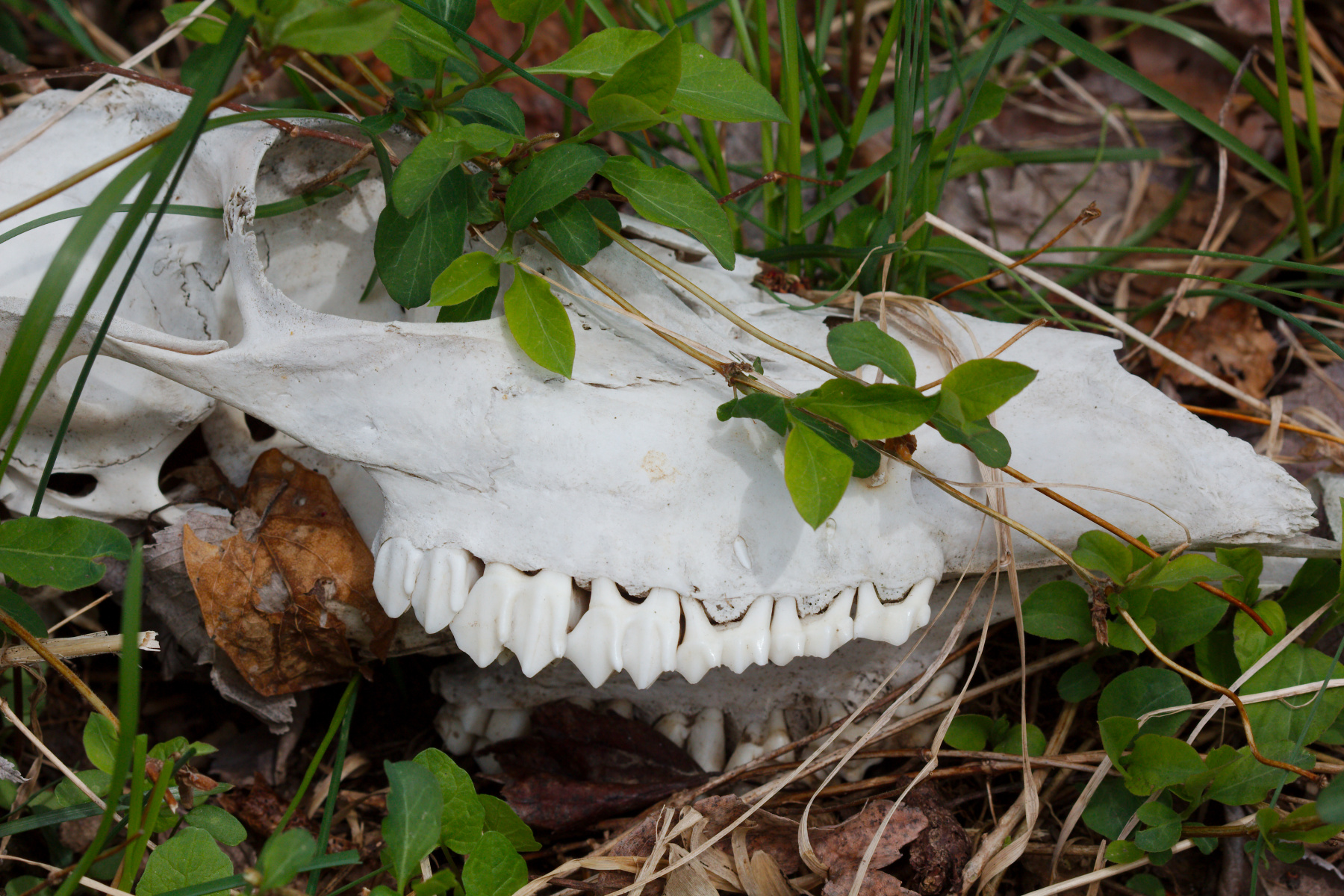
Meandering Stream
It was a cool day today but not really cold. I took a break shortly after noon and went out into the empty lot next to my office building. I say empty lot but really it isn’t empty, it simply hasn’t been built on. There are trees, shrubs, woody and herbaceous perennials, and annuals in abundance. There are also animals, although mostly I see birds and (especially later in the year) insects and spiders. It’s clear that there are deer there and I’ve seen them on rare occasions.
I came across one today, or what was left of one. There were a few leg bones and then I found the skull, half buried under some Japanese honeysuckle. The first picture if of the top of the deer’s skull, showing the intersection of the Coronal and Sagittal Sutures, where the frontal and two parietal bones all come together. It looks to me like a river, meandering through an arid waste. Or maybe not. The second picture shows the skull, as I found it.