My back was up to a full day’s work today. Although there were a few rough spots I made it through, trying to get up now and then to move around (because “Motion is Lotion” as they say). When I got home I took pictures of various flowers in the back yard. I really thought it would be pushing it to get down on the ground for photography. I did for the caterpillar photo yesterday but getting back up was a chore. So, I sat in a chair and photographed what was all around, including blue Lobelia, butterfly weed, Lantana, and a few other flowers. I like the Cleome with the black-eyed Susan flowers behind it.
Flowers and Plants
Cleome ‘Senorita Blanca’
Atteva aurea (Ailanthus Webworm Moth)
I took some butterfly pictures this afternoon, as well as some flower pictures. While sitting in the chair that Cathy was in when I took the picture for a few days ago I could get pretty close to a few flowers without having to strain my back. Then walking around I saw this prettily colored ailanthus webworm moth (Atteva aurea) on a black-eyed Susan. It took me a while to get down on the ground to get the pictures but I think it was worth the effort. Although it’s named for and feeds on a non-native tree, the Ailanthus webworm moth is actually a North American native from Florida, where its original host was the Simarouba glauca (paradise tree) and Simarouba amara.
Lobelia cardinalis
This red Lobelia cardinalis is growing under the cherry tree at the north end of our yard. It’s really bright and I thought it was worth getting a picture of. With my back still bothering me I wanted to be really careful getting behind it so I could get the picture without having to bend over and with the trunk of the cherry tree available for me to brace the camera against. I was very carefully watching where I was stepping so I wouldn’t trip but about half way back, all of a sudden, I whacked my head against a ceramic wren nesting box hanging from a branch of the tree. I didn’t quite fall but it did my back no favors. Still, I got the picture. Coming back out I was even more careful where I walked and I kept an eye on that nesting box.
Cathy In The Back Garden
With my back still bothering me, I stayed home today. I did put in a little time at work, mostly a long phone call to discuss a proposal that is being written for a project that includes a web site. When Cathy got home from work I asked if I could take her picture for my photo of the day. She agreed and I took almost two dozen shots of het with her flowers. Most obvious are the Rudbekia (the Black-eyed Susans). There is also orange and yellow butterfly weed Asclepius tuberosa) on the right. In front of that is the pale pink spider flower (Cleome). There are other annuals in pots and there is the red teapot lower down.
Black-eyed Susans
I’ve posted pictures that have Black-eyed Susans in them but today’s photo is just of them. To say we have a few is a bit of an understatement. The reality is that we have let them run riot and there are a lot of them in the back yard. They add so much color that we don’t really mind, especially around the patio. We’ve managed to keep one large and one small walkway through them, so we can get out into the yard. They are pretty popular with the pollinators, attracting bees, flies, moths, and butterflies. One interesting thing about them is the photos I take always look bluer than they look in real life and I have to correct for that. On the other hand, the leaves really do have a fair amount of blue in their green.
Junonia coenia (Common Buckeye)
I chased down some butterflies in the back yard today, including this common buckeye (Junonia coenia). They are resident year round in the south as far north as North Carolina and they move north over the course of the summer. Because of that we tend to have them later in the year than other butterflies and I’ve only just started to see them. They are pretty easy to identify and are very different to the other species that we have. This one, obviously was interested in the black-eyed Susan flowers that are in such abundance in our yard right now.
Green Swamp
I’ve gone to the Green Swamp a few times during our weeks at the beach. Sometimes with a largish group and sometimes just a few others. I went by myself today and had a nice time. I planned not to go too far, with the primary goal of getting some pictures. I got some nice shots of Venus fly traps (Dionaea muscipula) and sundews (Drosera sp.). It was fairly dry and many of the pitcher plants (the purple Sarracenia purpurea And the yellow Sarracenia flava) were a little the worse for that. Still, I got some pictures. I also got a good shot of a palamedes swallowtail (Papilio palamedes (. But this is my favorite photo from the trip, showing the long leaf pines (Pinus palustris).
Eristalis transversa (Transverse Flower Fly)
I was taking photos of the black-eyed Susan flowers this evening when I spotted this little fly, a transverse flower fly (Eristalis transversa) visiting them. It wouldn’t stay still for very long and I had a hard time getting a good picture. Ideally it would be on top of the dark eye in the flower, but I wasn’t able to get that. I like the combination of colors that matches the flowers. These are pretty little flies and easily spotted in the garden. As flies go, I enjoy these about as much as any.
Tiger Swallowtail and Tiger Lily
The tigers are out in force. We have tiger lilies (Lilium lancifolium) blooming in a few areas in the yard. They are especially spectacular in the morning when the sun is on them. We also have tiger swallowtails (Papilio glaucus) in pretty good numbers. They are mostly on the tiger lilies and on the buddleia bushes and we’ve counted more than ten together on one buddleia bush. Most of them are the standard yellow and black but about ten percent are the darker version that I photographed a few days ago.
Red Roses
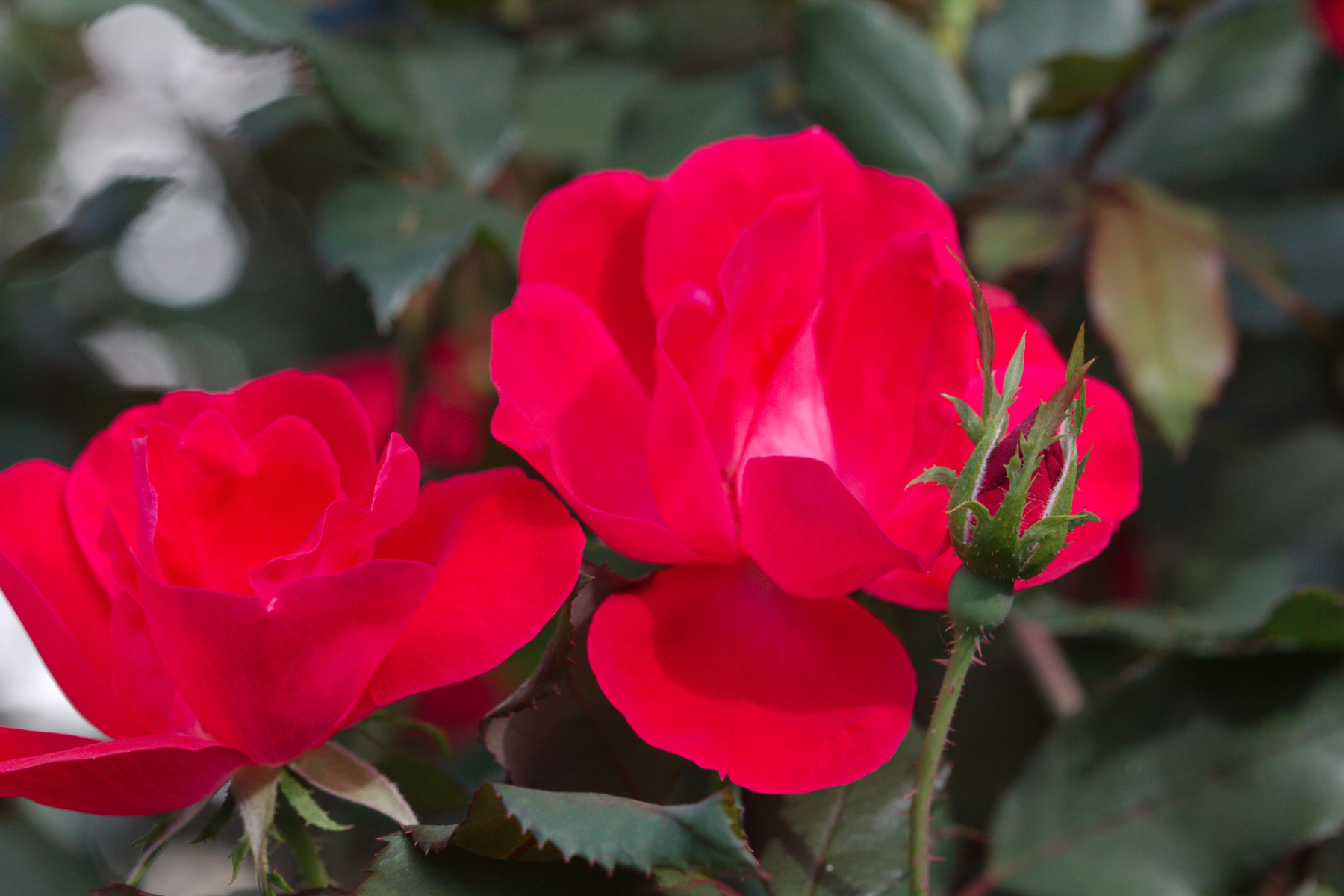
Cathy’s mom had a visit today from an old friend and her husband. They brought these flowers, which was nice, and they looked lovely in the late afternoon sun coming in through the dining room windows. I took pictures of them from a bunch of different angles. Deep reds like this are a challenge for my digital camera and they tend to overwhelm the sensor but this one turned out pretty well. No disrespect meant towards Canon. It’s a really intense color and it came out well. Our eyes are such remarkable organs with the ability to see such a huge range of color and brightness that it isn’t actually surprising that technology is still trying to get there. We’ve come a long way, though.
Roses ‘Perle d’Or’
We’re getting a second flush of roses on the ‘Perle d’Or’ outside our front door. This small polyantha rose has a nice, apricot-yellow color with perfect, if tiny buds, opening to somewhat less perfect blossoms that are, nonetheless, quite lovely. The fragrance alone is enough to make me want this rose and putting it right outside our front door was a good choice. It has been killed back in parts in some particularly cold winters but generally it does pretty well and so far has not suffered any irreversible damage.
Back Garden at Dusk
It was a pretty evening today and I took this photo out our kitchen door at dusk. It’s hard to convey the feeling at dusk, because it tends to look like nothing so much as an underexposed photo. I obviously had to be a little careful not to lighten this photo any more than necessary, in order to retain that dusky feeling. You can see the three ornamental, lighted, garden globes in this photo, although only one of them is actually lit. A second one seems to work some days and not others. They aren’t all that well made, unfortunately, and don’t last very well. That’s a little disappointing.
Lilium lancifolium (Tiger Lily)
The tiger lilies are blooming and they are really spectacular this year. My dad had these growing in his garden and from time to time we would take the little bulbils that form in the angle between the leaves and stem on these plants and we’d put them in our garden. We continued that process, with bulbils from our own plants and now we have a pretty good number of them around the yard. These are growing in the small bed where an oak tree once grew. That tree was dying when we bought the house and has since been removed. There are daffodils there and Cathy often puts annuals in the center of the bed, but these lilies are growing towards the back (the house side). They are over six feet tall and quite striking, with racimes of large, orange, downward-facing flowers.
Blackberry Lily (Iris domestica)
The blackberry lilies (Iris domestica and formerly Belamcanda chinensis) have started to bloom in the garden. We originally got this when I collected some seeds and planted them at our old house. We brought some here with us in 2006 and they have really taken hold. We sprinkle the seeds around and let them grow where they will. They aren’t nearly so aggressive as to be a problem and they are so pretty. I had a picture of the buds recently but this is the flower. They open in the morning and each individual flower only lasts a day, but they are born in profusion and soon we’ll have dozens of them in bloom, scattered around the yard.
Blackberry Lily (Iris domestica)
We’re in that in between time, after the spring and early summer bloomers have finished up but before the late summer flowers have really started in earnest. There are a few things in bloom, including the day lilies and the buddleia are starting to bloom and attract bees and butterflies. The gooseneck loosestrife (Lysimachia clethroides) has been blooming but doesn’t add a lot of color, having white flowers. Also, I don’t care how desperate you are for blooms, I don’t recommend you put this anywhere near your garden, unless that’s all you want. Pretty soon these buds will begin to open. They are Iris domestica, the blackberry lily, which until recently also went by the name Belamcanda chinensis and sometimes known as leopard lily. These have self-seeded around the yard but are well within the limits of what’s easy to control, if they come up where you don’t want them. I highly recommend them for any sunny garden.
Coneflower
There are quite a few really amazing coneflower (Echinacea purpurea) varieties now and if I had the space and the time and the money, I’d consider a collection of the as one aspect of a large garden. They vary in color from the “standard” pinkish-purple bracts and with orange spikes, as seen here, to all sort of oranges, yellow, and darker purples. They flower shapes vary, as well, and they are all lovely. Sadly, there are enough plant-eating insects that enjoy them that they don’t often last in pristine condition. Photographing them in their prime means getting them when the flowers first open, because the bracts get holes in them almost immediately. Still, they provide color in a time when not a lot is blooming.
Eastern Bumble Bee
I went out looking for pictures as usual this afternoon, when I got home from work. There is Campanula in bloom in the yard, and I took some pictures of those flowers. They don’t tend to come out the same color in photographs as they are in real life. Not entirely sure why. Then I moved over to the gooseneck loosestrife (Lysimachia clethroides), which is a real attraction to the bees. It’s quite invasive and I really would recommend against planting it in the strongest language, but if you already have it, you might as well enjoy the bees. There were a few honey bees but mostly it was the common eastern bumble bees (Bombus impatiens) that were moving quickly from flower to flower.
Hydrangea macrophylla
We have a pair of Hydrangea shrubs growing along the back of our garden. one of them is fairly large and growing strongly. The other, this Hydrangea macrophylla, is not so big but it’s blooming, at least. The deer seem to like it, so we’ve allowed the Forsythia to grow in front of it a little, to help protect it from them. Of course, that makes it harder for us to see, as well. You can’t have everything. The sterile florets, which have large petals, are a very pale pinkish with touches of blue. The much smaller fertile florets are quite blue, and the combination is quite nice.
Strawflower
Cathy bought some strawflower, also known as golden everlasting (Xerochrysum bracteatum) this spring and has it in a container on the back patio. They are quite bright and lovely to see from the kitchen door. As the flowers open, the center is a bright orange that complements the yellow of the stiff petal-like bracts. As the flower ages, the central disk turns brown, as seen here, but the bracts remain. This gives the flowers their “everlasting” common name. They are already basically dry, so they don’t dry out and turn brown, but rather keep their yellow color. Apparently in their native Australia they grow in sweeping drifts in open grassland, which must be quite beautiful indeed.
Day Lily
The day lilies are coming into bloom. These are great plants and easy to grow. They like full sun but are quite tolerant of a bit of shade (with a bit of reduced blooming, though). You often see them growing in ditches along road sites in the country. Those that we have are from a very small town that no longer exists in rural Pennsylvania. The houses are all gone, except for a few stone basements slowly being filled by the passing of time. around one of them is a huge patch of day lilies. They are in fairly deep shade, so don’t bloom profusely, but they are happy and continue spreading their roots. I dug up a few many years ago and they really responded to the sun and never fail to satisfy.